
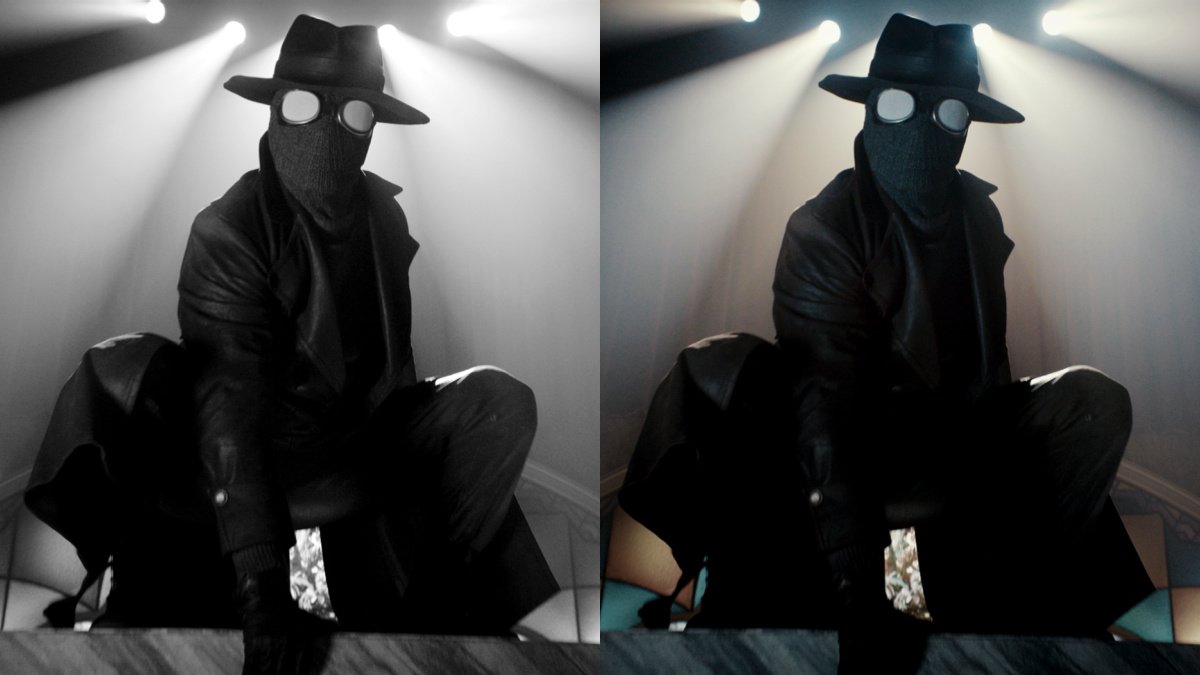
Spider-Noir was a double labor of love for Oren Uziel and his team, who took on the unprecedented challenge of producing a black-and-white and colorized version of the new superhero series starring Nicolas Cage.
“It’s never been done before, and I have a better understanding of why that would be the case now that I’m done with it,” says Uziel, the co-showrunner and executive producer of the series. “If you’re doing it right, you have to find this really strange balance in between the two.
“If you’re prepping to shoot black and white, sometimes it’s green lipstick and fairly strange colored walls, because that’s just going to show up the best in black and white. But if you shoot that in color, it’s gonna look insane. So, you have to find a happy medium for everything. It’s a challenge.”
When Uziel began developing the project, which sprung from Sony’s Oscar-winning Into the Spider-Verse movie, the vision was strictly black and white, a decision that helped ground the direction of the aesthetic: 1940s film noir, using modern tools to create rich contrast between deep blacks, a lot of shadows and hard lighting.
The pivot to also colorizing Spider-Noir came in the prep period, without an extension of the production timeline, which created a heavier workload for all department heads. Fortunately, a California tax break incentive that required the show to start shooting for a few days in July of 2024 ahead of principal photography gave the team an essential trial run.
“That helped us get a sense of how we were going to do the color and black and white,” says Uziel.
Spider-Noir cinematographer Darran Tiernan recalls the circumstance as “a huge advantage.”
“We got to shoot a scene with all the textures about two months before we started shooting for real,” says Tiernan, who shot the series digitally on the Sony VENICE 2 while relying on Canon Rangefinder lenses for a grain quality he felt was closest to classic noir. “All the testing in the world can only show you so much, but when you put it up on its feet with actors, and you’re actually shooting a scene, we could fine-tune those things before we start principal photography.”
That tuning process required constant calibration and communication between the Spider-Noir camera and costume departments, since wardrobe directly impacted the delicate dance of light and shadow in every frame.
“There’s a fine line when you’re doing two different mediums,” explains costume designer Trayce Gigi Fields. “You really need to make sure that in the color version, if you want things to pop, they need to pop. And then in the black and white version, there needs to be enough texture, or enough fabric, or enough of a sheen, or something, to keep it interesting.”
In order to satisfy the needs of all departments throughout the 100-day shoot, while also honoring the overall commitment to noir, Tiernan made every monitor on set black and white, with the exception of color DIT monitors, which were usually reserved for his and Uziel’s eyes only.
“But also, in order to help art and costume departments,” Tiernan explains, “I set out cameras with the same color science and the same lookup tables as the show would have when we were shooting, so they could investigate, ‘What does this red look like as black in black and white, and therefore, what does it look like in color?’”
Dressing Spider-Noir
For the principal characters alone, Fields and her team created over 1,000 pieces of clothing from scratch, and sometimes they dressed 300 extras in a single day to stitch vibrant life into the 1933 period piece, set in New York City.
“It was massive,” she says, noting that her biggest challenge was figuring out how every piece of clothing worn on screen would look in both color palettes.
“There was a special lens that we had to camera test almost every single thing,” she says. “The color on this is sort of like a Technicolor sort of feel. It’s like black and white that is now colorized. And to me, that is super incredible, because I’ve not really seen that done so much.”
Tiernan adds: “The color is kind of special in its own way. It’s definitely not normal.”
The blend of the pulp detective genre and the superhero template unites two American pop culture obsessions.
“One is known for its black and white, and one is known for its sort of poppy colors,” explains Uziel, who takes his first step into television with Spider-Noir after a career as screenwriter (22 Jump Street, Mortal Kombat, The Lost City) and directing one feature film (Shimmer Lake). “And if you’re doing a version of the show in color, it’s like, let’s do a version of noir in a color palette that no one who loves noir has seen before, and then with the black and white, it’s like, well, let’s do a comic book movie, a version that comic book fans have never seen before.”
His goal was to introduce fans of one cinematic style to the other, and there’s a lot for both to appreciate in the detective saga led by Cage’s character, Ben Reilly. He’s very different from the youthful Peter Parker version of Spider-Man, and is also different from the character Cage voiced in Spider-Verse. He’s also not the character Andy Samberg voiced in Across the Spider-Verse. He’s both new and old.
“I’m not anywhere near a high school kid anymore, so I couldn’t quite relate to that story, and I feel like it’s been told a lot. But we haven’t told the version where Spider-Man’s older and has sort of been through a lot, is a little more weathered, a little more cynical, a little more noir infused, so it came out of that,” Uziel says.
“This was always a little bit of, ‘What if we could make a Humphrey Bogart movie where Bogart just happened to be Spider-Man?’” he adds. “So, my story references are really steeped in Third Man, Night of the Hunter, In a Lonely Place, and then all the way up through neo noir: Chinatown, LA Confidential, Miller’s Crossing, the movies of John Dahl. I love The Last Seduction.”
Oren Uziel on How to Watch Spider-Noir

Cage has ample experience in the neo-noir genre, having previously worked with Dahl in the 1993 hitman drama Red Rock West, in addition to starring in brooding detective dramas like Snake Eyes, 8MM, Kiss of Death and Bad Lieutenant: Port of Call New Orleans.
“He’s got an encyclopedic knowledge of probably all cinema, but noir in particular. He just knows all these characters, and so he was very excited when I was talking about Bogart,” says Uziel. “Over the course of making the show, we really fine-tuned the character together. He brought a lot of big ideas to what he wanted to do, and I think it was important for both of us not to do a version of the character that we’d seen before.”
For anyone wondering which version to watch, Uziel, Tiernan and Field all agree: watch both, but start with the black and white.
“I do love them both now after all this work, but in my head, I prioritize the black and white,” says Uziel. “But then every time we’re working on the color, and I’ll watch the color cuts, I’m like, ‘This is awesome. This is really cool.’ And then when we switch back to black and white, I’m like, ‘Oh, right. This is what it’s supposed to be.’”
Spider-Noir is now available on MGM+’s linear broadcast channel and Prime Video.
Photos courtesy of Prime Video and MGM+



