
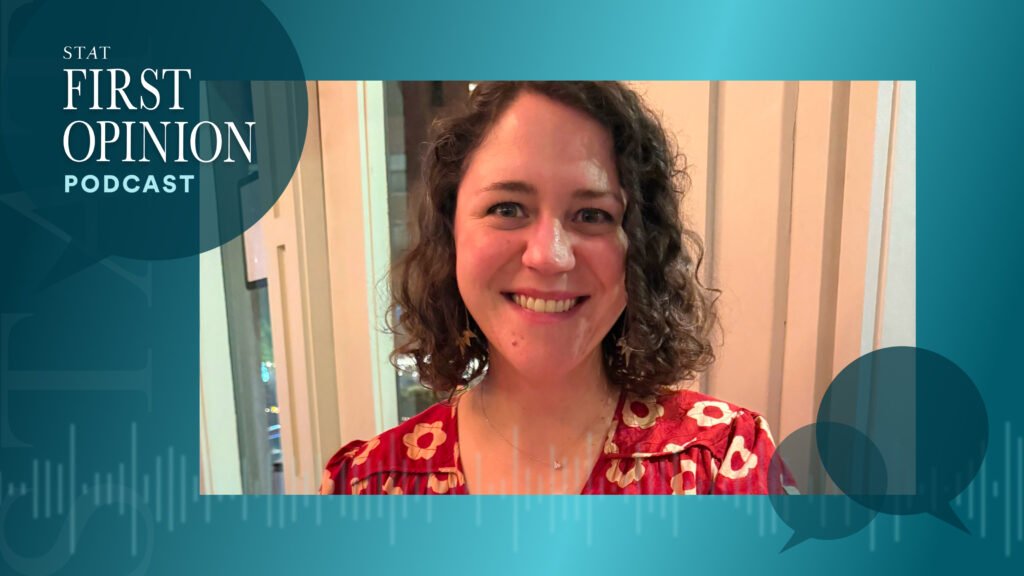
Below is a lightly edited, AI-generated transcript of the “First Opinion Podcast” interview with Sarah Mupo. Be sure to sign up for the weekly “First Opinion Podcast” on Apple Podcasts, Spotify, or wherever you get your podcasts. Get alerts about each new episode by signing up for the “First Opinion Podcast” newsletter. And don’t forget to sign up for the First Opinion newsletter, delivered every Sunday.
Torie Bosch: In recent years, there’s been a quiet shift in medicine. I’m not talking about a new drug or a new insurance headache. I’m talking about the way we write “health care.” Historically, it’s been two words. But increasingly, people, especially in the industry, have changed it to one word. At STAT, perhaps no linguistic decision is as important as: Should “health care” be one word or two?
Welcome to the “First Opinion Podcast.” I’m Torie Bosch, editor of First Opinion. First Opinion is STAT’s home for big, bold ideas from health care providers, researchers, patients, and others who have something to say about health care’s most important and interesting topics. This season, we’re focused on the intersection of medicine and culture.
Today, I’m speaking with Sarah Mupo, my colleague, who is STAT’s director of editorial operations.
Sarah Mupo, welcome to the “First Opinion Podcast.”
Sarah Mupo: Thank you for having me, Torie. Delighted to be here.
Bosch: So how long have you been at STAT?
Mupo: I’ve been at STAT since its founding in 2015. So it has been over a decade. It’ll be 11 years in November.
Bosch: So you’re the director of editorial operations here. What does that mean exactly?
Mupo: That means that I am one of STAT’s copy editors. I kind of oversee the day-to-day copy and production of stories going up on the site, and keeping an eye in our publishing platform of where things need to be and moving things around on the home page. And I send out a few of our newsletters, like Daily Recap, that go out throughout the week. I work with our newsletter strategist and SEO editor closely, and I partner with our product team when they’re doing editorial projects, you know, a little bit of everything.
Bosch: All sorts of stuff, yeah. So we’re talking to you today sort of in your capacity of the copy desk. So you created the STAT style guide, right? What is a style guide and why is it so important in journalism?
Mupo: A style guide is a reference for reporters and editors, the newsroom at large, to have consistency in our stories about how we write things. It’s also a reference, in some ways, of how to write about people and places and things and concepts accurately — sensitively writing with care about different topics, or sometimes it’s as simple as this word is hyphenated when we write it, or this is capitalized or this is not capitalized. Sometimes it’s a simple thing, sometimes it’s a little more in depth.
Bosch: So we’re going to talk specifically about one style choice. But before we get into that one, and I know you know what I’m talking about, are there other style choices you’ve had to make in the past that were sort of tricky? Can you think of any?
Mupo: One recent thing that comes to mind is having a more expanded entry in our style guide about weight and body size. It was motivated by writing a lot more about the new GLP-1 drugs. We have, it seems like, at least a story a week about these drugs, not only the biotech business aspect but how they’re affecting people’s lives, and people who are taking the drugs. And the goal with that was writing accurately and sensitively about this topic and thinking about things of, Do we use person-first language? Would we use people’s weights in stories? Thinking through those things that are a little bit trickier to be in service to the reader and write about things in a clear way, but also in a way we’re writing with care.
Bosch: Absolutely. And so that brings us to the reason we’re here today. So there has been a very long-standing debate over whether “health care” is one word or two. I think generally STAT follows the Associated Press Stylebook with a few exceptions. We use the serial comma, AP does not. I’m grateful that we do. Thank you so much for that.
So yeah, AP has long had “health care” as two words, even as the medical industry has increasingly gone to one word. Probably about 90% of the op-eds that I edit for First Opinion use one word, and I get into these very protracted discussions sometimes with writers about that, which we could talk about more later. I’d love to share some of those pet peeves.
But the Associated Press made a big announcement back in April. So what happened?
Mupo: So they made the announcement at the ACES conference this year. … I’ve attended in past years, couldn’t make it this year, but one of the big sessions at the conference is what’s new in the AP Stylebook. And in past years, before the presentation would start, the editors in the audience would be sort of gently asking the presenters before: “Is this the year for ‘health care’?” There’s been a lot of interest in a style change of moving from two words to one.
When the change happened this year in April, I did see on LinkedIn that from someone who was there that people cheered, there was a commotion. It seemed like it was really warmly received.
Bosch: And what was your immediate response when you heard the news in a breaking tweet?
Mupo: My immediate response was: What’s STAT going to do? We generally follow AP, as you said, in most instances, but “health care” is such a big word for STAT. It’s a cornerstone of our coverage. We have a weekly newsletter about health care. I wanted to take a step back after the announcement and give a little bit of time to think about how we should proceed with our own style decision.
Bosch: So for somebody who doesn’t stare at letters and words all day like we do, I sort of think that this probably feels a little silly, to think so much about a space. Why is it so important whether “health care” is one word or two?
Mupo: As much as it can seem like a silly thing, as you said, the way that we write our stories and the way that the words look and sound to readers, it matters. And, you know, words with a space or without a space can signal something to a reader. And we were, you know, thinking about that with our decision.
Bosch: So you ended up putting out a call for STAT reader responses in which you asked people to vote for one word or two or and share their thought process. So how many responses did you expect to get when we first put it out?
Mupo: I thought maybe 50. Our reader call-outs can get a varying number of responses. We often put them at the bottom of big stories that we write where maybe we’re looking for tips or more people who have the experience of something that we wrote about in the story.
But this was kind of a different kind of reader call-out. When the decision came out, I polled our reporters and editors and some of them wrote in to me giving me their really thoughtful responses of how they felt about it. But I also thought it was important to ask our readers, many of whom work in the health care industry or … we’re all touched by health care in some way, but we have very interested and engaged readers on health care and I wanted to see what they think.
Bosch: And in the end, how many people submitted responses and what was the breakdown of votes?
Mupo: We had over 200 who wrote in, and I’m very grateful that they did. It was really enjoyable going through all their responses. People really gave us strong arguments and opinions one way or the other. And it’s clear that this really touched a nerve with people. And the breakdown was about 60% one word and about 40% for two.
Bosch: What were the primary arguments first in favor of one word?
Mupo: One word, a lot of people said, you know, that’s what the industry has been trending toward. Some people were also making the argument that with many words that usage, when it’s a word that kind of comes into use as two words, that over time things can shift to one word. Someone gave the example of babysitter — “baby space sitter,” then going to “baby hyphen sitter,” and now we commonly use it as one word.
Bosch: It’s sort of funny that you mentioned that because I’m just remembering from my four years as a copy editor long ago — the 2004 or ’06 AP style guide is burned into my brain and it’s like a fossil. But there’s a very clear like “do not hyphenate” rule on “health care,” right? Like AP didn’t even want that hyphen anywhere near the word.
Mupo: And this year too, it’s very interesting that in addition to “healthcare,” one word, they made the decision as well to have “daycare” and “childcare” as one word. And those have long been two words, all uses. So there was really a movement this year on space, no space, tighten it up.
Bosch: So what were the primary reader arguments in favor of two words?
Mupo: People were talking about that with “health” and “care” written separately, that it places the emphasis on both words, which I found a compelling argument when I was coming to our style decision. And it definitely signals as well that there are many types of care. There’s “health care,” but in giving other examples of like “prenatal care,” “dental care,” “medical care,” like those aren’t written as one word. And so this sort of usage is a parallel.
Bosch: Yeah, it sort of struck me in reading through the entries, which I loved, that a lot of the two-word arguments were almost more sort of philosophical in nature.
Mupo: Yeah, definitely. And it was interesting to see the motivations behind the arguments, where as you said, some were philosophical, some were sort of more linguistics, grammar, and then some were just like, “come on, let’s appeal to common sense.” There was one entry that stuck out to me as someone who has been a copy editor for essentially her whole career. Someone said that they are a 30-year copy editor veteran and “please don’t give me another new thing to remember.” And, you know, that’s relatable. In copy editing, there are so many rules and guidance and things to keep in mind that at this point feel like second nature, but it’s still a lot to keep in your brain.
Bosch: If I remember correctly, I’m going by memory here, I think that that reader said, “please let my brain have this as a treat.” And I just, I love that. I will remember that always. We even saw some familiar names in the responses, didn’t we?
Mupo: We did. Our former editor Karen Penner wrote in with a really eloquent, thoughtful, defense of two words. And even a line that I really enjoyed, and I’m paraphrasing, but, “I hate to think in my four years as a STAT editor, I wasted time putting a space in between ‘health’ and ‘care.’” That’s just one sentence in an incredibly thoughtful response that really resonated with me.
Bosch: Totally. One of the replies or one mode of reply that I was really interested in is the people who thought that both are right depending on grammatical usage.
Mupo: Yeah, that was also interesting. But in a practical sense of having our reporters and editors remember the guidance, “be consistent,” I wanted to just choose one that, you know — I love grammar, but I also wanted to be clear for everyone, what to write.
Bosch: And I thank you for that. I spent enough time trying to tell writers that, “well, if the clause that follows a colon is a complete sentence, then we upper case. And if not, we lower case.” And that’s enough. I don’t need to go into “health care” as a noun versus adjective. So I appreciate it.
Mupo: Torie, thank you for being in my corner on that one.
Bosch: The amount of arguments I have with writers over capitalizations, it’s just wild.
So while I would love to keep chitchatting about that, I guess you have other things to do. So what did you ultimately decide that STAT should do?
Mupo: We ultimately decided to keep “health care” as two words. In addition to the arguments that we’ve talked about, I did find it very compelling to keep it as two words. Our own consistency felt like a compelling argument as well. STAT is relatively new, as a bit over a decade-old publication. We’ve written “health care” as two words this whole time, and I also wanted that continuity going forward as well. We have a great weekly newsletter, Health Care Inc., and that’s also written as two words, and that felt important as well.
Bosch: And so the response went out. We’re recording this the day after. No, we’re recording this the day that the response —
Mupo: The day the big decision dropped.
Bosch: Everyone has been waiting. Have you received any response from either readers or folks at STAT about your decision?
Mupo: I have not received any reader feedback, any like personal emails, but I have received a really warm response from the staff on keeping it two words. So that’s been nice. I’m glad we’re all rowing in the same direction, right?
Bosch: God help us when we’re not.
Is there anything else that STAT readers should know about style or anything else you do?
Mupo: All of the work of copy editors is very much in the background and something not seen by readers, but it is important work. And, you know, even the smallest things can take a reader out of a story if there is a typo or if they notice that double space after a period. Or if they read something and maybe to the reader’s eye, maybe the tone is off a little bit. Those are things that copy editors are spending a lot of time thinking about and taking a really careful eye reading through stories to give the reader the crispest version of the story that we can, and it’s important work. And, you know, shout out to all the other copy editors.
Bosch: And you know, thank you because you and every other copy editor I’ve worked with have saved me so many times. So thank you for being our final line of defense before stuff goes out into the world.
Mupo: It’s my pleasure.
Bosch: Sarah Mupo, thank you for coming on the “First Opinion Podcast.”
Mupo: Thanks for having me, Torie.
Bosch: And thank you listening to the “First Opinion Podcast.” It is produced by Hyacinth Empinado. Alissa Ambrose is our senior producer and Rick Berke is the executive producer. You can share your opinion on the show by emailing me at [email protected], and please leave a review or rating on whatever platform you use to get your podcasts.
Until next time, I’m Torie Bosch, and please don’t keep your opinions to yourself.



