
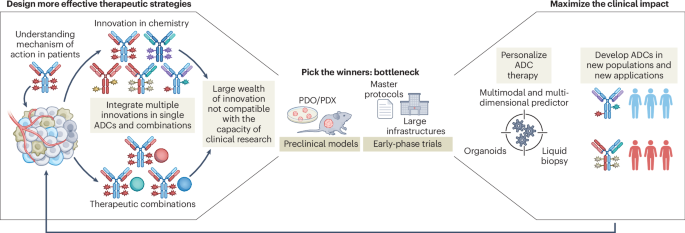
André, F. et al. Trastuzumab deruxtecan versus treatment of physician’s choice in patients with HER2-positive metastatic breast cancer (DESTINY-Breast02): a randomised, open-label, multicentre, phase 3 trial. Lancet 401, 1773–1785 (2023).
Modi, S. et al. Trastuzumab deruxtecan in previously treated HER2-low advanced breast cancer. N. Engl. J. Med. 387, 9–20 (2022).
Colombo, R. & Rich, J. R. The therapeutic window of antibody drug conjugates: a dogma in need of revision. Cancer Cell 40, 1255–1263 (2022).
Colombo, R., Tarantino, P., Rich, J. R., LoRusso, P. M. & de Vries, E. G. E. The journey of antibody-drug conjugates: lessons learned from 40 years of development. Cancer Discov. 14, 2089–2108 (2024).
Zippelius, A., Tolaney, S. M., Tarantino, P., Balthasar, J. P. & Thurber, G. M. Unveiling the molecular and immunological drivers of antibody-drug conjugates in cancer treatment. Nat. Rev. Cancer https://doi.org/10.1038/s41568-025-00869-w (2025).
Drago, J. Z., Modi, S. & Chandarlapaty, S. Unlocking the potential of antibody-drug conjugates for cancer therapy. Nat. Rev. Clin. Oncol. 18, 327–344 (2021).
Zhang, Z. et al. Results from a phase 1/2 study of 7MW3711: a novel B7-H3 antibody-drug conjugate (ADC) incorporating a topoisomerase I inhibitor in patients with advanced solid tumors. J. Clin. Oncol. 43, 3035 (2025).
Bardia, A. et al. Final results from the randomized phase III ASCENT clinical irial in metastatic triple-negative breast cancer and association of outcomes by human epidermal growth factor receptor 2 and trophoblast cell surface antigen 2 expression. J. Clin. Oncol. 42, 1738–1744 (2024).
Wei, Q. et al. Perivascular niche-resident alveolar macrophages confer interstitial pneumonitis related to trastuzumab deruxtecan. Cancer Res. 85, 2081–2099 (2025).
Koganemaru, S. et al. Potential mechanisms of interstitial lung disease induced by antibody–drug conjugates based on quantitative analysis of drug distribution. Mol. Cancer Ther. 24, 242–250 (2025).
Cilliers, C., Menezes, B., Nessler, I., Linderman, J. & Thurber, G. M. Improved tumor penetration and single-cell targeting of antibody-drug conjugates increases anticancer efficacy and host survival. Cancer Res. 78, 758–768 (2018).
Rubahamya, B., Dong, S. & Thurber, G. M. Clinical translation of antibody drug conjugate dosing in solid tumors from preclinical mouse data. Sci. Adv. 10, eadk1894 (2024).
Thorup, J. R. et al. Microscaled cell surface proteomics for cryo-preserved cells and tissue samples. Mol. Cell. Proteomics 24, 101437 (2025).
Shimauchi, A. et al. Enhanced HER2 internalization by clathrin-dependent endocytosis in non-small cell lung cancer positive for HER2 mutations. Br. J. Cancer 133, 976–985 (2025).
Sak, M. M. et al. The oncoprotein ErbB3 is endocytosed in the absence of added ligand in a clathrin-dependent manner. Carcinogenesis 33, 1031–1039 (2012).
Caculitan, N. G. et al. Cathepsin B is dispensable for cellular processing of cathepsin B-cleavable antibody-drug conjugates. Cancer Res. 77, 7027–7037 (2017).
Tsao, L. -C. et al. Effective extracellular payload release and immunomodulatory interactions govern the therapeutic effect of trastuzumab deruxtecan (T-DXd). Nat. Commun. 16, 3167 (2025).
Erickson, H. K. et al. Antibody-maytansinoid conjugates are activated in targeted cancer cells by lysosomal degradation and linker-dependent intracellular processing. Cancer Res. 66, 4426–4433 (2006).
Dubowchik, G. M. et al. Cathepsin B-labile dipeptide linkers for lysosomal release of doxorubicin from internalizing immunoconjugates: model studies of enzymatic drug release and antigen-specific in vitro anticancer activity. Bioconjug. Chem. 13, 855–869 (2002).
von Schwarzenberg, K. et al. V-ATPase inhibition overcomes trastuzumab resistance in breast cancer. Mol. Oncol. 8, 9–19 (2014).
Ogitani, Y., Hagihara, K., Oitate, M., Naito, H. & Agatsuma, T. Bystander killing effect of DS-8201a, a novel anti-human epidermal growth factor receptor 2 antibody-drug conjugate, in tumors with human epidermal growth factor receptor 2 heterogeneity. Cancer Sci. 107, 1039–1046 (2016).
Iwata, T. N. et al. A HER2-targeting antibody-drug conjugate, trastuzumab deruxtecan (DS-8201a), enhances antitumor immunity in a mouse model. Mol. Cancer Ther. 17, 1494–1503 (2018).
Pistilli, B. et al. Patritumab deruxtecan in HR+HER2− advanced breast cancer: a phase 2 trial. Nat. Med. 31, 3492–3503 (2025).
Mosele, F. et al. Trastuzumab deruxtecan in metastatic breast cancer with variable HER2 expression: the phase 2 DAISY trial. Nat. Med. https://doi.org/10.1038/s41591-023-02478-2 (2023).
Planchard, D. et al. Efficacy, safety, and biomarker analysis of datopotamab deruxtecan in advanced non-small cell lung cancer: ICARUS-LUNG01 phase 2 study. Cancer Cell 44, 1147–1159.e6 (2022).
Chen, W. et al. Trastuzumab deruxtecan (T-DXd) resistance via loss of HER2 expression and binding. Cancer Discov. https://doi.org/10.1158/2159-8290.CD-25-0647 (2025).
Coates, J. T. et al. Parallel genomic alterations of antigen and payload targets mediate polyclonal acquired clinical resistance to sacituzumab govitecan in triple-negative breast cancer. Cancer Discov. 11, 2436–2445 (2021).
Abelman, R. O. et al. TOP1 mutations and cross-resistance to antibody-drug conjugates in patients with metastatic breast cancer. Clin. Cancer Res. 31, 1966–1974 (2025).
Sledge, G. W. et al. Mechanisms of resistance to trastuzumab deruxtecan in breast cancer elucidated by multi-omic molecular profiling. NPJ Breast Cancer 12, 1 (2025).
Weisser, N. E. et al. An anti-HER2 biparatopic antibody that induces unique HER2 clustering and complement-dependent cytotoxicity. Nat. Commun. 14, 1394 (2023).
de Goeij, B. E. C. G. et al. Efficient payload delivery by a bispecific antibody-drug conjugate targeting HER2 and CD63. Mol. Cancer Ther. 15, 2688–2697 (2016).
Andreev, J. et al. Bispecific antibodies and antibody–drug conjugates (ADCs) bridging HER2 and prolactin receptor improve efficacy of HER2 ADCs. Mol. Cancer Ther. 16, 681–693 (2017).
Gu, Y., Wang, Z. & Wang, Y. Bispecific antibody drug conjugates: making 1+1>2. Acta Pharm. Sin. B 14, 1965–1986 (2024).
Zhang, J. et al. 302MO Phase I study of iza-bren (BL-B01D1), an EGFR x HER3 bispecific antibody-drug conjugate (ADC), in patients with locally advanced or metastatic breast cancer (BC). ESMO Open 10, 104874 (2025).
Rigby, M. et al. BT8009; a nectin-4 targeting bicycle toxin conjugate for treatment of solid tumors. Mol. Cancer Ther. 21, 1747–1756 (2022).
Baldini, C. et al. First-in-human, phase I/II dose escalation and expansion study of zelenectide pevedotin in patients with advanced solid tumors: results from monotherapy dose escalation. J. Clin. Oncol. 43, 3728–3738 (2025).
Dean, T. T., Jelú-Reyes, J., Allen, A. C. & Moore, T. W. Peptide–drug conjugates: an emerging direction for the next generation of peptide therapeutics. J. Med. Chem. 67, 1641–1661 (2024).
Strosberg, J. et al. Phase 3 trial of 177Lu-dotatate for midgut neuroendocrine tumors. N. Engl. J. Med. 376, 125–135 (2017).
Kritikou, E. Warburg effect revisited. Nat. Rev. Cancer 8, 247 (2008).
Chang, H. W. et al. Generating tumor-selective conditionally active biologic anti-CTLA4 antibodies via protein-associated chemical switches. Proc. Natl Acad. Sci. USA 118, e2020606118 (2021).
Brennan, F. R. et al. Impact of antibody Fc engineering on translational pharmacology, and safety: insights from industry case studies. mAbs 17, 2505092 (2025).
Dumontet, C., Reichert, J. M., Senter, P. D., Lambert, J. M. & Beck, A. Antibody–drug conjugates come of age in oncology. Nat. Rev. Drug Discov. 22, 641–661 (2023).
Carter, P. J. & Lazar, G. A. Next generation antibody drugs: pursuit of the ‘high-hanging fruit’. Nat. Rev. Drug Discov. 17, 197–223 (2018).
Walsh, S. J. et al. Site-selective modification strategies in antibody–drug conjugates. Chem. Soc. Rev. 50, 1305–1353 (2021).
Bhakta, S., Raab, H. & Junutula, J. R. Engineering THIOMABs for site-specific conjugation of thiol-reactive linkers. Methods Mol. Biol. 1045, 189–203 (2013).
Lyon, R. P. et al. Reducing hydrophobicity of homogeneous antibody-drug conjugates improves pharmacokinetics and therapeutic index. Nat. Biotechnol. 33, 733–735 (2015).
Sheridan, C. Now with oligos: antibody–oligonucleotide conjugates are the new drug modality to watch. Nat. Biotechnol. 44, 3–5 (2026).
Burke, P. J. et al. Development of novel quaternary ammonium linkers for antibody–drug conjugates. Mol. Cancer Ther. 15, 938–945 (2016).
Merkul, E. et al. First platinum(II)-based metal-organic linker technology (Lx®) for a plug-and-play development of antibody-drug conjugates (ADCs). Expert Opin. Drug Deliv. 16, 783–793 (2019).
Anami, Y. et al. Glutamic acid–valine–citrulline linkers ensure stability and efficacy of antibody–drug conjugates in mice. Nat. Commun. 9, 2512 (2018).
Bargh, J. D., Isidro-Llobet, A., Parker, J. S. & Spring, D. R. Cleavable linkers in antibody–drug conjugates. Chem. Soc. Rev. 48, 4361–4374 (2019).
Izzo, D. et al. Innovative payloads for ADCs in cancer treatment: moving beyond the selective delivery of chemotherapy. Ther. Adv. Med. Oncol. 17, 17588359241309461 (2025).
Carr, R. A. et al. N-myristolytransferase (NMT) inhibitors as novel potent payloads for antibody drug conjugates. Cancer Res. 83, 2635 (2023).
Ackerman, S. E. et al. Immune-stimulating antibody conjugates elicit robust myeloid activation and durable antitumor immunity. Nat. Cancer 2, 18–33 (2021).
Primac, I., Tabury, K., Tasdogan, A., Baatout, S. & Herrmann, K. The molecular blueprint of targeted radionuclide therapy. Nat. Rev. Clin. Oncol. 22, 869–894 (2025).
Neumann, C. S. et al. Targeted delivery of cytotoxic NAMPT inhibitors using antibody–drug conjugates. Mol. Cancer Ther. 17, 2633–2642 (2018).
Su, D. et al. Modulating antibody–drug conjugate payload metabolism by conjugation site and linker modification. Bioconjug. Chem. 29, 1155–1167 (2018).
Smith, L. M., Willmore, E., Austin, C. A. & Curtin, N. J. The novel poly(ADP-Ribose) polymerase inhibitor, AG14361, sensitizes cells to topoisomerase I poisons by increasing the persistence of DNA strand breaks. Clin. Cancer Res. 11, 8449–8457 (2005).
Yap, T. A. et al. Phase Ib SEASTAR study: combining rucaparib and sacituzumab govitecan in patients with cancer with or without mutations in homologous recombination repair genes. JCO Precis. Oncol. 6, e2100456 (2022).
Yin, G. et al. Enhancing Topo1i ADC efficacy: development of homogeneous dual-payload ADCs combining Topo1i with microtubule inhibitors or PARP inhibitors. Cancer Res. 85, 2870 (2025).
Sun, W. et al. SPARC: a multipayload ADC architecture for programmable drug combinations. Bioconjug. Chem. 36, 2158–2171 (2025).
Sutro Biopharma. Dual payload ADCs to overcome resistance. https://www.sutrobio.com/wp-content/uploads/2026/02/2026-World-ADC_HP-Gerber_Plenary_Final.pdf (2026).
Abdelhamed, S. et al. PF-08046032: a novel, investigational CD25-directed antibody-drug conjugate optimized for selective depletion of regulatory T cells in advanced malignant tumors. Mol. Cancer Ther. 24, 963–975 (2025).
Ashman, N., Bargh, J. D. & Spring, D. R. Non-internalising antibody–drug conjugates. Chem. Soc. Rev. 51, 9182–9202 (2022).
Cote, G. M. et al. 965P First- in- human study of the first-in-class non-cellular targeting antibody-drug conjugate (ADC), Micvotabart pelidotin (MICVO), in patients (pts) with select solid tumors. Ann. Oncol. 36, S591–S592 (2025).
Lu, G. et al. Co-administered antibody improves penetration of antibody–dye conjugate into human cancers with implications for antibody–drug conjugates. Nat. Commun. 11, 5667 (2020).
Gupta, A. et al. EGFR-directed antibodies promote HER2 ADC internalization and efficacy. Cell Rep. Med. 5, 101792 (2024).
Tan, D. S. -W. et al. TROPION-Lung15: a randomized phase III study of osimertinib combined with datopotamab deruxtecan (Dato-DXd) or Dato-DXd alone versus platinum-doublet chemotherapy in patients with EGFR-mutated advanced non-small cell lung cancer and whose disease has progressed on prior osimertinib. Ther. Adv. Med. Oncol. 17, 17588359251385410 (2025).
Zhang, Y. et al. Neratinib induces ErbB2 ubiquitylation and endocytic degradation via HSP90 dissociation in breast cancer cells. Cancer Lett. 382, 176–185 (2016).
McCombs, J. R., Chang, H. P., Shah, D. K. & Owen, S. C. Antibody-drug conjugate and free geldanamycin combination therapy enhances anti-cancer efficacy. Int. J. Pharm. 610, 121272 (2021).
Murai, J. et al. Rationale for poly(ADP-ribose) polymerase (PARP) inhibitors in combination therapy with camptothecins or temozolomide based on PARP trapping versus catalytic inhibition. J. Pharmacol. Exp. Ther. 349, 408–416 (2014).
Zimmermann, A. et al. A new class of selective ATM inhibitors as combination partners of DNA double-strand break inducing cancer therapies. Mol. Cancer Ther. 21, 859–870 (2022).
Robinson, H. M. et al. Combination of the ATR inhibitor, ART0380, with irinotecan for treating ATM-negative tumors. Cancer Res. 85, 2905 (2025).
Abelman, R. O. et al. Sequential combination of sacituzumab govitecan and talazoparib in metastatic triple negative breast cancer (mTNBC): results from a phase II study. J. Clin. Oncol. 42, 1102 (2024).
Pistilli, B. et al. Abstract P2-08-27: ICARUS-BREAST02: Safety, Tolerability, & Anti-tumor Activity of patritumab deruxtecan (HER3-DXd) monotherapy & combinations in patients (pts) with inoperable advanced breast cancer (ABC) following progression on trastuzumab deruxtecan (T-DXd). Clin. Cancer Res. 31, P2-08–27 (2025).
Abel, M. L. et al. Targeting replication stress and chemotherapy resistance with a combination of sacituzumab govitecan and berzosertib: a phase I clinical trial. Clin. Cancer Res. 29, 3603–3611 (2023).
Lin, R. et al. First-in-human trial of SYS6010 combined with SYH2051 in patients with advanced gastrointestinal tumors. J. Clin. Oncol. 43, 3037 (2025).
Ki, D. H., Oppel, F., Durbin, A. D. & Look, A. T. Mechanisms underlying synergy between DNA topoisomerase I-targeted drugs and mTOR kinase inhibitors in NF1-associated malignant peripheral nerve sheath tumors. Oncogene 38, 6585–6598 (2019).
Cabaud, O. et al. Overcoming resistance to anti-nectin-4 antibody-drug conjugate. Mol. Cancer Ther. 21, 1227–1235 (2022).
Chen, R. et al. Inhibition of MDR1 overcomes resistance to brentuximab vedotin in hodgkin lymphoma. Clin. Cancer Res. 26, 1034–1044 (2020).
Siena, S. et al. Exploratory biomarker analysis of trastuzumab deruxtecan (T-DXd) treatment for HER2-positive (HER2+) metastatic colorectal cancer (mCRC) in DESTINY-CRC02 (DC-02). Cancer Res. 85, 7148 (2025).
Fu, R. et al. A novel and promising therapeutic approach for treating pancreatic cancer: Nectin‑4‑targeted antibody‑drug conjugates alone or combined with autophagy inhibitors. Int. J. Mol. Med. 55, 66 (2025).
Wang, Y. et al. A potential strategy for bladder cancer treatment: inhibiting autophagy to enhance antitumor effects of Nectin-4-MMAE. Cell Death Dis. 15, 293 (2024).
Xu, C. et al. Modulating autophagy to boost the antitumor efficacy of TROP2-directed antibody-drug conjugate in pancreatic cancer. Biomed. Pharmacother. 180, 117550 (2024).
Xue, W. et al. Enhancing antitumor efficacy of CLDN18.2-directed antibody-drug conjugates through autophagy inhibition in gastric cancer. Cell Death Discov. 10, 393 (2024).
Powles, T. et al. Enfortumab vedotin and pembrolizumab in untreated advanced urothelial cancer. N. Engl. J. Med. 390, 875–888 (2024).
Vulsteke, C. et al. Perioperative enfortumab vedotin and pembrolizumab in bladder cancer. N. Engl. J. Med. 394, 1257–1269 (2026).
Tolaney, S. M. et al. Sacituzumab govitecan plus pembrolizumab for advanced triple-negative breast cancer. N. Engl. J. Med. 394, 354–366 (2026).
Launonen, I. -M. et al. Chemotherapy induces myeloid-driven spatially confined T cell exhaustion in ovarian cancer. Cancer Cell 42, 2045–2063 (2024).
Mai, N. et al. Real world outcomes of sequential ADC therapy in metastatic breast cancer: patients treated with sacituzumab govitecan and trastuzumab deruxtecan. J. Clin. Oncol. 42, 1085 (2024).
Poumeaud, F. et al. Abstract PS08-02: Efficacy of Sacituzumab-Govitecan (SG) post Trastuzumab-deruxtecan (T-DXd) and vice versa for HER2low advanced or metastatic breast cancer (MBC): a French multicentre retrospective study. Cancer Res. 84, PS08-02 (2024).
Tripathy, D. et al. ACE-BREAST-03: a phase 2 trial evaluating ARX788, an anti-HER2 antibody drug conjugate (ADC), for the treatment of HER2+ metastatic breast cancer (mBC) in patients who have been previously treated with trastuzumab deruxtecan (T-DXd). J. Clin. Oncol. 42, TPS1123 (2024).
de Almeida, L. F. C. et al. Sequencing antibody-drug conjugates in metastatic breast cancer: a systematic review. Cancer Treat. Rev. 142, 103067 (2026).
Huppert, L. A. et al. Multicenter retrospective cohort study of the sequential use of the antibody-drug conjugates (ADCs) trastuzumab deruxtecan (T-DXd) and sacituzumab govitecan (SG) in patients with HER2-low metastatic breast cancer (MBC). NPJ Breast Cancer 11, 34 (2025).
McGregor, B. A. et al. 1994P Updated efficacy profile of the double antibody drug conjugate (DAD) phase I trial: Sacituzumab govitecan (SG) plus enfortumab vedotin (EV) in ≥ second line in metastatic urothelial carcinoma (mUC). Ann. Oncol. 35, S1153–S1154 (2024).
Tan, Y. -H. C. et al. Abstract 5993: Identification of predictive biomarkers of response to ADCs by HTS of highly molecularly characterized panels of patient-derived organoids (PDOs). Cancer Res. 85, 5993 (2025).
Garassino, M. C. et al. PL02.11 normalized membrane ratio of TROP2 by quantitative continuous scoring is predictive of clinical outcomes in TROPION-Lung 01. J. Thorac. Oncol. 19, S2–S3 (2024).
Niedermayer, K. et al. Mass cytometric detection of homologous recombination proficiency in circulating tumor cells to predict chemoresistance of metastatic breast cancer patients. Int. J. Cancer 157, 1465–1480 (2025).
Alizzi, Z. et al. Identification of RAD51 foci in cancer-associated circulating cells of patients with high-grade serous ovarian cancer: association with treatment outcomes. Int. J. Gynecol. Cancer 33, 1427–1433 (2023).
Baca, S. C. et al. Liquid biopsy epigenomic profiling for cancer subtyping. Nat. Med. 29, 2737–2741 (2023).
Hornsveld, M. et al. Modelling ADC sensitivity and mode-of-action in human cancer derived organoids. Mol. Cancer Ther. 24, B094 (2025).
Meric-Bernstam, F. et al. Efficacy and safety of trastuzumab deruxtecan (T-DXd) in patients (pts) with HER2-expressing solid tumors: DESTINY-PanTumor02 (DP-02) interim results. J. Clin. Oncol. 41, LBA3000 (2023).
Harbeck, N. et al. Trastuzumab deruxtecan in HER2-positive advanced breast cancer with or without brain metastases: a phase 3b/4 trial. Nat. Med. 30, 3717–3727 (2024).
Tang, Z. et al. Ultrasonic head-mounted device spatiotemporal opening blood–brain barrier enhances the brain permeation of drugs for treatment of radiation-induced brain injury. Int. J. Pharm. 674, 125430 (2025).
Meric-Bernstam, F. et al. Efficacy and safety of trastuzumab deruxtecan in patients with HER2-expressing solid tumors: primary results from the DESTINY-PanTumor02 phase II trial. J. Clin. Oncol. 42, 47–58 (2024).
Vulsteke, C. et al. Perioperative enfortumab vedotin (EV) plus pembrolizumab in participants with muscle-invasive bladder cancer (MIBC) who are cisplatin-ineligible: the phase 3 KEYNOTE-905 study. ESMO Congress 2025 Abstract LBA2 (2025).
Geyer, C. E. et al. LBA1 Trastuzumab deruxtecan (T-DXd) vs trastuzumab emtansine (T-DM1) in patients (pts) with high-risk human epidermal growth factor receptor 2–positive (HER2+) primary breast cancer (BC) with residual invasive disease after neoadjuvant therapy (tx): Interim analysis of DESTINY-Breast05. Ann. Oncol. 36, S1556–S1557 (2025).
Harbeck, N. et al. Neoadjuvant trastuzumab deruxtecan alone or followed by paclitaxel, trastuzumab, and pertuzumab for high-risk HER2-positive early breast cancer (DESTINY-Breast11): a randomised, open-label, multicentre, phase 3 trial. Ann. Oncol. https://doi.org/10.1016/j.annonc.2025.10.019 (2025).
Loibl, S. et al. Trastuzumab deruxtecan in residual HER2-positive early breast cancer. N. Engl. J. Med. 394, 845–857 (2026).
Gerdemann, U. et al. A single dose of a CD137 antibody–drug conjugate protects rhesus macaque allogeneic HCT recipients against acute GVHD. Blood 146, 1127–1141 (2025).
Tolaney, S. M. et al. Trastuzumab deruxtecan plus pertuzumab for HER2-positive metastatic breast cancer. N. Engl. J. Med. 394, 551–562 (2025).
Locke, K. W., Maneval, D. C. & LaBarre, M. J. ENHANZE® drug delivery technology: a novel approach to subcutaneous administration using recombinant human hyaluronidase PH20. Drug Deliv. 26, 98–106 (2019).
Wasserman, R. L. et al. Recombinant human hyaluronidase-facilitated subcutaneous infusion of human immunoglobulins for primary immunodeficiency. J. Allergy Clin. Immunol. 130, 951–957 (2012).



