
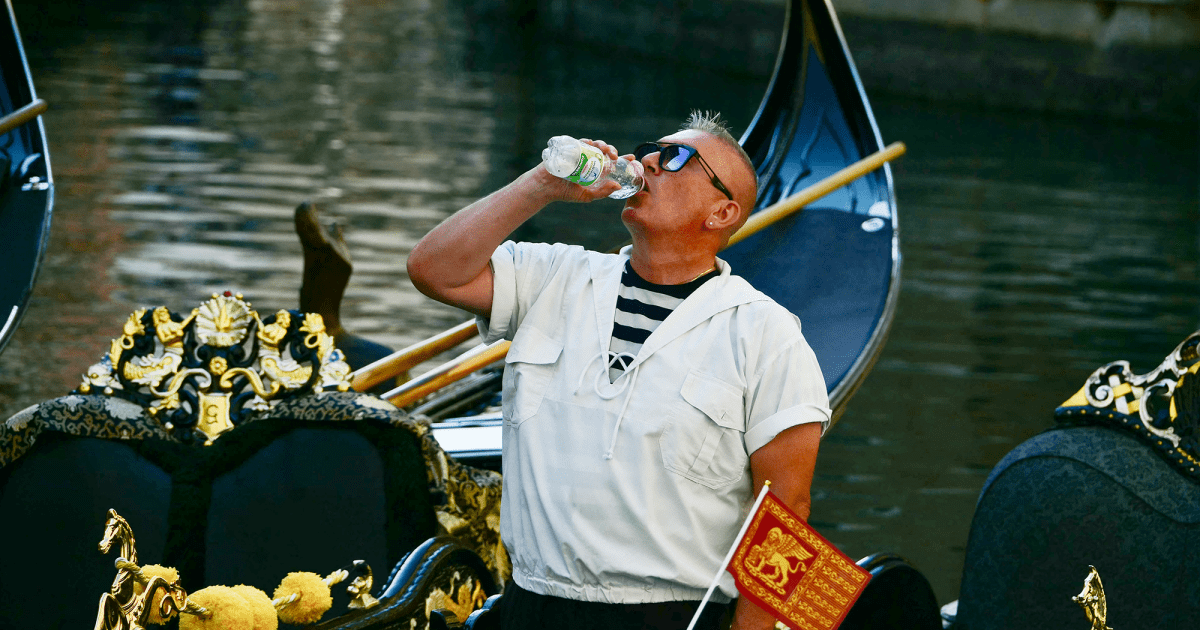
A gondolier hydrates while waiting for customers in Venice, Italy, June 26.Stefano Rellandini/AFP via Getty
This story was originally published by Slate and is reproduced here as part of the Climate Desk collaboration.
With Western Europe in the grip of a punishing early-summer heat wave, maximum health alerts have been issued in Rome, Paris, and even London. Thursday was the UK’s and Switzerland’s hottest June day on record, with each just below 100 degrees F, while France endured its warmest day ever on Wednesday, with temperatures in some areas rising to approximately 111 degrees F.
The toll of the sweltering temperatures driven by a heat dome has been stark: French authorities have recorded at least 48 drownings as people try to escape the heat, while hot cars have tragically claimed the lives of three young children. Spain is seeing a similarly tragic reality. Between Sunday and Thursday alone, an estimated 327 people lost their lives to the extreme conditions, according to data from the Spanish health ministry’s monitoring system.
Italy has recorded the highest heat mortality in Europe for three consecutive summers.
Italy, where I live, is under severe strain too. Even though this is the country that holds the title for Europe’s hottest-ever temperature (119.8 degrees F in Sicily in 2021), the current climate is testing those limits once again. On Friday, the Italian Ministry of Health placed 18 major cities on strict Level 3 red alert (bollino rosso), indicating immediate risk to even healthy adults. These cities include Rome, Milan, Florence, Venice, Turin, Bologna, Genoa, and Bari.
That warning seems prescient—of the five people who have died so far, one was a 61-year-old male in the Piacenza area who collapsed while working in his vineyard. Though this initial toll seems small compared to those in Spain and France, Italy has recorded the highest heat mortality in Europe for three consecutive summers, capturing a grim toll of roughly 18,800 deaths in 2022, 13,800 in 2023, and over 19,000 in 2024. (Numbers for 2025 aren’t in yet.)
Moreover, even as other places in Europe are looking toward relief this weekend, meteorologists warn that Italy’s anomalous heat wave will not ease significantly until early July. Yet, tourism figures for this summer indicate a record-breaking 172 million people are slated to come to the Bel Paese in July and August. Oh, and remember—we do not really do air conditioning in this country (more on that in a moment). If you are heading our way, how will you cope?
The Italian health ministry offered sage advice in their recent circular titled “Protect Me From the Heat”: Avoid going out between 11 a.m. and 4 p.m. (when the weather is at its hottest), limit alcohol and coffee (sorry), dress in natural fibers such as linen (do this anyway), eat lightly (again, sorry), and drink at least a liter and a half of water.
Always carry a bottle with you, too; in both the countryside and cities in Italy, you are bound to come across a water fountain. If filling water from somewhere public grosses you out, fear not; there is a knack to it. There should be signs saying Acqua Potabile (drinking water) above the fountain. If it says Acqua Non Potabile, it’s a no-go. If you’re headed to Rome, there are specific drinking-water fountains called nasoni, named because they resemble long noses. There are about 2,500 dotted around the Eternal City.
On a much broader spectrum, there is an app called Acquea that pinpoints over 150,000 points with drinkable water throughout Italy. Run by Rome’s water company, Acea, the app also gives out the sodium and calcium levels of the liquid from the fountains and has a built-in tracker to monitor hydration (small amounts of sodium are essential to rehydrating effectively).
Lunch during hotter times tends to be a no-cook affair. Instead of devouring a plate of hot pasta or a whole pizza come midday, opt for timeless Italian summertime classics such as prosciutto-wrapped melon, a refreshing caprese salad, or an insalata di riso (rice salad) tossed with light ingredients such as vegetables and eggs. Back in 2023, the Italian Ministry of Health even advised swapping out pranzi freddi (cold lunches) for gelato instead. “Consuming an ice cream or a milkshake can be an alternative to a midday meal,” the guide suggested.
Speaking of sweet treats to cool down, Sicilian granita is a semi-frozen dessert similar to a slush, but with fresh ingredients and a more crystalline texture. Originating on the Italian island, but now found everywhere in Italy, popular flavors of granita include lemon and strawberry. In Rome, grattachecca (shaved ice) is king come the summer months. Vendors manually shave ice off of a block and into a cup. The ice is then drenched with flavored syrups, making for a perfect Roman summer street food.
Coffee doesn’t have to be a complete no-go either. There are plenty of cold coffee options, such as caffè shakerato, a drink made by vigorously shaking coffee with ice and a sweetener in a cocktail shaker, or caffè leccese, a sweet, almond-based coffee from Puglia made by placing almond syrup and ice cubes in a glass and topping them off with espresso.
There are plenty of crisp indoor sights, such as art galleries and museums, catacombs, and stone churches filled with art.
While mastering the local food and drink menus is a delicious way to stay cool, surviving an Italian summer also requires a bit of structural strategy. Wherever you are staying or plan to eat, make sure you call before you book to inquire about whether they have air conditioning. The reason it is not a given in Italy is a somewhat unique belief called colpo d’aria (hit of air). According to Italian lore, a sudden exposure to a cold draft while you’re hot is believed to cause neck aches, stomach cramps, earaches, and headaches. Fortunately, recent market data shows unit sales have increased by 16 percent since last year, providing a glimmer of hope that this attitude is changing given the heat waves.
If you find yourself AC-less, the shutters found on the facades of all Italian residential properties can provide much-needed respite. Do as Italians do and keep them closed during the morning to stop the sunlight from getting in and warming up your hotel room.
The boiling weather doesn’t necessarily mean you have to skimp on major landmarks, either—it just means you may have to switch it up. If you fully intend to brave the heat between 11 a.m. and 4 p.m., make sure you get tickets in advance to avoid queuing for hours in the blistering sun.
More importantly, make sure your midday landmarks are indoors; standing in the center of the Colosseum at noon during a heat wave is a surefire way to ruin your day. But Italy has plenty of crisp indoor sights to see, such as art galleries and museums, catacombs, and stone churches filled with art.
Taking a stroll (passeggiata) and sightseeing at night is also just as nice as doing it in the day. You’ll probably meet more locals along the way too, as they seldom step out when it is boiling. During summer, main attractions stay open until 7 p.m., and even offer exclusive night openings; after-hours entry at the Vatican or visiting the Colosseum by moonlight allow you to see world-class history under the stars.
And remember, Italy is more than its cities. With tourists never being too far from a beach or hills, and train travel being cheap (and air-conditioned!), holidaymakers can always substitute a day wandering around cobblestoned streets for white sands or grassy paths to keep out of the humidity. By learning to adjust your clock, leaning into the art of the pranzi freddi, and treating the midday heat as an excuse for an extra gelato, you won’t just survive the intense Mediterranean summer, you will get to experience Italy in a safer way, exactly the way the locals have become accustomed to.



