
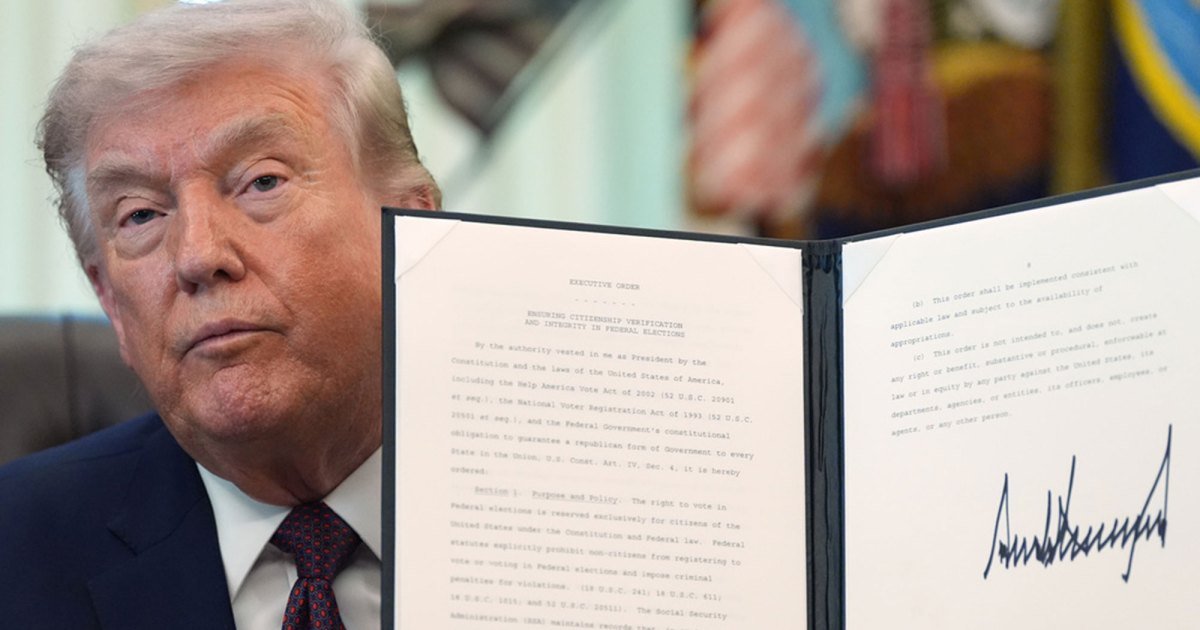
Donald Trump holds a signed executive order in March, purporting to restrict mail-in voting. Alex Brandon/AP
In his crusade to undermine American democracy, Donald Trump doesn’t have to win to win. He only needs to create a mess.
Look at this week’s news. There were several court actions regarding Trump’s outrageous attempt to restrict mail-in voting for the midterms. The back-and-forth was confusing, as the Supreme Court undid a lower court’s decision that had blocked key components of Trump’s plan. The US Postal Service then announced it would proceed with Trump’s scheme, but a federal judge subsequently issued a temporary restraining order that prevented the USPS from moving ahead. The legal fight is continuing, with mail-in voting due to begin within several weeks in some states.
So…chaos. Which is what Trump desires. Surely, he wants to succeed in severely limiting mail-in balloting—an obsession of his that seems patently unconstitutional, given that the founders handed the authority to run and oversee national elections only to the states and Congress. But he also triumphs if his shenanigans foster uncertainty.
It will be a disaster for democracy should Trump manage to win this legal battle and limit mail-in voting
Many voters do not follow the ins and outs of electoral law. As with most issues, they hear and see snatches of news and miss key developments and important details. It can be tough to be fully informed on this front. But if voters receive the impression that mail-in ballots might not count, might not be permitted, or might expose a voter to extra scrutiny, some voters might not bother to vote or might be intimidated from voting.
It will be a disaster for democracy should Trump manage to win this legal battle and limit mail-in voting. Eight states run elections primarily by mail: California, Colorado, Hawaii, Nevada, Oregon, Utah, Vermont, and Washington. So does Washington, DC. And several other states rely heavily on mail-in ballots. But even if the courts ultimately reject his assault on postal voting, the confusion he’s sowing could, to a degree, subvert the election.
Trump’s attack on mail-in ballots is only one front in his war on voting. He already has succeeded in pushing Republicans to gerrymander congressional districts ahead of schedule to tilt the playing field this year toward the GOP. The Trump administration also just announced it will deploy 1,000 election monitors to voting sites in November.
Past administrations have sent out monitors without causing disruptions. But given Trump’s adversarial stance toward state election authorities and his ceaseless pushing of bogus election conspiracy theories, there’s reason to worry that mischief and voter intimidation could be prompted by his supposed monitors.
There also has been speculation among Trump detractors that he might resort to stationing troops, National Guard forces, or ICE agents at polling places to scare off voters.
One cause for concern: The Justice Department’s civil rights division has apparently hired for its election monitoring project a lawyer named David Michael Levin, who in 2016 was charged in Florida with three felonies for allegedly hacking into government election sites. According to Democracy Docket, the charges were reduced to two misdemeanors, and he pleaded guilty and served 20 days in jail. Moreover, Harmeet Dhillon, who heads the civil rights division, which is responsible for election monitoring, is a 2020 election denier who pushed Trump’s false claims about that contest. Having her head an election monitoring mission would be like placing Robert F. Kennedy Jr. in charge of the nation’s vaccine policies. Oh…wait.
There also has been speculation among Trump detractors that he might resort to stationing troops, National Guard forces, or ICE agents at polling places to scare off voters. If anything like this happens, Trump and the GOP will argue that citizens entitled to vote have no reason to fear the presence of ICE agents. But since ICE agents have rounded up American citizens—and often acted violently—their appearance at these sites would likely keep some voters away. Who wants to risk being erroneously apprehended or getting caught up in a violent ICE action—just for exercising their constitutional right to vote?
Such speculation is far from idle. Bobby Charles, the Republican gubernatorial candidate in Maine, recently said he would ask White House border czar Tom Homan to send ICE agents to the state’s polling stations. (In July, Johan Sebastián Durán Guerrero, a Colombian national, was shot and killed by ICE agents in Biddeford, Maine. He was mistakenly targeted by ICE agents who were looking for his roommate.) Trump and his minions don’t have to dispatch ICE on Election Day to frighten away voters; a public discussion of this prospect could be enough to keep some voters at home.
It’s so damn obvious but still deserves saying: Nothing this administration states about voting should be taken at face value.
Markwayne Mullin, the secretary of the Department of Homeland Security, has said that he would not deploy ICE agents to intimidate voters, but there’s no reason to accept his promise. After all, Trump and his entire administration have been promoting the baseless lie that election fraud is rampant and noncitizen voting is a significant problem. In a speech in July, Trump declared that DHS had identified 250,000 noncitizens on the voter rolls of four states. But since then, DHS has not been able to produce proof of this, and it has even acknowledged that the number was inflated.
It’s so damn obvious but still deserves saying: Nothing this administration states about voting should be taken at face value. Pushing his Big Lie about the 2020 election, Trump nearly annihilated the nation’s constitutional order. He mounted a disinformation campaign to discredit legitimate voting results and incited violence to stay in power. After that, screwing around with the midterms is peanuts for him. No one should be surprised that he will use whatever power he now has to rig the coming elections in his favor. All media coverage of his assault on mail-in voting and his other attempts to reduce voting participation should be presented within the context that Trump is a clear and present threat to democracy.
The US electoral system is a crazy quilt of state and local election authorities. It won’t be easy for Trump to meddle in hundreds of contests across the country—especially in Democratic-led states. Mail-in ballots may be his best shot. But with only 19 House seats deemed toss-ups at this point, Trump and his crew will only have to interfere in a handful of races to help his Republican cultists remain in charge of Congress.
These coming elections are not only significant because control of the legislative branch is at stake at a time of crisis. They will demonstrate whether the United States can have free and fair elections or whether Trump and the GOP will prevail in their ongoing endeavor to impose minority rule on America.



