
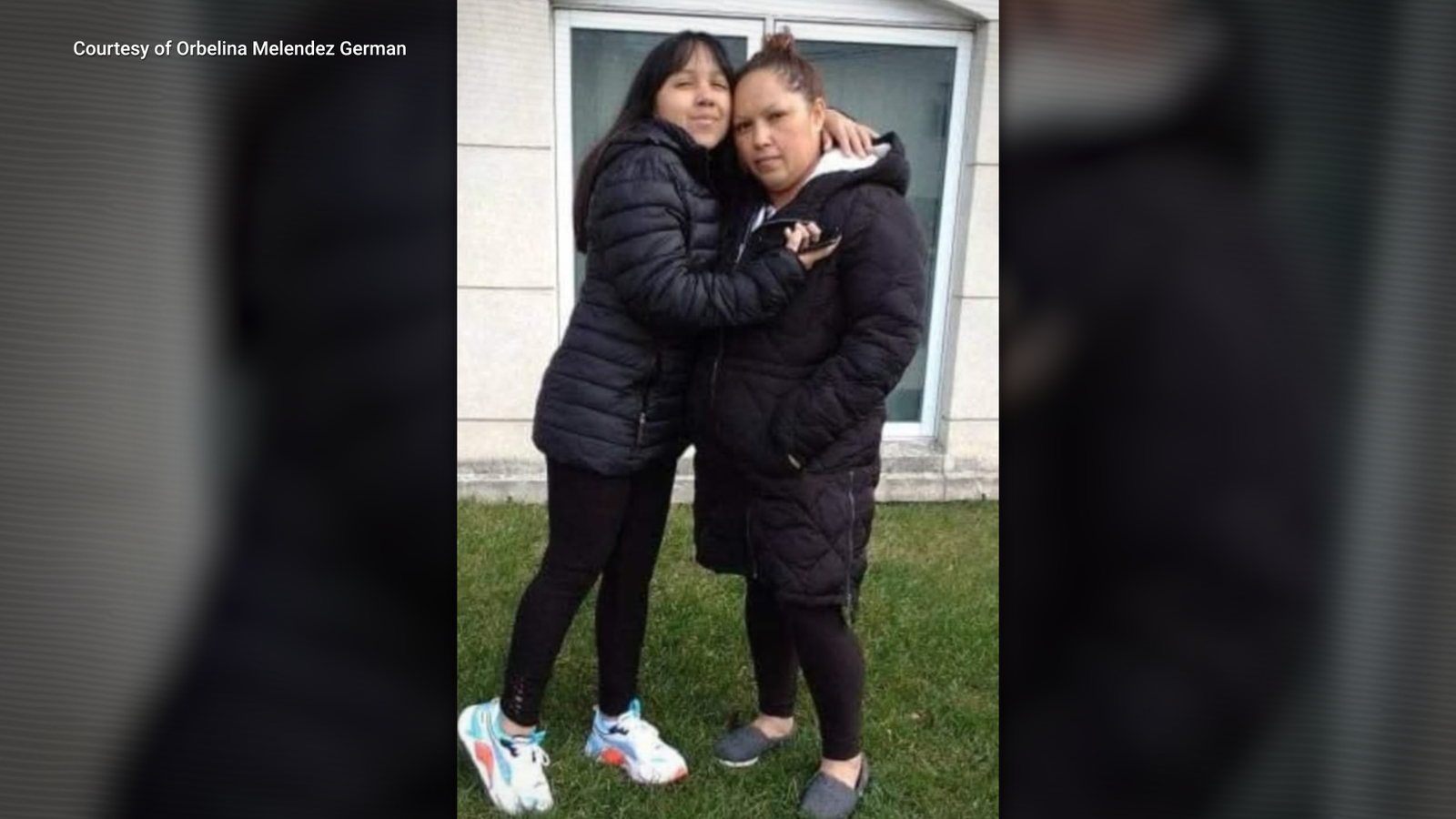
Brixy Melendez German turned 18 in January. A student at Dover High School, she was determined to get back on track with her studies this school year after she fell behind. She hopes one day to study architecture.
Allison Garcia will be 18 in July. A senior at Mainland Regional High School in Linwood, she had enrolled in four Advanced Placement classes in preparation for a pre-medicine or pre-law path at Rutgers. She wants to study psychology.

Two Jersey girls, from opposite ends of the state. They have never met. Yet their lives are tied to one another, and to those of countless more young people throughout the U.S.: Their families and their dreams were torn apart by President Donald Trump’s immigration deportation policy.
Brixy, whose hometown is about 41 miles west of New York City, was taken into custody by U.S. Immigration and Customs Enforcement agents in April and detained at Delaney Hall in Newark. Days later, in a move that crushed her mother’s spirit further, she was transferred more than 1,200 miles away, to a Louisiana detention center.
“Mi hija quiere graduarse,” Brixy’s mom, Orbelina Melendez German, told NJ Spotlight News in an interview conducted in Spanish last week and translated. My daughter wants to graduate.
“Brixy is a responsible girl. She works and she studies,” Melendez German said. “I’m still shocked they arrested my daughter, took her from me, without any kind of court date or hearing or anything like that. It’s unjust.”
Adulting at 17
Beyond the heartache, young people are bearing the Trump policies’ effects on mental health, school performance — even family finances.
Allison’s mom, Patricia Balbuena Soto, was detained on July 24, the day after Allison turned 17. Living as an independent minor since then, Allison was thrust into adulting. With the new responsibilities came loneliness.
“It’s not having anybody to talk to or eat dinner with or to give me a hug goodnight — that’s been the hardest part,” Allison told NJ Spotlight News. “Getting over the fact that, like, there was nothing that I could do that would bring her back and I kind of just had to suck it up and keep going.”
Allison dropped two of her four AP classes in the fall after she struggled to attend school and maintain the home she shared with her mom, about 11 miles south of Atlantic City. A high school senior during the day, Allison was now working full-time evening shifts at an ice cream shop in nearby Ocean City.
In early June, Allison reflected on the school year. She had missed about three weeks of classes — unthinkable in her days as a high achiever.
“I felt so helpless,” Allison said. “I just was not the same person and didn’t have the same amount of time to study. It was really hard for me to work and [go to] school and worry about my mom and send my mom money and pay the bills and cook dinners and clean my house — the list was just hard and it still is now.”
Need for security
To thrive, especially in educational settings, children need safe, nurturing and predictable environments. Uncertainty about family security is linked to a child’s inability to attend school, focus and learn, with lasting ill effects.
Nearly one-fourth of New Jersey residents, or 2.2 million people, are foreign-born, according to the American Immigration Council, an advocacy group. In all, 40% of New Jersey children were either born outside the United States or live with at least one parent who is, according to the Annie E. Casey Foundation Kids Count Data Center. Only California, with 44%, has a bigger such population.
 Credit: (Courtesy of Orbelina Melendez German)
In Camden County in February, news footage showed children running from their school bus stop when they spotted ICE agents, who were seeking a wanted man. On social media, images like that play non-stop.
“There’s evidence and decades of quality research, both quantitative and qualitative, that has shown that anti-immigrant policies are very harmful to children, families and communities,” said German Cadenas, associate professor of clinical psychology at Rutgers University’s Graduate School of Applied and Professional Psychology.
Aggressive approaches that separate families have an impact even on those who have legal status, said Cadenas, who is associate director of the Center for Youth Social Emotional Wellness, where he leads the Lab for Immigrant Rights and Mental Health.
Heightened immigration enforcement has caused more worry among Latinos, according to a Pew Research Center report released in November, before ICE raids reached a peak in Minnesota in the winter. Around 52% of Latino adults reported they worry that they, a family member or a close friend could be deported. In early 2025, the figure was 42%.
Asylum case
“I felt powerless,” Orbelina Melendez German said of the moment on April 13 that her daughter was taken into custody and detained at Delaney Hall. “They didn’t even let me in to see her because I didn’t have a lawyer present.”
Melendez German says she felt deceived at her ICE welfare check-in that day. She went with her four children: Brixy, 18; Joshua; 13, Rachelle, 12; and Yorleni, 10.
She has an immigrant asylum case pending, and her four children are listed in her application.
When ICE officials learned that Brixy had recently turned 18, they immediately arrested her to begin deportation proceedings, according to her attorney, Taylor Iodice, who works for the American Friends Service Committee Immigrants’ Rights Project.
The family believes Brixy’s age prompted ICE to detain her, though they were never given a reason, Iodice said. Brixy could have continued to be part of her mother’s case, even though she is now 18, Iodice added.
On April 30, Brixy was transferred to Richwood Correctional Center, a 1,129-bed detention facility in Monroe, La., operated by LaSalle Corrections, a private prison company, Iodice said.
Since then, Brixy’s mom and lawyer have had trouble staying in communication with her. Brixy, though, told them that she wants her story heard, they said.
 Credit: Courtesy of Orbelina Melendez German
“I’m using our names because we are not criminals,” Melendez German said. “She’s just a girl who likes to play with her siblings. She likes to watch movies with them, share experiences with them.”
She said she suspects that her daughter’s mental health is deteriorating, given Brixy’s descriptions of “dreadful, horrifying conditions” at both detention centers.
Sudden death
Brixy came to New Jersey with her mom and siblings when she was about 10 years old from Honduras, fleeing life-threatening conditions. By ninth grade, home finances were dire due to a sudden death in the family, Melendez German said.
To help her mom and siblings, Brixy stopped going to school for two years to work full time.
“Después, mejor decidió volver a estudiar,” her mom said. Afterwards, she decided it was better to return to her studies.
This was to be the school year that put her back on track toward a high school diploma. Still, after classes she took shifts at one of her two part-time jobs, cleaning homes or working at McDonald’s.
“She was the one helping out here at home with money,” Melendez German said.
The negative effects on academic performance, family finances and mental health are inextricably linked to experiences like Allison and Brixy have lived through this past school year, one as a U.S.-born daughter of immigrants and the other foreign-born to non-Americans.
Tanya Suarez, an adjunct professor at Montclair State University pursuing a doctorate in teacher education and development, works with high school students who have an ICE presence in their neighborhoods. Due to the limited number of students she works with, she asked not to name her large urban district.
Suarez was accustomed to typical end-of-school-year dips in motivation. What she noticed in some students, though, was another layer of distraction and stress.
“It’s just the constant worry in the back of their mind that they kind of smile through in their day-to-day because they have school, assignments, work, but ultimately, it’s something that’s always on their mind,” Suarez, a former social worker, said. “It’s causing burnout, anxiety, lack of sleep.”
Some students found relief in a restorative circle, which are group sessions organized to build community and elevate voices. “It was coming out in ways that they couldn’t quite verbalize before talking it through,” she said.
Deportation efforts, particularly of those who don’t have criminal backgrounds, overwhelmingly target hard-working residents of poor communities, said Javier Robles, president of Latino Action Network.
“We’re one of the most expensive states to live in and these federal immigration policies targeting Latino families are just devastating to their basic income when, many times, it’s the breadwinner who’s getting detained,” Robles said.
Allison took on more ice cream shop shifts in the fall, when property tax overdue notices arrived.
“It was kind of a reality check,” she said. “A lot of adulting things I didn’t know how to do and now I’ve got the hang of it.”
An immigrant advocacy group, El Pueblo Unido, based in Atlantic City, stepped in to help her adjust to living independently after she contacted it for help. That tip came from her mom, in her native Mexico, to which she was deported in July.
The group helped her obtain health insurance, and now she interns for the staff when she’s not at school or work.
‘Living their lives’
Taylor Iodice, Brixy’s attorney who works at American Friends Service Committee’s Immigrant Rights Program, has been in the field for three years. In 2025 she began working exclusively with those under 24 years old.
“This age group hasn’t been targeted at this rate for detention in the past,” said Iodice, adding that the uptick applies especially to those without criminal histories or arrests.
The legal team at the New Jersey Consortium for Immigrant Children has seen the trend.
“Our clients who historically weren’t targets for detention, specifically 18- to 21-year-olds, are now being targeted and put in detention,” said Alma Godinez, a senior attorney for the consortium’s Rapid Response Initiative.
“Whether they’re driving and get stopped by ICE, whether they go to an ICE check-in after their 18th birthday and ICE is choosing to detain them at that point — there are various situations in which we’re seeing this happen. Even kids who are at work and become victims of a raid,” Godinez said. “There are all these different situations in which young people living their lives — who are just part of the community in New Jersey — are suddenly subjected to ICE enforcement action.”
It is important to share Brixy’s story, Melendez German says, because she wants people to know that she is not the only mom going through this. During Trump’s second term, more than 6,200 people under 18 years old have been detained by ICE, according to The Marshall Project, a nonprofit news website.
“There are thousands of moms with their children in there,” Melendez German said of the detention centers. “It’s unjust. What I want is my daughter’s freedom. That’s all I ask for.”
Cadenas, the Rutgers clinical psychology professor, said his recent research found that activism and advocacy are key ways for immigrant communities to cope, build confidence and feel empowered, and enhance their outcomes.
“For young people, activism can be really protective and effective because it helps them gain a sense of agency, in a situation that is very much outside of their control, and a sense of connection to networks that support them,” Cadenas said. “Activism is connected to greater mental health well-being, greater educational outcomes and greater work-related outcomes.”
Allison says she recognizes that in herself. “I’ve changed so much throughout this school year,” she said.
Still, she acknowledges complicated feelings of hope and sadness. High school graduation is on Friday.
“All my friends will have their entire families there and I’ll just have no one,” she said. “My mom won’t be there taking pictures. That, to me, is a little hard to think about. But again, I kind of just have to keep going and I can’t really focus on the negative parts because then that’s how I just get really upset and lose my motivation.”
She plans to attend Rutgers University in the fall. She will seek ways to uplift immigrant voices, including her own.
“I wasn’t very aware of what was going on until I got the phone call that my mom was detained,” Allison said. “It’s very important for us to educate our community members and the next generation so that they’re aware of what’s happening so that they can protect their families and themselves and just speak up for the people that don’t have the same privileges that we do.”



