
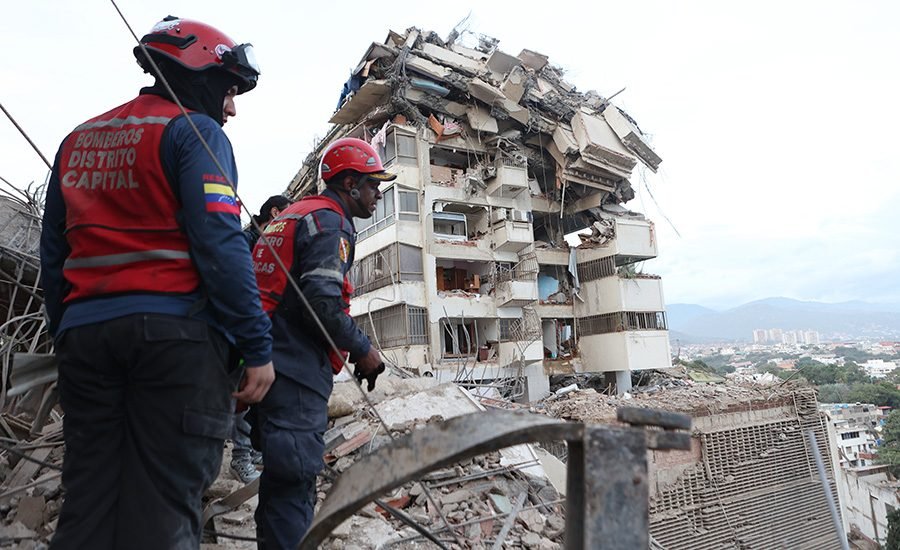
A pair of severe temblors the evening of June 24 in northern Venezuela has caused catastrophic damage, with reports of at least 188 people dead. Search and rescue continued the following day among collapsed buildings in the capital of Caracas and other northern cities as the full scale of the damage begins to come into view.
The level of destruction identified by early assessments shows at least 250 damaged or collapsed buildings, with at least 200 people still trapped inside. In addition to the confirmed death toll, as many as1,520 people have been injured and 157 are missing, and those figures are expected to rise over time.
The magnitude 7.5 earthquake occurred at 6:05pm local time, shortly after a magnitude 7.2 foreshock. The epicenters were located about 160 km (100 miles) west of Caracas. The earthquakes were relatively shallow, which can cause greater damage to buildings and infrastructure. It was the most powerful earthquake recorded in Venezuela in more than a century.
Early estimates from the U.S. Geological Survey forecast that fatalities could ultimately be in the tens of thousands, with estimated economic losses in the tens of billions of dollars.
U.S. Geological Survey
Rescue teams are beginning the difficult process of trying to reach people in collapsed or damaged structures. Early images of the scenes in Caracas and elsewhere show several high- and mid-rise buildings have collapsed with extensive damage to infrastructure, including the city’s airport, which has been closed. Subway service was suspended and natural gas was also turned off in the capital, according to the Associated Press.
An Immediate Need for Temporary Housing
Beyond search and rescue, initial relief efforts will be focused on housing the millions of people rendered homeless by the earthquake, as well as reestablishing transportation infrastructure so relief can flow in, says Kit Miyamoto founder of the nonprofit Miyamoto Relief and structural engineering firm Miyamoto International.
Miyamoto Relief has already dispatched a team from its Mexico office, many of whom have experience in the response to the 2017 Puebla earthquake in Mexico City.
Looking for quick answers on construction and engineering topics?
Try Ask ENR, our new smart AI search tool.
Ask ENR →
Based on his own past experience in earthquake response relief operations in Turkey, China and around the world, Miyamoto say about 5 million people in Venezuela will need shelter immediately.
“When this kind of earthquake happens, somewhere around half of the building stock is heavily damaged,” Miyamoto says. “So out of 10 million people who experienced heavy shaking [in the earthquake zone], probably about 5 million people now see a certain amount of damage in their houses or apartments and won’t use the [structure], which is a pretty smart things to do, since aftershocks can be bigger than the first ones.”
While Venezuela modernized its building codes in the 1970s with seismic design elements that are found in many buildings built since the 1980s, much of the country’s building stock is made of nonductile concrete, unreinforced masonry and adobe brick that can fail in earthquakes. “Those are the ones you will see on the news that appear to have pancaked as they collapsed,” says Miyamoto, adding that initial estimates place about two million mid- and low-rise buildings in the affected area. “Generally speaking for this kind of earthquake and situation, you’re going to see about 20% to 30% of building stock to be damaged pretty badly.”
Miyamoto sees similarities in this disaster to the 2023 earthquake in eastern Turkey. That was also a double event, with magnitude 7.8 and 7.7 shocks causing widespread damage and killing more than 50,000 people. “That one affected about 50% of the building stock,” Miyamoto says. “And the change in building codes in the 1980s was similar to Venezuela. But Turkey in a sense is a wealthier country and had been preparing for an Istanbul earthquake, so it had a robust response capacity ready. That is not the case here.”
Venezuela’s Acting President Delcy Rodriguez has announced a $200-million reconstruction fund for hospitals and homes damaged in the earthquake.
The United States said it was sending two international search-and-rescue teams to help in the disaster response and that it would contribute $150 million toward Venezuela’s recovery through nongovernmental associations and the United Nations.
Source: www.enr.com



