
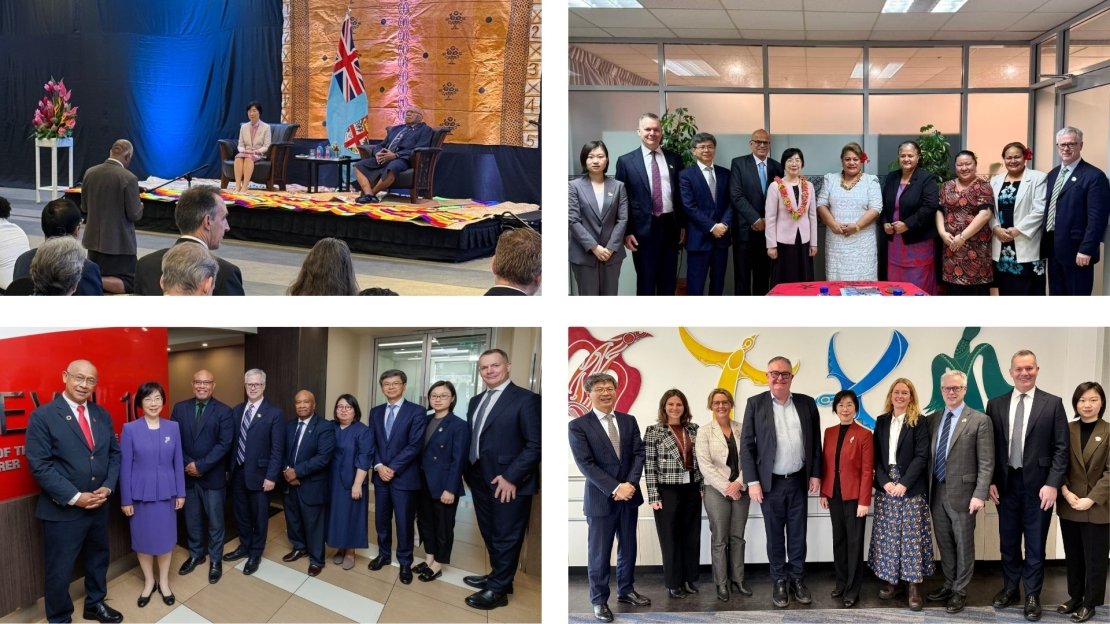
Asian Infrastructure Investment Bank (AIIB) President Zou Jiayi visited Fiji, Samoa, Papua New Guinea and New Zealand July 26-31 to deepen AIIB’s engagement with members and partners in the Pacific region and explore how the Bank can support their infrastructure priorities through a strategic, selective, partner-focused approach.
Across the four members, discussions highlighted shared priorities around improving connectivity, strengthening climate resilience and energy security, expanding productive infrastructure and digital infrastructure, and mobilizing public and private investment. At the same time, counterparts emphasized the need for development partners to take into account the region’s unique challenges, including acute climate exposure, dispersed geography, high infrastructure costs, small markets and limited implementation capacity.
In Fiji, discussions focused on building on its early partnership with AIIB and moving toward a more programmatic engagement. Priorities included support for rural infrastructure resilience, renewable energy, water and sanitation, inter-island transport, smart traffic management and tourism-related infrastructure. The discussions also highlighted opportunities to strengthen private-sector participation and public-private partnerships, while ensuring that investments support economic growth, service delivery and fiscal sustainability.
Samoa’s priorities centered on infrastructure that can connect people and markets while creating opportunities for domestic economic development. Discussions explored inter-island connectivity, airport and maritime infrastructure, energy security, climate adaptation, digital and financial connectivity, as well as infrastructure to support agriculture, tourism and exports. Project preparation and technical assistance, it was noted, will be important in helping Samoa develop a focused pipeline of priority investments.
In Papua New Guinea, discussions underscored the potential for a stronger and more structured AIIB partnership as the economy develops its infrastructure pipeline. Areas of interest included transport connectivity, agricultural commercialization, national electrification, renewable energy, port expansion and private-sector financing. The proposed policy-based financing operation could provide an important foundation for a broader multi-year partnership, while discussions on energy highlighted Papua New Guinea’s significant renewable energy potential and the scope for greater private-sector participation.
In New Zealand, discussions focused on how AIIB and New Zealand can work together more closely to support sustainable infrastructure development across the Pacific. Areas of potential cooperation included project preparation, cofinancing, technical assistance, knowledge sharing and private-sector participation. Discussions emphasized the importance of maintaining strong governance, environmental and social standards, transparency and effective coordination with other development partners as AIIB expands its engagement in the region.
Across the visits, Zou highlighted AIIB’s diverse financing toolkit, including sovereign-backed and nonsovereign-backed financing, project preparation support, policy-based lending and other innovative financing solutions to support sustainable infrastructure development. She also emphasized that partnerships with other multilateral development banks, bilateral development institutions and regional organizations will be central to ensuring that AIIB’s support is complementary and responsive to members’ needs.
The visits reaffirmed strong interest among members and partners in the Pacific region in AIIB’s infrastructure focus and flexible financing approach. It also underscored the importance of engaging with the region in a disciplined and pragmatic way – focusing on projects where there are clear national priorities, sufficient readiness and strong development additionality, while taking account of implementation capacity and affordability.
For AIIB, the visits mark an important step in strengthening its role as a long-term infrastructure partner in the Pacific region. By combining multi-year approaches, high-quality project preparation, innovative financing and closer collaboration with development partners, AIIB can help members in the Pacific region address critical infrastructure gaps while supporting climate resilience, connectivity and sustainable economic growth.
Source: www.aiib.org



