
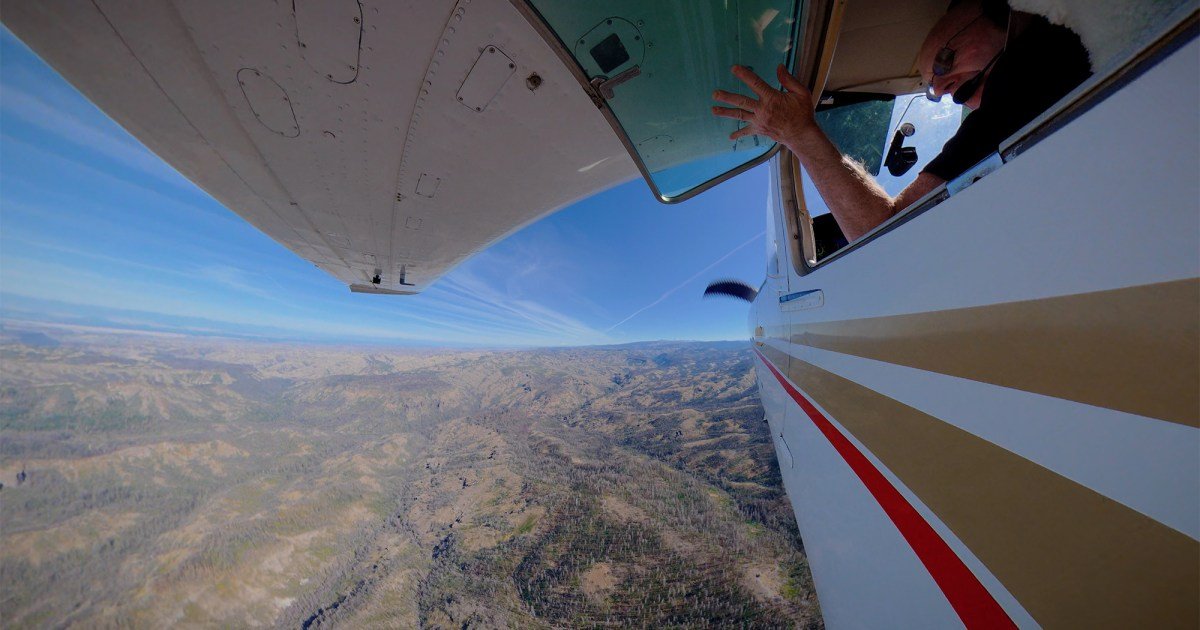
A view of the Lassen Area from above.Peter Berger
On a hot, sunny day in California, I crawled into the tiny cockpit of a small Cessna aircraft to fly around one of the state’s most active volcanoes, Mt. Lassen.
I wasn’t looking for lava. The volcano in Lassen Volcanic National Park hasn’t erupted in more than 100 years. Instead, I was looking for the telltale signs of herbicide spraying across vast stretches of forestland. I’d already seen it from the ground: seemingly endless expanses of land devoid of plant life because glyphosate—a.k.a. Roudup—or similar herbicides were deployed to kill everything except young tree saplings being grown for timber. But it was hard to fully get a sense of the scale.
What would it look like from the sky?
I knew record amounts of glyphosate were being sprayed in California’s forests, much of it in the wake of the megafires that have hit the state in recent years. For our Mother Jones investigation, my colleague Melissa Lewis and I analyzed more than 5 million state records and found that the state’s fastest growing market for the controversial chemical was to spray forestlands.
That’s when the scale of the destruction hit me.
As the cramped little plane took off from an airfield in Chico, with me sitting in the co-pilot seat, I had to fight the urge to nervously press my feet down, because they rested on pedals that—insanely to my mind—could send the plane careening off in some unwanted direction. Pilot Gary Kraft, who’d agreed to take me up as part of his nonprofit EcoFlight’s mission to show people nature from the sky, initially said not to worry about the pedals, but then, sternly, warned me against pressing on them. I didn’t need to be told twice.
As our Cessna ascended, my anxiety waned, and the birds-eye beauty of the volcanic landscape took shape. Mount Lassen marks the southern end of the Cascade Range, and the northern beginning of the Sierra Nevada mountains. This confluence of sparsely populated mountains is among the most majestic in a state brimming with natural beauty.
The plane headed out of the farm-rich Central Valley and took us over oak-studded foothills, cut with deep canyons whose cascading creeks are home to some of the state’s last remaining spring run chinook salmon—a threatened species under the Endangered Species Act.
Soon, the oak trees gave way to the Christmas-shaped trees so many of us associate with the mountains, towering conifers like firs and cedars. And that’s when the scale of the destruction hit me.
First, we spotted the dead hillsides where two of the state’s largest infernos—the 2021 Dixie Fire and the 2024 Park Fire—had burned across mountainsides.

Then, there it was: the telltale signs of herbicide spraying. All the trees had been cleared, and rather than fresh spring grasses and green bushes, the mountainsides hosted nothing but dirt.


The United States Forest Service and timber companies say they use glyphosate to reforest land after it is harvested by loggers. They say killing all other plant life helps trees regrow faster by reducing competition for sunlight, water, and soil nutrients. In Lassen National Forest, the federal government plans to spray about 10,000 acres.
Our reporting showed that private timberland around Lassen was the state’s heaviest sprayed forestland in recent years. Seeing the destruction from the sky, mountainside after mountainside, this scale of lifeless earth felt surreal—like I was watching a movie about some other planet.
One supposed fact that glyphosate proponents repeat a lot is that the herbicide binds with soil, meaning it won’t move and contaminate other places. Yet a 2020 study by the US Geological Survey found it in 74 percent of American streams tested. Peer-reviewed studies also have found the herbicide is toxic to fish and other aquatic life, like those spring-run Chinook salmon. The Environmental Protection Agency has said it likely harms 93 percent of endangered species. And the World Health Organization has called glyphosate a probable human carcinogen.
Bayer, Roundup’s manufacturer, insists it is safe when used according to the EPA-approved label. In 2020, the EPA deemed glyphosate reasonably safe for people and the environment, but a collection of labor and environmental groups sued, arguing that the EPA was wrong and hadn’t properly conducted its review. The Ninth Circuit Court of Appeals agreed, saying the agency did not provide adequate evidence for its conclusion. The EPA is now in the process of reassessing the herbicide.
But even as the federal government works to make that determination, the spraying of environmentally sensitive forestlands is continuing at a breakneck pace. And the impacts of all this spraying, which only recently came to the public’s attention following our yearlong investigation, will undoubtedly take years or even decades to fully assess.



