
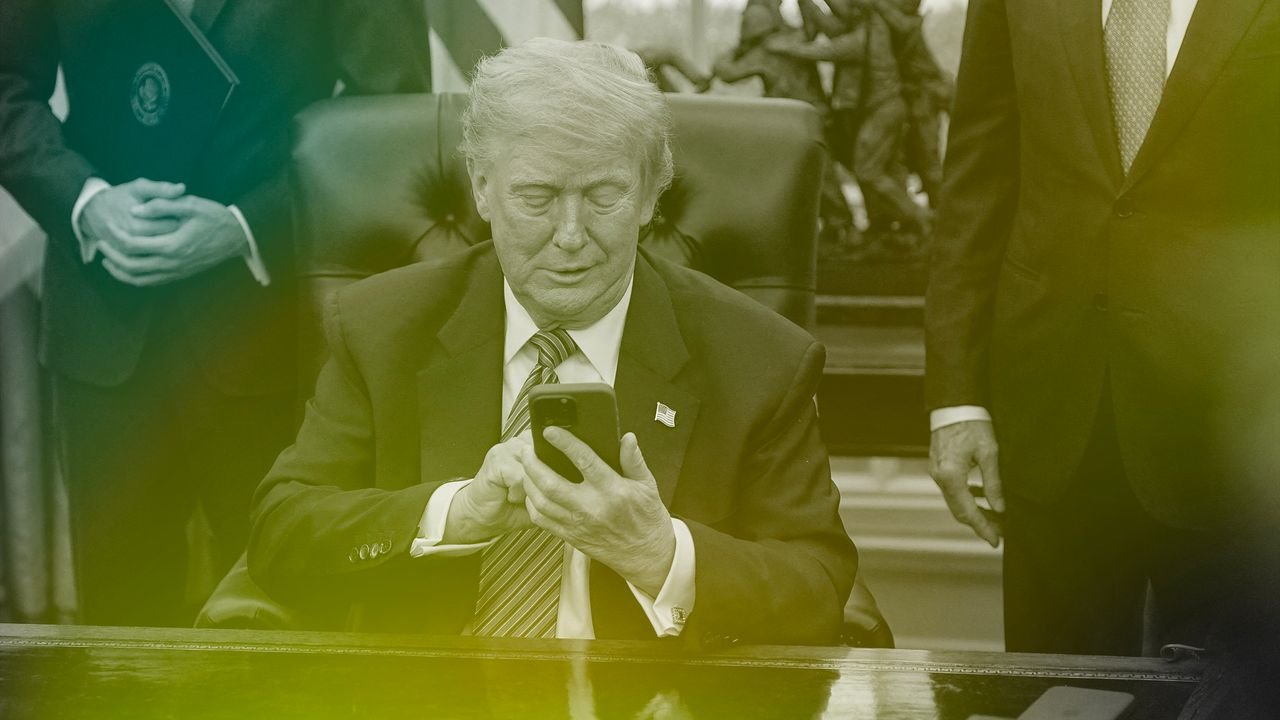
These developments prompted more cries of outrage, including one from the Democratic senator Mark Warner, who has introduced a bill that would ban social-media companies from selling fast access to accounts of government employees. Two media organizations—the Intercept and the Freedom of the Press Foundation—filed suit in a New York federal court claiming that Truth API violates their constitutional right to access Presidential statements on equal terms with other press organizations and members of the public. “This brazen grift targets not only the markets but the First Amendment,” Seth Stern, the chief of advocacy at the Freedom of the Press Foundation, said. “It cannot stand.”
That remains to be seen. Ever since Trump was elected in 2016, he has been eagerly exploiting gaping weaknesses in the U.S. legal system: federal conflict-of-interest laws that largely don’t apply to the President or Vice-President; a presumption, which the Supreme Court validated in its dreadful Trump v. United States ruling of 2024, that a sitting President can’t be prosecuted for official acts; and a long-standing Department of Justice policy that it cannot indict or prosecute a sitting President. “They’ve discovered the cheat code,” Hedtler-Gaudette said, referring to Trump, his family, and his acolytes. “If you don’t care about the reaction, if you don’t care about public shaming, then you can basically do anything you want, because we have this strange legal framework that basically exempts the President from the law while he’s in office.”
As a corporate entity, Trump Media & Technology doesn’t enjoy any such protections, but it insists that it isn’t doing anything wrong. In the conference call, McGurn pointed out that other social-media companies already market A.P.I. feeds to other businesses. That’s true. For example, Elon Musk’s X offers various corporate subscription choices, including cheaper metered options and all-access plans that reportedly start at upward of forty thousand dollars a month. But Trump doesn’t post on X much these days. And Musk doesn’t hold a federal office—not anymore, anyway.
Evidently, Trump Media is clearly banking on its A.P.I. scheme to help turn around a social-media business that has been hemorrhaging traffic, money, and stock-market value. In July, the number of visitors to Truth Social was down by more than thirty per cent compared with the same month last year. In its latest quarter, Trump Media generated total revenues of just $1.7 million, but booked a loss of $238.1 million, much of which it attributed to a sharp decline in the value of its investments in bitcoin and other digital assets. Early last year, when crypto was riding high, the company made a disastrous decision to accumulate bitcoin on its balance sheet. More recently, it has pivoted in another direction—nuclear fusion. It’s in the process of merging with TAE Technologies, a California-based company that is trying to develop a carbon-free energy source by fusing hydrogen with boron. So far, these turnaround efforts have failed to reassure investors. Since the start of last year, Trump Media’s stock, which trades under the ticker symbol DJT, has fallen by about seventy-five per cent.
As anyone who has followed Trump’s business career knows, flapping around and racking up large losses isn’t anything new to him. Neither is cashing in on the Presidency. But is it possible that he’s gone too far this time? The White House claims he doesn’t have anything to do with the management of his businesses, which he placed in a revocable trust run by his son Donald Trump, Jr., and it has referred questions about Truth API to Trump Media. Many independent ethics experts are unimpressed by these assurances. “If I had been the White House counsel, or Trump’s private counsel, I would have said, ‘You can’t do this,’ ” Richard Painter, who served as the senior ethics lawyer in George W. Bush’s White House, told me. “The key facts are that Donald Trump owns a big chunk of Truth Social, and he’s getting a financial benefit from the company selling early access to the public announcements on his social feed. That runs up against the insider-dealing laws, which say you can’t give information or a tip to someone who then trades on it and gives you something valuable in return.” Although Trump posting policy announcements on Truth Social could well be official acts that fall under the immunity privilege that the Supreme Court granted to Trump, Painter said that “Truth Social providing preferential access to U.S. government information is not an official act.”



