
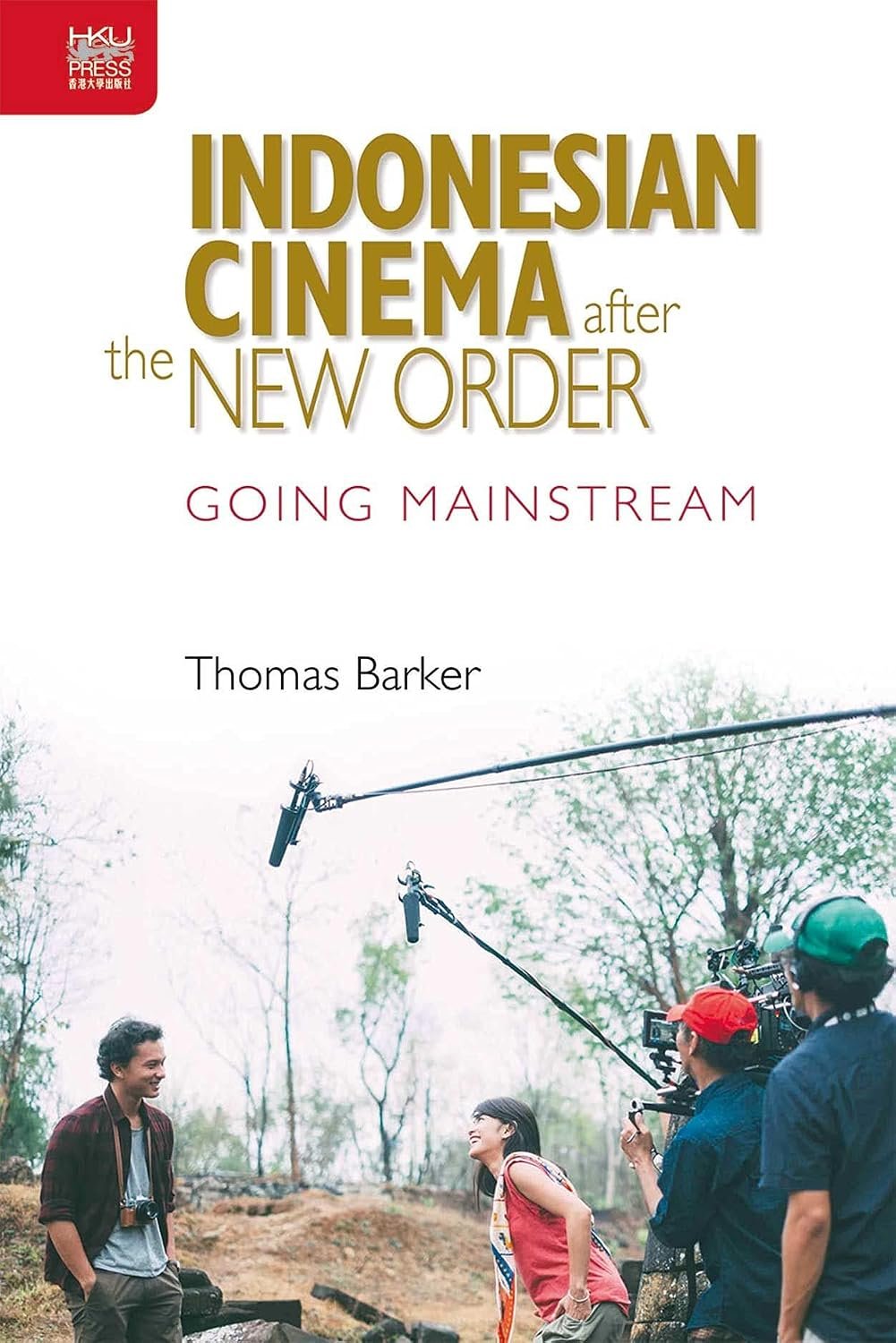
Thomas Barker’s “Indonesian Cinema after the New Order: Going Mainstream” approaches Indonesian cinema primarily through the structures surrounding it rather than through extensive analysis of individual films. Politics, business networks, censorship, exhibition, television, religion and ethnicity are all given considerable space, with Barker’s central argument being that the fall of Suharto in 1998 changed Indonesian cinema significantly without entirely dismantling the institutions and relationships inherited from the New Order.
Buy This Title
by clicking on the image below
Barker begins considerably earlier than Reformasi, looking back to cinema in the Dutch East Indies and questioning some of the established ideas surrounding film nasional. Early production and exhibition were distinctly cosmopolitan, involving European and ethnic Chinese entrepreneurs and films imported from Shanghai, Europe and the United States. After independence, however, an increasingly nationalist conception of cinema emerged, most prominently associated with Usmar Ismail and “Darah dan Doa”. Ismail described the film as having been made “entirely without any commercial considerations whatsoever”, presenting idealism as almost inseparable from the idea of a genuinely national cinema.
One of the more interesting aspects of Barker’s approach is how he complicates this distinction between nationalism and commerce. Ethnic Chinese producers, and later businessmen of Sindhi Indian origin, were frequently accused of being primarily interested in profit, even though these communities played a substantial role in financing, importing and producing films. Barker consequently shows how debates about artistic quality were often entangled with racial and nationalist assumptions. His discussion of the Japanese occupation similarly adds an uncomfortable complication: propaganda structures restricted artistic freedom but also trained Indonesian cultural workers in modern media production and demonstrated cinema’s potential as a means of addressing mass audiences.
The sections dealing with the New Order are particularly concerned with the concentration of power. Cinema 21 emerges as a crucial institution, with its influence extending through exhibition and Hollywood imports while personal, political and business connections helped reinforce its position. By the 1990s, Indonesian cinema had entered what Barker calls mati suri, essentially “a coma.” At the same time, private television expanded rapidly, attracting audiences away from cinemas but also providing employment to filmmakers and creating the enormously popular sinetron format.
The arrival of Reformasi therefore appears initially as a major rupture. Films such as Kuldesak represented a younger generation attempting to work outside existing structures, while filmmakers such as Riri Riza became associated with the revival of local production. Barker is careful, though, not to turn this period into a simple narrative of independent filmmakers overthrowing an obsolete system. As one testimony in the book states, “we didn’t have capital. We didn’t have money.” Many younger filmmakers consequently ended up working with established producers and companies.
This is arguably the book’s most persuasive recurring point: Reformasi created opportunities without producing a complete economic reset. By 2008, more than 60 percent of domestic production came from seven major companies, most of which were either New Order businesses or connected to them. Barker traces the resulting oligopoly through companies including Multivision Plus, Soraya Intercine and MD Pictures, while Cinema 21 remained dominant in exhibition even after competitors such as Blitz/CGV entered the market.
The amount of detail devoted to corporate structures, ownership arrangements and institutional relationships is definitely a strength, highlighting the level of research here, which is definitely of the highest level. Barker provides useful information that conventional film histories tend to overlook, although there are parts that one could describe as dry. For this writer, though, this is actually a plus for the book, which avoids focusing extensively on the frequently dull aesthetics, filmmaking styles or detailed readings of individual works
The chapters on horror and Islamic popular cinema provide a more direct connection between this institutional framework and the films themselves. In the former, Barker connects the revival of Indonesian horror with unresolved memories of the violence of 1965–66. Ghosts become a means through which “silenced and repressed history” can return indirectly, an interpretation that offers useful background for the later work of filmmakers such as Joko Anwar and films like Satan’s Slaves. The argument is convincing, although at times the broader political reading threatens to overshadow the substantial variety that exists within the genre.
Similarly, Barker’s discussion of “Ayat-Ayat Cinta”, Hanung Bramantyo and Islamic-themed cinema places the films within the emergence of an increasingly affluent Muslim middle class. Religion, consumption, romance and popular culture are shown as interacting rather than necessarily opposing forces, resulting in what one source describes as a “battle between market forces and Islamic messages.”
The later chapters also temper any idea that Reformasi produced straightforward liberalization. Censorship continued through the LSF, the 2009 Film Law disappointed many filmmakers, labour conditions remained poorly regulated, and attempts at collective organization were frequently weakened by internal disagreements. The “Berlinale Gate” scandal, involving government funds intended to support an Indonesian delegation to Berlin, provides a particularly striking example of the persistence of older institutional habits. Joko Anwar’s criticism that officials retained “the same attitude as in the past” fits neatly with Barker’s broader argument.
Regarding the actual writing, Barker’s pen is clear, to the point, and manages to offer intense details of information in a way that remains easy to follow, and essentially, read. The introduction, as is frequently the case in academic books, tends to be a bit more complicated in syntax and overall communication of the context, while there are moments when the use of the word “cinema” becomes too excessive. The notes on the bottom of the pages helps in terms of placement, but the fact that actual notes that give additional detail about what is written on the actual text coexist with source references, disrupts the readability to a point. These however, are just minor issues in a book that is quite easy to read overall and offers a significant amount of info. Furthermore, the edition by Hong Kong University Press is quite appealing, with the glossy paper and the hard cover highlighting its quality.
“Indonesian Cinema after the New Order” is therefore more convincing as a political and industrial history than as a work of film criticism. Within this frame, Barker succeeds in showing that the development of Indonesian cinema cannot be explained simply through directors, genres or individual successes. The persistence of monopolies, censorship, business networks and state involvement is just as important to understanding how the industry moved from the uncertainty of the 1990s into the considerably more productive post-Reformasi period



