
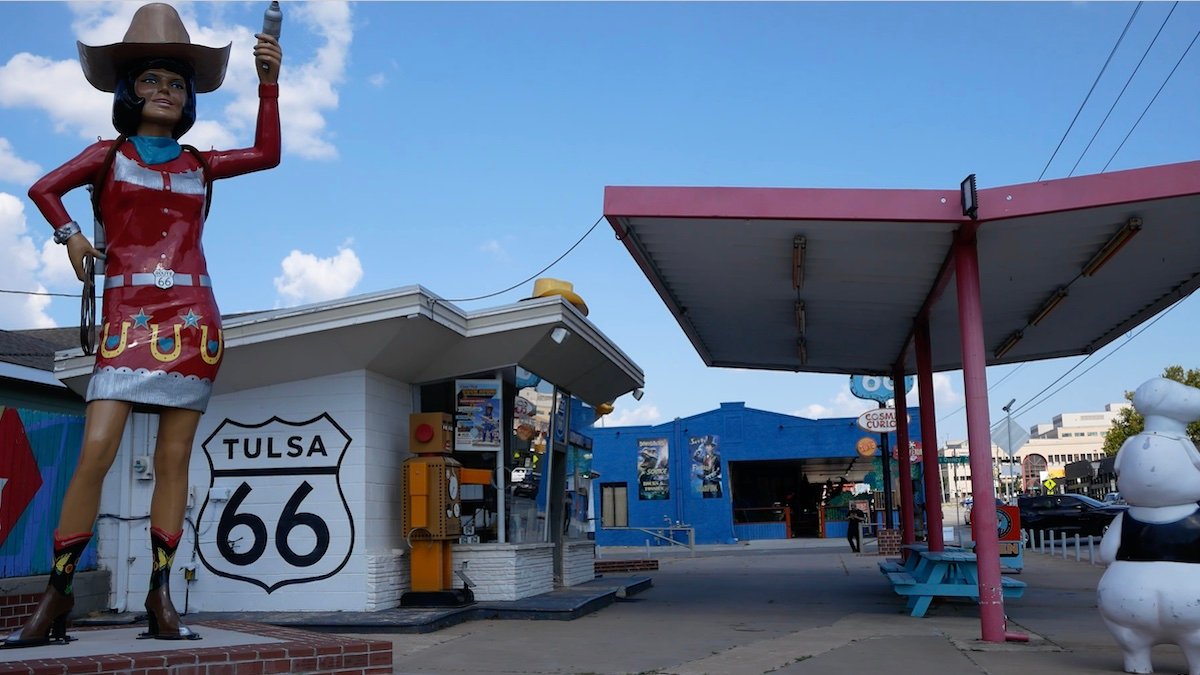
Charles Lay knows it might look like he made his film “Rt. 66” specifically for the Amarillo International Film Festival.
Amarillo is on the historic highway, celebrating its 100th anniversary this year, and signs of Americana charm peek out from every corner of the Panhandle city — from the eight-decade old GoldenLight Cafe & Cantina on Sixth Street, to the Cadillac Ranch of painted classic cars, to the giant yellow Big Texan Steak Ranch, known for its 72-ounce steak-eating challenge.
The big cowboy sign for the latter — originally situated along Route 66 — is exactly the kind of image Lay sought out for his short film.
The Amarillo International Film Festival embraces its iconic location, even offering a $500 Route 66 Award. A trip along Route 66 may be the thing that first brings people to Amarillo, but the city’s friendliness and charm — to say nothing of the excellent and diverse food options — just might make them stay a while. The same goes for the city’s fast-growing film scene.
Lay’s “Rt. 66” combines iconic images — many from Amarillo — with audio Lay collected on a long Route 66 roadtrip from Chicago, where he grew up, to Los Angeles, where he now lives. The film, produced by Aadi Sinha, played in the Saturday morning Student Shorts Block at the festival.
We talked with Lay about his favorite Route 66 images, and why Amarillo is his favorite place to find his kicks on Route 66.
Charles Lay on ‘Rt. 66’ at the Amarillo International Film Festival
MovieMaker: How did you became a filmmaker?
Charles Lay: I can’t recall the exact point when I “became” a filmmaker. Growing up, I would wrangle my friends and make videos and shorts on my parents’ old camcorders and phones. I first dipped into documentary filmmaking in a class at Emerson College called Advanced Documentary Workshop. I had watched plenty of documentaries and was an avid street and life videographer, but never put things together cohesively. Learning the basics of docs really changed how I viewed making films, capturing live and telling the story in the edit.
MovieMaker: What made you want to make a film about Route 66? What’s your connection with it?
Charles Lay: The idea came about because I was moving to Los Angeles and began planning what route to take from Chicago. I didn’t have a previous connection to 66 besides always seeing the start of it when going to the Art Institute in Chicago. I had never gone on a proper American road trip — stopping at the world’s largest something and other similar roadside attractions.
I began researching what (relatively) off-the-beaten-path things there were to do and see along the route. I stumbled upon a wonderful website called Roadside America where they list different roadside attractions and Americana. This was a sort of Pandora’s box for me, as it displayed maps with attractions labeled, and I could plan out a route to hit as many as possible.
This website is also where I discovered what Muffler Men were – the giant fiberglass statues of men in the film. After the fourth man visited, my friend’s dubbed the rest of the trip our “Giant Men Road Trip.”

MovieMaker: How did you get the idea to juxtapose these many statues with audio of other people talking? It’s really incredible when the stories sync up with the characters, and kind of even more fun when they don’t.
Charles Lay: For me, the idea to tell the stories through the statues and images came pretty late into post. On the actual drive, I didn’t take many interview-style videos — only audio — so I knew I had to work around that. In the editing room, I remember thinking how well the giant space man and space woman were as a vehicle to show two lovers longing for their loves, and it just sort of naturally progressed from there.
It was somewhere in rural New Mexico where I began thinking about the contrast between the Buddhist Temple and the Jesus Theme Park. From there, I started piecing together that so many of the things I was photographing were foils.
All of the footage was captured along the route or in a town a little off the main road. I knew a lot of the things I wanted to capture from my planning on Roadside America, but was definitely open when I saw stuff along the ride. The audio clips were a mix of audio from the journey and interviews I did after the fact.
When I decided the film would showcase two sides of different binaries, I knew I was going to need to find new subjects. I spent a couple of months networking and reaching out to members of Navajo Facebook groups looking for people to interview, which was a really interesting journey.

MovieMaker: What’s your favorite location on Route 66?
Charles Lay: I know how this looks, but I would put Amarillo at the top of the list! I specifically made Amarillo a stopping place because of how many roadside attractions were in close proximity. It had Big Tex, the Second Amendment Muffler Man, Cadillac Ranch, the Big Gun, and the Ozymandias Legs statue all within a short drive. Everyone knows Cadillac Ranch, but I was more taken aback by the Big Gun. Everything is bigger in Texas. A close second would be the Buddhist Temple and Gardens in Oklahoma. They were very serene and pretty surreal.
MovieMaker: Did you know the Amarillo International Film Festival had a Route 66 award when you submitted, or was that just wild luck? Any experience with the festival or the city?
Charles Lay: Haha, I did not know the festival had a Route 66 award when I submitted, but got a good chuckle when I read about it. When looking for festivals to submit to, I looked for fests in states and cities along the route — here I found the Amarillo International Film Fest! The doc was both filmed on the route and is about it, so the prize being awarded to the film that “best embodies the Route 66/ Road Trip vibe and/or is filmed on Route 66” made my friends laugh. They also accusing me of creating the film for the prize.
Funnily enough, I didn’t even know it was the centennial celebration until I began editing. Not sure how that one slipped by.
You can read more about the Amarillo Film Festival here and read more of our festival coverage here.
Main image: “Rt. 66,” directed by Charles Lay



