
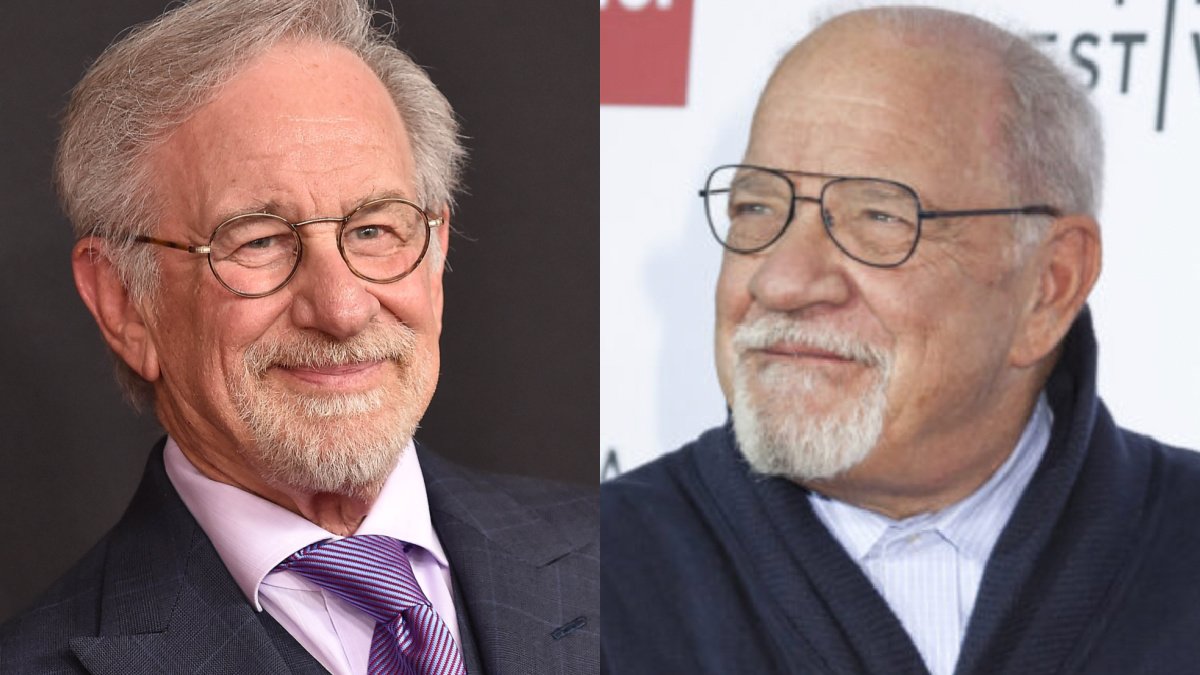
In the new book Stranded on Earth: How Night Skies Became E.T. the Extra-Terrestrial, author Max Evry tells the little-known origin story of E.T., which once ruled the box office as the most successful movie ever — and, in the process, investigates the creative process of two great filmmakers, Steven Spielberg and Paul Schrader.
E.T., the sweet story of an alien visitor to Earth began life as a rural alien siege movie called Night Skies, in which malevolent E.T.s attack a farm family. It was meant to be a direct follow-up to Steven Spielberg’s Close Encounters of the Third Kind, the 1977 smash that became Columbia Pictures’ biggest moneymaker.
Spielberg’s films — especially those involving extra-terrestrials — received a renewed appreciation this summer with the release of his latest, Disclosure Day. While Evry’s previous book, A Masterpiece in Disarray, focused solely on David Lynch’s 1984 bomb Dune, the new Stranded on Earth tracks the making of E.T. through many film projects, including the fraught production of Close Encounters.
The following excerpt from Stranded on Earth details the development of Close Encounters, which at one point involved the acclaimed writer-director Paul Schrader, who turned out to have a very different sensibility than Spielberg.—M.M.
Steven Spielberg came up with a plot about a government debunker who turns believer after a close encounter of the second kind, then gets involved in a government project to send him to the stars. The ensuing process took a litany of writers to shape the director’s sketchy ideas into a cohesive film. It ultimately became the story of Roy Neary (Richard Dreyfuss), a blue-collar worker in Indiana who is forever changed by an encounter with a UFO.
The first writer hired for the project (for $35,000 after delivery of one draft plus revisions) was Paul Schrader, a movie critic-turned-screenwriter whose violent magnum opus Taxi Driver was simultaneously being produced by Michael and Julia Phillips. That psychotic vigilante movie was offered to Brian De Palma before Martin Scorsese made it his own. Even with Robert De Niro attached as Travis Bickle, Taxi Driver nearly did not get made.
“Keeping that package together was very difficult,” says Michael Phillips of Taxi Driver. “Columbia loved Close Encounters and hated Taxi Driver. We didn’t have a go picture. Steven volunteered to be there if needed, and was open to directing when we thought we were losing Marty. As a friend he offered to be around. There was a community. At that time everybody was so eager to break in and generous in helping each other, reading each other’s scripts, editing suggestions.”
Spielberg’s presence was ultimately not required on Taxi Driver and Scorsese transformed Schrader’s script into a dark classic. When Schrader turned in his draft for Spielberg’s UFO film (which was titled Kingdom Come in late 1973, but was registered with the WGA as Close Encounters of the Third Kind in January ’74), the director took advantage of that film community by getting Hal Barwood and Matthew Robbins’ two cents. The two had co-written Spielberg’s 1974 The Sugarland Express.
Said Barwood: “The reason we got involved with Close Encounters is because Paul had written a screenplay. Steve gave it to us and said, ‘What do you think, guys?’ Turns out he didn’t like it at all. Like Schrader’s stuff, it was really good but a very cold/serious version of something like Men in Black. Really grim, a bit like French Connection.”
“It wasn’t what I like, my personal tastes,” said Phillips. “Paul and Steven are oil and water in terms of what they love about movies. Paul wrote a very serious script, which he referred to as ‘Saul on the road to Damascus.’ It didn’t have the joy that is pleasantly Steven.”
Spielberg was even more blunt, telling Future magazine: “I sat down with Paul and fed him my story infinitus. Paul simply sat down at a typewriter and, within weeks, returned my story to me in the form of many convoluted pages consisting mostly of 1,000-word monologues. I remember reading that script and wanting to close the account of my interest in UFOs. The Air Force debunker angle had to go, and so did Paul Schrader.”
Paul Schrader and Steven Spielberg’s Disagreements Over the Close Encounters of the Third Kind Script
Schrader’s 134-page first draft of Close Encounters deals with a character not dissimilar to real-life astronomer J. Allen Hynek. In fact, the hero’s name is J. Paul VanOwen, and the story opens — cheerily enough — with him having a sensor graphically surgery-ed into his chest. Similar to Saul’s conversion to Paul the Apostle, he goes from debunker to believer and abandons his family early on by faking his death. Those longer-than-long monologues of experiencer stories that Spielberg complained about are a problem. While there is a world where they could have given the movie a documentary-like verisimilitude, this kind of writing was not compatible with a show-don’t-tell blockbuster.
Says author-journalist Matt Zoller Seitz: “I am intrigued by the idea of Spielberg initially having Paul Schrader involved, because if there’s anything that Schrader’s work has told us, [it’s that] there’s not a hell of a lot of practical difference between piety and obsession. So many of his characters are tormented religious pilgrims, even if they’re fallen people like Travis Bickle or the drug dealer in Light Sleeper. It seems perfect to have had him involved, even if he didn’t end up going the distance.”
Julia Phillips specifically asked Columbia Pictures head David Begelman not to read the draft Schrader wrote, fearing it would kill all momentum on the movie. She wrote in her memoir: “Certainly it was not a screenplay Spielberg wanted to direct, although it very much created the Roy Neary character, a man obsessed by something way beyond his intellectual but within his visceral comprehension.”
The original writer confirmed in his book Schrader on Schrader & Other Writings that he and Spielberg fell out “along strictly ideological lines.”
“I said, ‘I refuse to send off to another world, as the first example of Earth’s intelligence, a man who wants to go and set up a McDonald’s franchise,’ and Steven said, ‘That’s exactly the guy I want to send.’ Steven’s Capra-like infatuation with the common man was diametrically opposed to my religious infatuation with the redeeming hero — I wanted a biblical character to carry the message to the outer spheres, I wanted to form missions again.”
Schrader added: “The only thing I deserve a credit for is changing Steve’s mind about doing the film as a UFO Watergate. I thought it ought to be about a spiritual encounter. That idea stayed and germinated.”
Explains Barwood of the Schrader draft: “You had that tough feel, and Steve didn’t want to do that, so he decided to write it… and he did.”
Other writers including John Hill, David Giler, and Jerry Belson made passes at the script. Spielberg ultimately took it upon himself to collate his own draft, taking the story in a new direction following an everyman instead of a government official. He typed up his version in the evenings after coming home from the editing suite on Jaws, writing from 11 p.m. to 8 a.m.
“I’m a night person, basically,” Spielberg told Rolling Stone in 1978. “I always stay up late, I sleep late in the mornings. I love the night.”
“At some point, Steven realized he had to write it himself because it was really hard,” remembers Michael Phillips. “It was something he wanted to do his whole life, and nobody was going to get it exactly right. He was talking about these cuboids at the end… it was hard to understand what he had in his head.”
Those “cuboids,” floating bright white blocks intended to feature in the finale, were designed and even partially shot for the Devil’s Tower sequence and teased with the inclusion of Sesame Street’s “The Square Song” during the intro of three-year-old Barry, who has an odd, UFO-related experience. They ultimately had to be scrapped after two days of filming. The effect and interactivity with the scientists were untenable given the VFX limitations of the time. They are also a good example of Spielberg’s excesses. Yes, cuboids are unquestionably “neat,” but what purpose did yet another light show serve the movie?
Commented Barwood: “Steve is not really a fluent screenwriter, and over the years always collaborated with others. When he was done, he showed it to us. It was on the way, pretty much there, but we had suggestions. He put us up in some addition to his Beverly Hills mansion for a week or so, working. Rick Dreyfuss was in on it too.”
Although Spielberg often says he wrote the part of Neary with Jack Nicholson in mind, Dreyfuss told The Miami News that he read the first draft and stated, “‘I just wish I were 10 years older.”
Dreyfuss added: “I didn’t talk him into anything, though after putting my two cents in I did sort of hang around the office a lot.”
He later related to Rolling Stone’s Cameron Crowe in 1978 that he wrote, “one speech. They cut it out.”
Of Dreyfuss’ contributions, Robbins says, “I believe he came up with, ‘I want to lodge a complaint,’ when we were writing his exchange with Truffaut.”
Said Phillips of Robbins and Barwood, “He trusted and relied on them. They were there and contributed continuously.”
Without question Barwood and Robbins’ biggest addition was Barry, whose abduction from and ultimate reunion with his mother Jillian (Melinda Dillon) provides an emotional thrust.
“When he’s delivered back to Melinda Dillon at the end, you have a human denouement which is positive, that beats out spectacle,” opines Barwood. “We invented Barry and the sequences he’s involved with, which enriched Melinda’s part.”
As lensed by Vilmos Zsigmond, the red-light-tinged sequence of Jillian trying to frantically escape the alien presence as it attempts to enter her home gives us our first taste of Spielberg depicting aliens as less “benign” and perhaps terrifying. The isolated country house foreshadows the rural horror he would attempt after.
“The scene where Barry is abducted from his home offers a glimpse of what Night Skies might have felt like,” says musician Andy Fosberry, who created a Night Skies tribute album in 2022. “The exterior of Jillian’s house looks beautiful but also remote and ready to be haunted. I let those feelings run wild when I was composing the album.”
Barry’s abduction is the closest to a true horror scene in Close Encounters, although Barwood — who conceived it — doesn’t agree.
“He wanted to make sure they were a force to be reckoned with,” says Barwood of the aliens. “Give them some personality that showed they weren’t human. There’s something about them that is awe-inspiring and a little bit blood curdling. I don’t see it as a horror thing because little Barry seems very interested in what’s going on out there. It’s not like he’s cowering in the corner and they’re going to grab him. He wants to go.”
“We added this high-stakes, personal element for basic dramatic reasons,” Robbins adds. “It was Steven’s staging and lighting that created the eerie atmosphere.”
“It’s a horror sequence,” adds journalist Eric Vespe, host of The Spiel podcast. “So much of the DNA that would become Poltergeist is in that scene, with toys coming to life. He’s so good at scaring you, man. He will focus on details like the screws coming out of the grates in the floor. You need a showstopper sequence that makes you think, ‘What’s coming next?’ You get this horror set piece where the mother is terrified, and — even if you know they’re not there to hurt anybody — at that moment you understand why she’s upset.”
In his book on the film for the academic series Constellations, Jon Towlson writes: “Alien abductions taking place at a remote farmhouse would become a staple of UFO movies post-Close Encounters — Communion (1989), Lifted (2006), The Fourth Kind (2009) to name just a few; in particular, M. Night Shyamalan would take inspiration from the scene for Signs (2002) which draws also on the August 1955 Kelly-Hopkinsville true case in which a family were menaced in their farmhouse by humanoids from a UFO.”
Columbia Pictures’ vice president of worldwide production, Stanley R. Jaffe, took great umbrage with Spielberg adding this sequence, which he felt was not in keeping with the tone of the script he greenlit prior to Barwood and Robbins’ contributions. Jaffe threatened to axe the whole production, but Julia Phillips managed to soothe the studio exec by getting Spielberg to shoot an alternate take where Jillian saves Barry from being abducted at the last second.
“Stanley Jaffe almost cancelled the show after he read our draft,” Robbins confirms. “Days prior to commencement of photography he came to Wyoming, insisting that our additions be thrown out. Worried about mounting costs, he threatened to pull the plug, but Julia called his bluff and won the day.”
Adds Barwood: “Jaffe was certainly very upset that Steve was doing these big revisions that didn’t go through him, which included a new character. Luckily, they didn’t shut it down. I think if Jaws hadn’t already been in Steve’s background they might have, but Jaffe was smart enough to realize, ‘Hey, this guy knows what he’s doing.’”
Stranded on Earth: How Night Skies Became E.T. the Extra-Terrestrial arrives this month from 1984 Publishing.
Main image: Steven Spielberg at the premiere of Indiana Jones and the Dial of Destiny in 2023, by DFree / Paul Schrader attends the Taxi Driver 40th Anniversary celebration during the 2016 Tribeca Film Festival, by Sam Aronov. Both photos courtesy of Shutterstock.



