
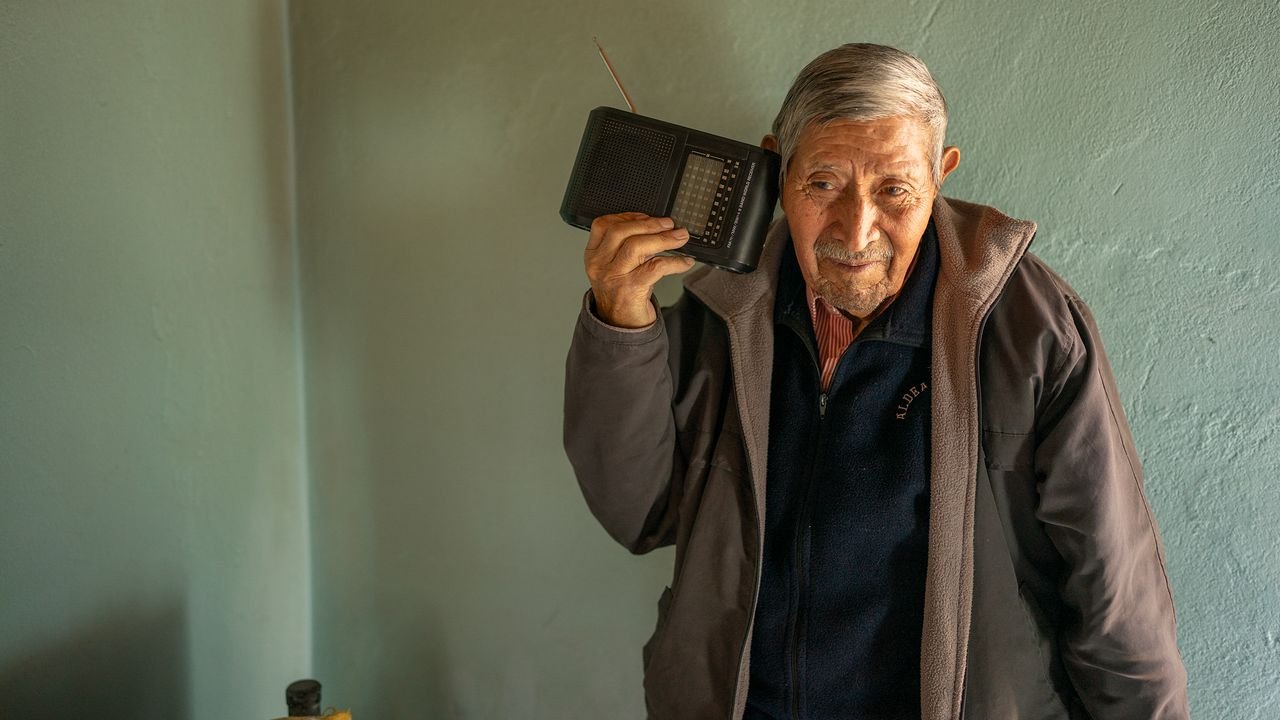
From my home, in New York City, I began tuning in to these broadcasts via online streaming sites. Listening to the messages felt a bit like eavesdropping. Residents across Argentina notified one another of planned visits, and of delays. (“He begs that you wait for him.”) People passed along birthday wishes, condolences, and general saludos. There were many notices about animals that had wandered off—horses, dogs, cows—and it was not unusual to hear, later, that those creatures had been found. I learned from LRA9 Radio Nacional, a station in the southern mountain town of Esquel, of a local hilltop nicknamed La Señal—the Signal—where people know that they can catch cellphone reception in order to submit, or respond to, radio messages. In northern Argentina, people sent radio messages asking their relatives to use an improvised pulley system to hoist their phones, in tin cans, to the tops of trees, in order to get enough wireless connection for a text to go through.
Pereyra had told me that it was not uncommon for gauchos living in outposts like his to hear on the radio that their wives had given birth, or that relatives had fallen seriously ill. I heard messages like these, too. From LU20 Radio Chubut, the largest radio station in the Patagonian province of the same name, I heard, “Inosencio Belisle, in Chubut, is advised that his brother Baldobino is sick and hospitalized in General Roca”—a twelve-hour drive away. A number was provided “if he would like to communicate . . . with his niece Malvina.” I began to recognize certain names that were regularly mentioned on the broadcasts. I listened for “Jorge Pereyra,” but the name never came up.
Since the popularization of broadcast radio, in the nineteen-twenties, people have been experimenting with ways to use the far-reaching signal to send personal messages back and forth. “Radio is one-sided,” Bertolt Brecht lamented in a 1932 essay, “The Radio as an Apparatus of Communication.” “The radio would be the finest possible communication apparatus in public life,” he went on, “if it knew how to receive as well as to transmit, how to let the listener speak as well as hear, how to bring him into a relationship instead of isolating him.” Brecht’s vision, of course, never fully came to pass; the rise of the telephone, among other technologies, basically obviated the need for radio messaging.
Argentina’s Mensajero Rural tradition has few analogues in the modern world, but it has many precursors. Such experiments have tended to thrive in contexts where landline-telephone use was impossible, for reasons of cost, infrastructure, or circumstance. In the seventies, the writer John McPhee, while travelling across Alaska for this magazine, heard of a radio program called “Tundra Topics,” which was basically a Mensajero Rural for isolated Alaskans. The show was, in theory, illegal—the Federal Communications Commission has long defined radio broadcasting as “intended to be received by the public,” rather than by individual listeners.
The Argentinean countryside had the right combination of factors for “radio letters” to take root and persist. Although the Andes form the country’s western border, much of Argentina is flat, particularly in large swaths of Patagonia and the Gran Chaco, allowing AM signals to travel hundreds of miles without obstruction. By the end of the Second World War, half of Argentinean households had a radio—more per capita than some European countries. The practice of airing private messages on broadcast stations in Argentina is believed to have begun in Patagonia, in the late thirties and early forties. Based in the southern cities of Comodoro Rivadavia, Río Gallegos, and Bariloche, these AM stations were controlled by some of the region’s largest landowning families, who, in addition to broadcasting talk shows, news, and music, used the new technology to communicate with their workers out in the fields. The progression to ordinary individuals sharing personal messages seems to have happened by chance. Juan Ignacio Revestido, a professor of communication studies at the University of Patagonia in Esquel and the author of a study about his local station’s Mensajero Rural, told me, “One day, the story goes, a woman delivering a work-related message on behalf of her boss also had a relative she needed to reach, and she asked the operator to slip her personal message into the broadcast.” When others heard it, they wanted to do the same.
As more radio stations opened across the countryside, they established Mensajeros from the beginning, because they were a sure way to create a devoted audience. The format has always been the same: a message is shared with the radio station, and then the host reads it out for all to hear. The service is usually free.



