
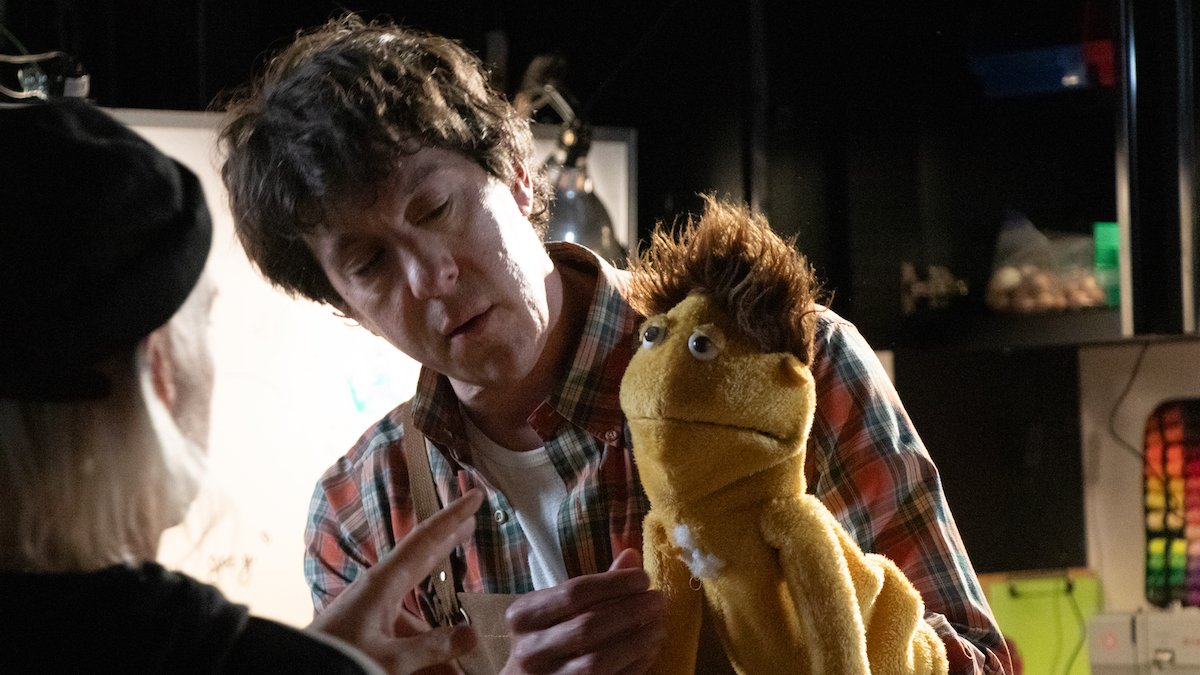
Gregory J.M. Kasunich knew things were working out for his puppet movie, “Meeting Your Maker,” when he forgot that his lead, a troubled puppet named Otis, was firmly under the control of a talented puppeteer named Amanda Maddock.
“Amanda’s performance was so convincing that there were moments on set when I found myself giving direction to Otis instead of Amanda,” says Kasunich.
“Meeting Your Maker” plays Saturday at the 35th edition of the beloved Woods Hole Film Festival in Cape Cod. It’s in a block of short films called Summer Camp, which is focused on stories that prove “the universe is at its best when things get a little weird.”
Things do get weird in “Meeting Your Maker,” a festival-circuit hit. It sneaks up on audiences by starting out farcical, then turning very dark, and ultimately empathetic.
Otis is a puppet who has appeared on nearly 300 episodes of a beloved kids’ show, but feels like he’s lost his way. He rues his failure to get on The Muppet Show, and feels like he’s on a treadmill to nowhere.
Woods Hole is known for films that are both bold and crowd-pleasing, and “Meeting Your Maker” fulfills both those ambitions. We talked with Kasunich, who wrote and directed it, about drawing on some of his own favorite childhood shows to create Otis, using puppets to cope, and casting Jonathan Kite, who both voices Otis and plays his puppeteer.
Gregory Kasunich on ‘Meeting Your Maker’
MovieMaker: How did you come up with the idea of using a puppet to talk about an existential crisis?
Gregory J.M. Kasunich: I’ve always been fascinated by the way puppets help us process difficult ideas. We use them to teach children about bullying, grief, divorce, fear, there is some sort of magic with puppetry that allows us to have conversations or process ideas that we might otherwise avoid.
I also grew up loving puppetry. I’m from Pittsburgh, so I was raised on Mister Rogers’ Neighborhood, and I’ve been a lifelong fan of The Muppets and, more recently, Don’t Hug Me, I’m Scared. Those influences were all swirling around in my head.
I started to think that, hey, if puppets can help children understand life’s biggest questions, what if we tried to do that for issues that a lot of adults are dealing with? So it sort of clicked — what if a depressed and anxious puppet was exploring these existential feelings?
MovieMaker: Otis seems to be abusing alcohol and suicidal, and all his problems seem to come from frustration with a career that’s stalled out. Did you kind of give him mental health diagnosis as you were writing him? He seems depressed in a way that would be cured by getting on the Muppet Show.
Gregory J.M. Kasunich: I never really gave Otis a specific mental health diagnosis. A lot of Otis came from my own lived experience, from working in this industry, and from watching friends and colleagues navigate a moment where so many people feel uncertain about the future. That helplessness can look like depression. That fear of the future can feel like anxiety. Those emotions aren’t unique to artists, they’re something many people experience when they lose sight of why they’re doing what they do. The film feels like it’s about purpose and meaning as much as it’s about navigating these feelings.
I also don’t think Otis’s problems would have been solved by getting on The Muppet Show. We have this tendency to believe that happiness lives just beyond the next milestone: When I get the job, when I win the award, when I finally make it, then I’ll be happy. But external validation is fleeting. I think it’s purpose and community that sustains us.
To me, Otis isn’t really searching for success, he’s searching for meaning. He’s lost his connection to the thing that once gave his life purpose, he does not feel like he matters, and that’s the emotional space I wanted to explore. Whether you’re a puppeteer, a dentist, or whatever, I think we’ve all had moments where we’ve wondered, “Why am I doing this?”

MovieMaker: Can you talk about the logistics of bringing him to life?
Gregory J.M. Kasunich: Bringing Otis to life was probably the most logistically challenging part of making the film. We were creating a character completely from scratch. We started by asking, what is he? Is he an animal? A monster? Something more human? We worked closely with our puppet producer and lead puppeteer, Amanda Maddock, to develop the look of Otis, his size, color, et cetera.
Once we landed on the design we had to be fabricated from the ground up, designed, sewn, rigged, and costumed. Joel Santos contributed to this part of the process. We ended up building multiple Otis puppets for different needs in the film.
When it came to the production, Tristan DeDe and Emily Müller built the set from scratch. The set had to be built at puppet scale and elevated so the performers could work underneath. The puppeteers needed monitors showing a live camera feed so they could see exactly what the audience would see while performing. We built specialized rigs so Otis could throw objects, move naturally through space, Amanda would ride on custom carts and rolling chairs to move otis through the world
The vocal performances added another layer of complexity. Every speaking voice and every song had to be carefully recorded and then dubbed back over the footage, which Austen Moret led. Even the background puppets each had their own individual singing voices, which needed to be recorded as well.
It was an incredibly demanding process, but also one of the most rewarding experiences I’ve ever had as a filmmaker.
MovieMaker: This is one of those movies that you want to immediately watch again to catch things you missed the first time around, once you understand better what’s happening. How hard was it to essentially shoot to different stories at once?
Gregory J.M. Kasunich: From the beginning, from the script phase, this was always the conceit. We always knew where the overlaps would be and what pieces we wanted to fold the two perspectives and two stories together, without giving away too much.
Since we knew we were going to do that from the beginning, it was always built into the design. Every scene had to work from multiple perspectives, so we were constantly thinking through how everything played on multiple levels and just continuing to hold all of that in our heads as we made the film. Producers Derek Tramont and Lee Sacks always had one eye on the script making sure we were tracking the story through the different layers.
We also tried to put a lot of little Easter eggs throughout the movie, certain eye lines, repeated moments, and little hints that point toward the twist without giving it away. My hope is that the film works the first time you watch it, but if you do go back and watch it again, you’re rewarded by seeing all of those little clues and realizing they were there all along.
MovieMaker: How did you find your fantastic lead, Jonathan Kite? And how did comedy forces like Thomas Lennon and the Sklar brothers come aboard?
Gregory J.M. Kasunich: I actually met Jonathan Kite at the Mammoth Film Festival, which is what I love about film festivals, you never know who you’re going to meet or what collaborations are going to come out of those experiences.
After the festival, we stayed in touch, exchanged information, and talked about future projects. Then, a while later, after I finished the script, I started thinking about who could play Otis, and Jonathan immediately came to mind, I knew he was the guy for the part. I just hoped he would say yes. I sent him the script, and he called me right after he read it and said he wanted to do it.
As we continued to develop the project, went into rehearsals, and started talking about who these other characters could be, it was Jonathan who reached out to Thomas Lennon and the Sklar brothers, his peers and colleagues, in the comedy, film, and television world. Between their relationship with Jonathan and how much they responded to the script, they were willing to come on board and share their time and talent with our film, which was incredibly exciting.
MovieMaker: Finally, can you talk a little bit about your rise as a filmmaker, and experience in the worlds of comedy and puppetry?
I think all of the films I make have a little bit of humor in them. I grew up on comedies and was heavily influenced by Abbott and Costello, Charlie Chaplin, Adam McKay, the Farrelly Brothers, and even someone like Yorgos Lanthimos, who has such a darkly comic sensibility. I’m always trying to bring drama into my comedy and comedy into my drama, so my work usually lives somewhere in between.
As far as puppetry goes, I have no formal training, I’ve just always been a fan of it. I’m always looking for interesting, unexpected ways to tell stories. One of my early films was about a man who goes on a date with a cardboard cutout of Marilyn Monroe, and my girlfriend at the time, who’s now my wife, Dr. Anjali Kasunich, was actually the puppeteer bringing that cardboard cutout to life around Los Angeles.
I’ve always been drawn to using surreal ideas to express very human emotions. I made another film called “How to End a Conversation” about a man grieving the loss of his girlfriend who literally carries her around on his shoulders. It was my way of personifying the weight of grief, and somehow it ended up being funny, heartbreaking, and surreal all at once.
I think that’s really my sensibility as a filmmaker. The more I lean into my own feelings, and the stranger and more bizarre my ideas become, the more accepted my work seems to be. It’s always exciting when people connect with the strange way I see the world.
You can learn more about the Woods Hole Film Festival here.
Main image: (L-R) Amanda Maddock, Jonathan Kite and Otis on the set of “Meeting Your Maker.” All photos by Jordyn Moore



