
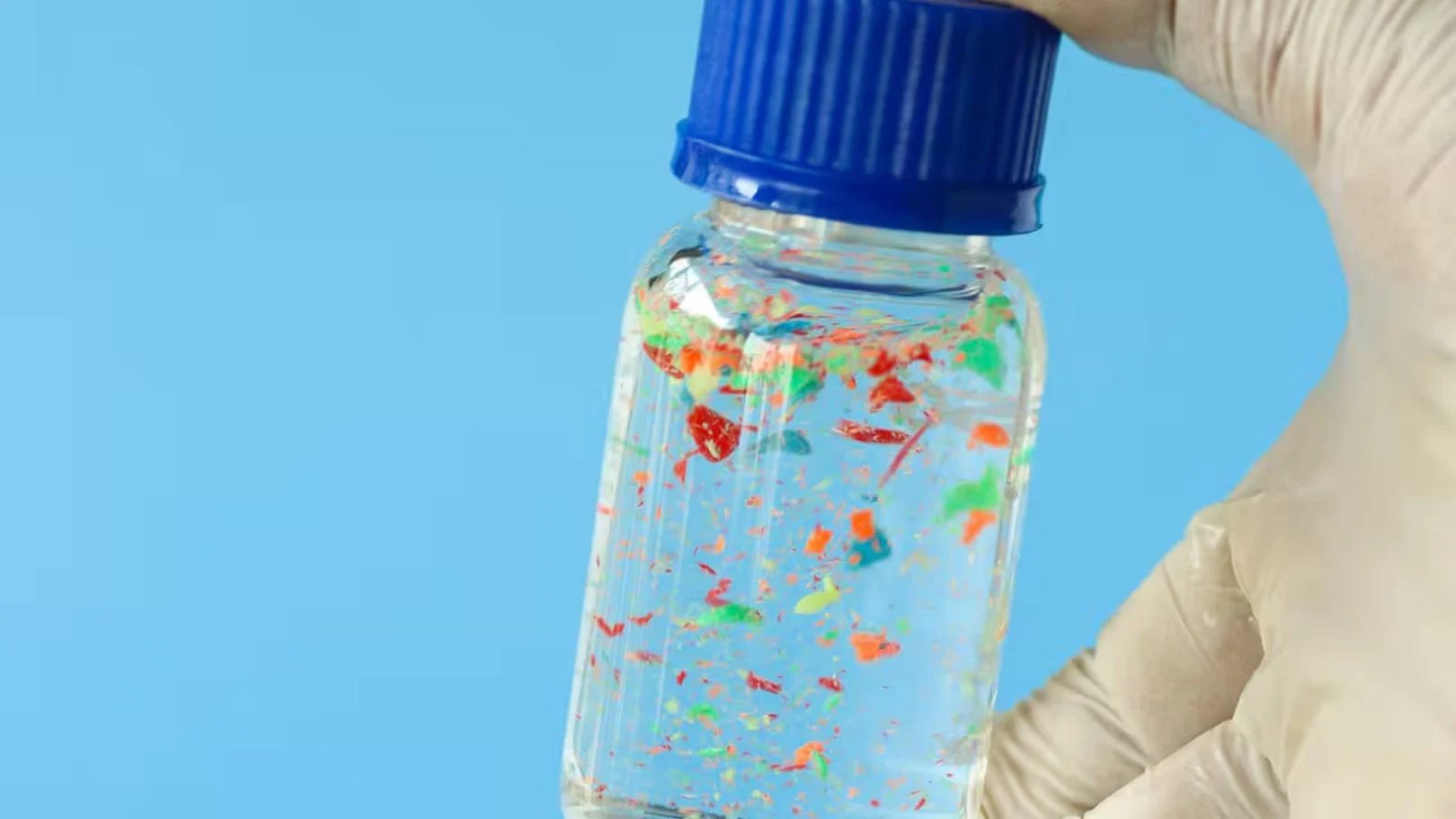
As social media says, microplastics are this generation’s lead and asbestos: useful things that seemed hunky-dory – until they weren’t.
Plastics are ubiquitous because they’re durable, versatile, and apparently stable.
As a result, they occupy our literal hearts and every environment, from the deep sea to ancient rocks. They’ve even created their own invasive-species-addled ecosystem of plastic-consuming plants and animals.
Health concerns are piling up as fast as the plastics, and new evidence suggests that these materials are not inert after all.
It’s a worrying revelation for people who would rather not harbor synthetic shards in their reproductive organs: researchers from Columbia University and the University of California, Berkeley, have demonstrated that microplastics become chemically active in water, catalyzing the creation of DNA-damaging free radicals.
This revelation, just published in the journal Nature, looms large given that our world is covered in water.
And guess what our bodies are mostly made of.
“Our research found that when microplastics interact with water, as they do when they’re in bottled water, or when they’re absorbed into our bloodstream, they spontaneously generate [these] high-energy reactive radicals,” explains first author Naixin Qian, a biotechnology chemist at Columbia University.
The researchers used multiple lab experiments, analytical techniques, and calculations to explore the reactivity of microplastics in water.
Their small size changes their properties:
“As plastic fragments into smaller and smaller particles, its surface area increases enormously,” explains Wei Min, study co-author and head of the biomolecular-dynamics-focused Min group at Columbia University.
“Then microplastics change the water that surrounds them, generating high-energy, reactive radicals that very likely contribute to biological damage that we see in animals and potentially in humans as a result of microplastic exposure.”
The researchers included six lab-grade, powdered common commercial plastics and delved down three lines of chemical evidence to demonstrate the formation of free radicals, specifically those of the hydroxyl type.
Made of oxygen and hydrogen, hydroxyl (OH) free radicals are among the most reactive, toxic types, whose cell-destroying prowess has helped found the booming antioxidant industry – which may not be that effective.
Based on the observations, the free radicals appear to originate from the interface of microplastics and water.
Then, when the researchers introduced lysozyme, a protein found in human bodily fluids like tears, saliva, mucus, and milk, they saw it clumping in a possibly not-so-healthy way; incidentally, protein clumps in the brain drive neurodegenerative diseases.
Adding caffeine acted as a molecular shield, halting this effect because caffeine is an antioxidant. But its protective effects are different in the lab and in the body.
The researchers also tested mouse-derived red blood cells, which were warped and fragmented by the free-radical-producing process.
Overall, the reactivity of microplastics is due to a counterintuitive cause.
The most hydrophobic (water-repelling) microplastics are the most reactive, and it’s exactly due to this fact. As they repel the water, they affect its molecular structure.
This reorganization of water molecules leads to changes in electrostatic forces, which also affect cats and packing peanuts.
In short, dissolved oxygen or hydrogen ions near the hydrophobic plastic surface pick up electrons from the water’s hydroxide ions, turning them into hydroxyl free radicals.
The researchers also mention the sheer number of processes that turn bulk plastics into microplastics.
In addition to industrial processes like (huge surprise) plastics manufacturing, our daily habits flood our fleshy bodies and abodes with microplastics.
Even opening and closing a water bottle abrades its cap.
Even opening and closing a water bottle abrades its cap.
“Various uses and processes in our daily lives can also generate microplastics, including microwave heating, sunlight exposure of bottled water during storage and IV injections in healthcare settings,” says study co-author Beizhan Yan, an environmental geochemist at Columbia Climate School.
“This foundational work provides a potential pathway for understanding their health impacts.”
Yan and other researchers, including co-authors from this work, are now using animal studies to ascertain how plastic particles migrate into fetal tissue during gestation.
The researchers are also exploring some ounce-of-prevention-is-worth-a-pound-of-cure avenues by testing how to reduce our exposures to tiny plastics.
Overall, the situation has sparked federal action: earlier this year the US Department of Health and Human Services (HHS) introduced the $144 million STOMP program to stomp out human-imbued microplastics.

One potential future solution? Changing our plastics, or at least their surfaces, because this work suggests that electrical, physical, and chemical activity happens here.
As Teresa Head-Gordon, a theoretical chemist and head of her eponymous Berkeley lab concludes, this “could ultimately lead to new engineering solutions by redesigning the chemistry of these commodity plastics to reduce the toxic outcomes on health and the environment.”
The research has been published in Nature.
This article was fact-checked by Fiona MacDonald and edited by Fiona MacDonald. While we pride ourselves on our process, we are only human. If you spot a mistake, please let us know.



