
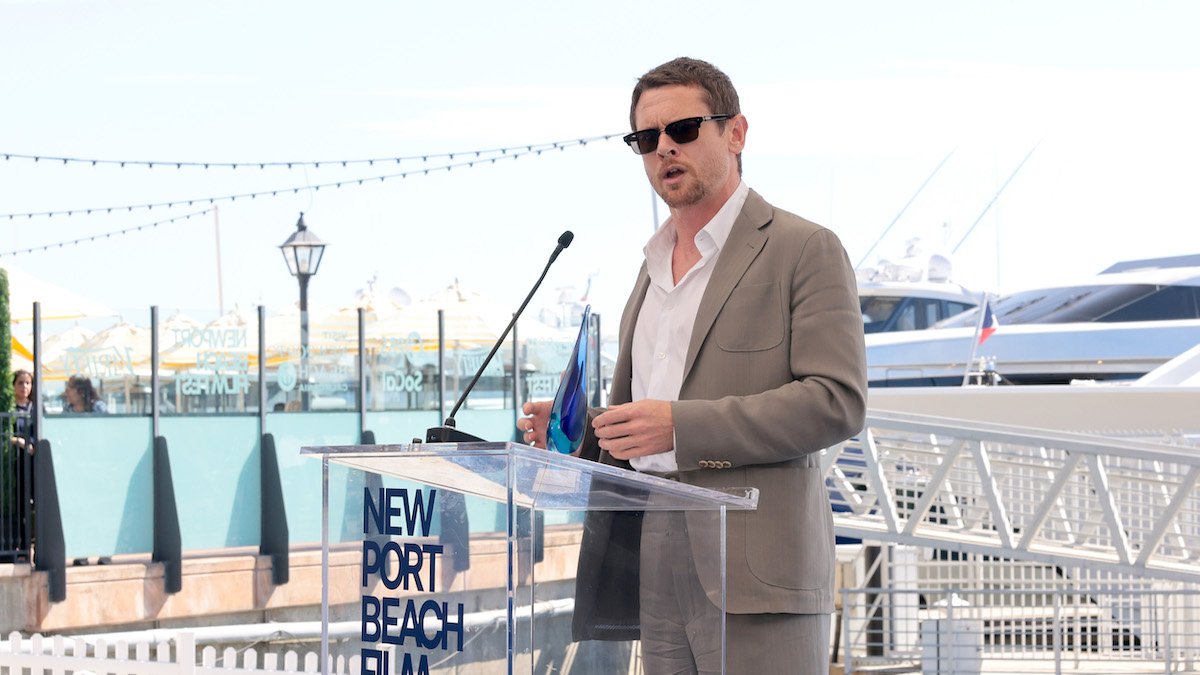
Danny Boyle’s latest film Ink traces the social impact of a capitalistic-driven media through the rise of Rupert Murdoch’s The Sun newspaper in post-war Britain, and leading man Jack O’Connell discussed its deeper impact on the arts after the film screened at the Newport Beach Film Festival on Sunday.
When asked what sparked his accomplished career in front of the camera, the English actor credited Samantha Morton’s Television Workshop, a community training program that catered to children from working-class families. Unfortunately, he lamented, his field is no longer as accessible as it once was.
“It was pure luck, really, that I had somewhere available to me that I could go and exercise this, and that was at the workshop that I trained at,” he said during a Q&A inside Newport Beach’s historic Lido Theater. “We sort of came through there, and it’s a shame really because that workshop was free.”
“We got to go there and we didn’t pay, which is unheard of 1792466871,” he continued. “We got to have this great education, which was mainly just playing and improvising and enjoying being able to swear at each other and not be reprimanded… I found myself very fortunate that I was exposed to that and got to join up with that, and it was a great introduction to the business, a great launchpad.
“We always had Samantha Morton to look up to amongst various other actors, but the reason I said it’s a shame is because it’s not free anymore. Now they had to start charging, which is a real indictment on where things have gotten to in the country I’m from, where this film’s set. Things have definitely gone backward.”
He added: “The access of arts within the community… that seems to be something that is considered dispensable by certain governments.”
Ink Actor Jack O’Connell on Losing One’s Soul
O’Connell plays the film’s anti-hero, Sir Larry Lamb, a newspaper editor that Murdoch hired in 1969 to rebrand The Sun, a failing publication that became the U.K.’s most popular tabloid under his leadership. Though Lamb and Murdoch (played by Guy Pierce) succeeded in dethroning the Daily Mirror as the country’s highest-selling paper, it came at a severe cost, forever damaging the integrity of the news business.
Though The Sun was revolutionary for making news more fun and entertaining by covering topics British journalists used to sneer at, including the then-emerging medium of television, it also catered to humanity’s most basic instincts — sex and violence — while lowering editorial standards that the press had been cautiously guarding up until that point.
The film, written by James Graham, poses a central question: Just because you have the power to publish a story, should you?
Editorial judgement is a key part of upholding the integrity of the news cycle, and Lamb tossed it out the window in the capitalistic pursuit of selling as many papers as possible, forever changing the news business as well as the societal culture it both reflects and shapes.
“Simply put, I think throughout the course of the film he hollows, and there’s like a parting of his soul,” O’Connell said. “And I’m always quite interested in stories about the intoxication of power or newly acquired power. With Larry, he began his career as one thing, and by the time he finished, he was something almost completely irrelevant to what he began as.”
“For me, a lot of this film and Larry’s story within the film is a comment on capitalism and hypercapitalism, because when this story takes place, we’re still in post-war Britain, and the attitude during the war was amazing solidarity within communities. Arguably, the country had never been more connected. There was real community and these guys gradually unpicked that, and we’re going into an age where eventually we get to the [Margaret] Thatcher years, where she starts selling off all of our national assets for capitalism.
“So that really then bled its way into all of our communities in Britain and decimated communities, whole trades, the miners. There was no infrastructure in place before she sold the soul of the country to protect these people. Whole industries, whole workforces just went stale overnight. This film takes place right on the precipice of that, so my take on Larry was that he was a product of that.”
The ever-increasing wealth gap between upper and lower classes has only continued to escalate in the 21st century, impacting the accessibility of a career in film and television, as well.
“Danny professes to have a chip on his shoulder,” said O’Connell, who also worked with Boyle on 28 Years Later and Bone Temple. “If you’re not from London, or there’s not a bit of nepotism, or these things like a spare 20k, it’s nigh impossible. The place I trained is now charging.”
Though there are still channels of access, the actor said, “If you haven’t got 20 grand, you’re sort of scuppered,” using a British slang word that is the American equivalent of screwed.
“It all sort of boils down to this: I really think art should be a birthright,” O’Connell said. “I think it should be accessible. I think we sort of have a responsibility to protect that.”
You can read more about the Newport Beach Film Festival here and read more of our festival coverage here.
Ink arrives in theaters on December 11 before streaming on Netflix.
Main image: Jack O’Connell speaks onstage during the Newport Beach Film Festival Honors at The Balboa Bay Resort on October 18, 2026 in Newport Beach, California. (Photo by Tiffany Rose/Getty Images for Newport Beach Film Festival)



