
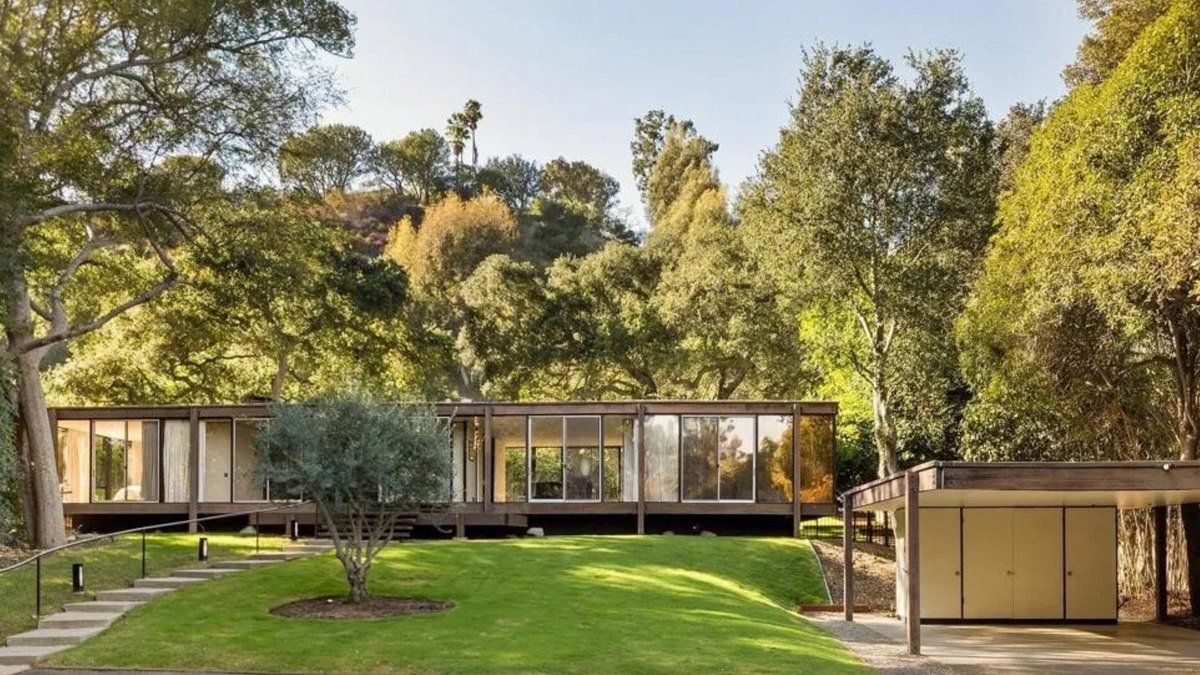
A three-bedroom midcentury modern home designed by Case Study architect Craig Ellwood has just come on the market in Pasadena, CA, for $3.25 million. It features a notable cantilevered glass pavilion.
Built in 1965, the Kubly House was originally constructed for less than $45,000. The 2,227-square-foot home has since been thoughtfully updated.
“What makes this house special is its architecture and design, and how true it has remained to the original,” says Chris Suarez, who is co-listing the property with Kimberly Benz of Suarez + Benz at Compass. “Nothing was significantly altered. Everything done was intended to restore the house to its original condition. The footprint, the floors, the glass—everything has remained true to the original design.”
Located in the Linda Vista neighborhood, the home has an iconic redwood, cantilevered glass pavilion that opens to a single-level floor plan. The private half-acre lot includes a pool and spa surrounded by lush landscaping with eucalyptus and oak trees.
With exposed post-and-beam construction, clean horizontal lines, and expansive walls of glass, the home was designed to give the illusion of floating above its natural surroundings. The deck was recently restored using specially milled wood.
“It was sourced from northern Washington and brought down here,” Suarez notes. “Everything was done painstakingly to avoid altering the house’s integrity, architecture, and design. That being said, significant work has been done, including updates to the roof, infrastructure, air conditioning, and electrical systems. All the major systems have been updated, but you wouldn’t necessarily know it because the work was done so carefully.”
Originally commissioned by ArtCenter College of Design alumni and educators Don and Sally Kubly, the home represents their understanding of design and the culture of the college community. It is still studied in classes there.
“Don was ArtCenter’s first president in Pasadena,” Suarez explains. “There’s also a connection through Craig Ellwood, who designed ArtCenter’s main campus building. The main campus is an incredible steel-and-glass building designed by Ellwood. Don played a significant role in moving the school from Los Angeles to Pasadena, where he served as president for many years. He’s very well known within that community, and this house is significant to the college’s history and culture.”
Based on available architectural records, the Kubly House is said to be Ellwood’s only documented residential project in Pasadena.
After remaining in the Kubly family for nearly six decades, the home changed hands for $3.6 million in 2022. Since then, the sellers have undertaken a preservation-minded restoration with Carl Bronson of Bronstruction, updating major systems to contemporary standards.
“A house that helped usher in much midcentury modernism was the Glass House, designed by Philip Johnson around 1948 or 1949,” Benz notes. “That design was definitely something Ellwood loved. You can clearly see that house’s influence here, which is important because it reveals some of the influences behind Ellwood’s work.”
Benz adds that the home’s design was also influenced by Ellwood’s peers, including midcentury designer George Nelson.
“A furniture plan developed for the house clearly referenced Mies van der Rohe and George Nelson, both important figures in midcentury modern design,” she says. “Even the deck and the steps leading to the house resemble a George Nelson bench. There’s actually a bench built into the concrete wall near the pool that resembles a George Nelson design. I don’t know whether Nelson designed or made it, but the influence is certainly there.”
The house is special because many of the original details have remained intact, she adds.
“You can see the influence of the people Ellwood admired throughout the house,” Benz says. “That significance is what makes this house important when you look at the midcentury modernist movement. All these examples are visible in the house and remain there.”
Some of the built-in furniture has a distinctive style, too.
“There’s a stunning floating credenza that looks like a George Nelson piece,” she notes. “We think it might be one of his designs. It’s in the living room. There’s also a built-in console that might be a George Nelson design as well. So, some of the furniture is actually built into the architecture.”
While some pieces are originals and others are reproductions, Benz says, “the most important thing was following the original plan. The history of this house is everything.”
When staging the home, she says they were “fortunate to discover an original interior design study among the blueprints, plans, and documents that came with the house. We were able to look at that study, and it became a guide and a road map for staging the property. Sourcing the furniture was a challenge because we had to find the specific pieces.”
The city of Pasadena has also identified the property as eligible for individual listing on the National Register of Historic Places.
Get real estate news in your inbox



