
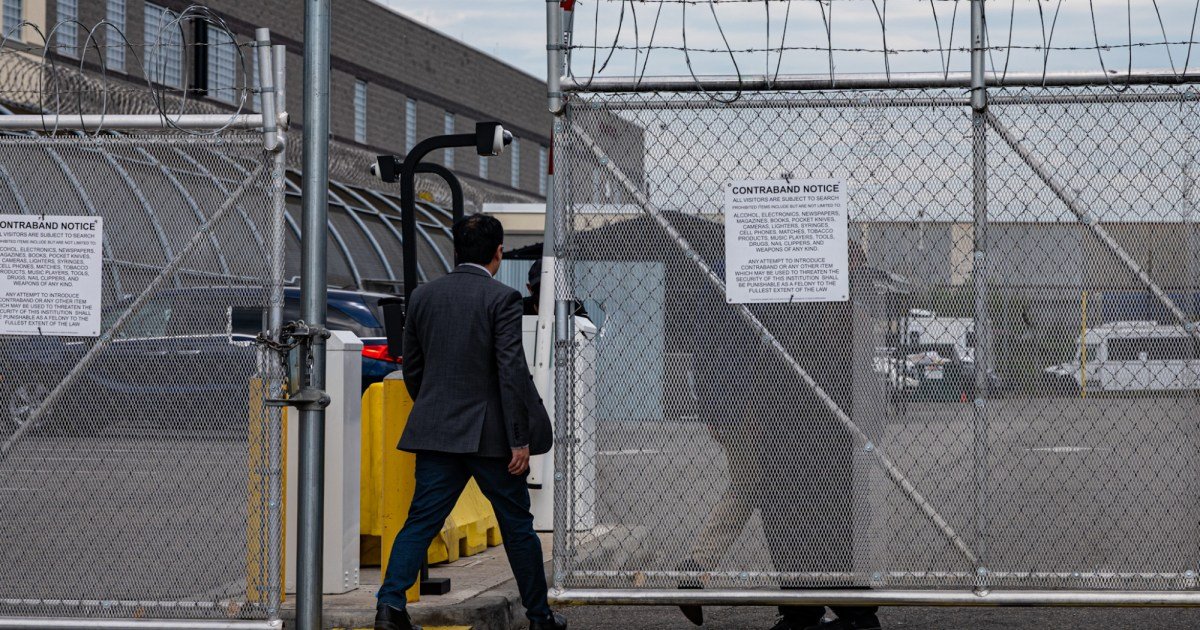
On Saturday, all family visits at ICE’s Delaney Hall detention center were cancelled. Senator Andy Kim made it inside—and found more questions than answers. Tom Hudson/Zuma
Early Saturday morning, a woman whose husband is detained at ICE’s Delaney Hall in Newark, New Jersey, drove nearly two hours to visit him. She was turned away at the gate.
GEO Group—the multibillion-dollar ICE contractor that runs Delaney Hall—had cancelled family visitation for the day. She sat on a curb, cried, and drove home. Throughout the morning, I saw half-a-dozen women and children arrive: all were told they would not be seeing their loved ones that day.
More than two weeks since detainees began a hunger and labor strike inside Delaney Hall—and their allies outside answered with near-daily protests—it’s still incredibly difficult to find out what’s going on inside the facility. Often, family members find their visits rescheduled or canceled, and journalists have not made it in, either.
Members of Congress are allowed by law to conduct unannounced oversight visits to ICE facilities like Delaney. But politicians have been turned away, too. New Jersey congresswoman LaMonica McIver is facing assault charges after she was arrested alongside Newark mayor Ras Baraka trying to conduct an oversight visit last year. New Jersey governor Mikie Sherrill tried to visit the jail in late May, and was denied.
New Jersey Senator Andy Kim was pepper-sprayed when he tried to enter Delaney Hall last month, and as my colleague Alex Nguyen reported, he was forced to directly call Homeland Security Secretary Markwayne Mullin for admittance. Kim returned Saturday morning to try again—and this time, he made it inside.
But even Kim wasn’t able to find out much about the conditions there: “They refused to let me talk to any detainees,” he told me as he exited Delaney Hall.
“They told me that if I were to speak to any detainees, the oversight tour would immediately be cut off and stopped. This is impeding my ability to lawfully do the oversight that I’m legally allowed to do, and I told them I thought this was a deep breach of my responsibilities and what the American people are demanding.”
What he was able to see was disturbing.
As Kim walked past the women’s unit, he said, he saw a group of women frantically waving their arms and pointing at someone curled up on a bed in pain. “They’re just frantic and waving and pointing, and I saw the woman curled up on the bed. I asked, ‘What is happening here?’” The guards, Kim said, didn’t answer. (GEO Group and ICE did not respond to requests for comment.)
“They continue to have only one full-time doctor here for hundreds of detainees, many of whom have significant medical concerns,” Kim said. At this point, there are about 600 people jailed in Delaney Hall, a thousand-bed facility which has faced accusations of inadequate medical care, wormy food and abusive guards.
On his oversight visit, Kim asked the guards why detainees’ video calls are being restricted. “’We’ll get back to you,’” he said the guards replied. He asked after specific detained people, whose families had asked him for help. Again, he said, the guards responded, “’We’ll get back to you.’”
He asked about one detained woman who has been hospitalized for several weeks. “They aren’t telling her family where she is, which hospital she’s in. They’re saying it’s a security problem,” Kim said. Guards told the family to file a Freedom of Information Act request to find out where she is, he said. “Can you imagine if your loved one was in a hospital and you don’t know what hospital they’re in, and then you’re told to just file some bureaucratic papers, and cross your fingers that they’re going to get back to you?”
“That’s the stuff that just pisses me off about this. I was here to get answers for these family members that I talked with earlier today, and I didn’t get them.”
For over a year, a group of volunteers has operated a “radical hospitality” tent outside Delaney Hall—the same tent where medics cared for Kim after he was pepper-sprayed.
On most weekends, when hundreds of family members might come to visit their loved ones, it’s bustling: volunteers distribute water and grocery gift cards, and children play on the rocking horse inside the tent to get some respite from the sun. Diapers, a volunteer told me, are often the most asked-for item.
This Saturday, though, the tent—painstakingly rebuilt after ICE agents reportedly ransacked it days earlier—was nearly empty after visits were cancelled for the day. A few individuals, turned away at Delaney Hall’s gate, stopped for bottled water and directions to the nearest bus stop.
“This is our money going to detain these people, and we’re not getting any answers,” Kim said. “I’m not getting answers on behalf of you, on behalf of other Americans, on behalf of the families of those that are detained. They deserve to have answers, they deserve to have their rights.”



