
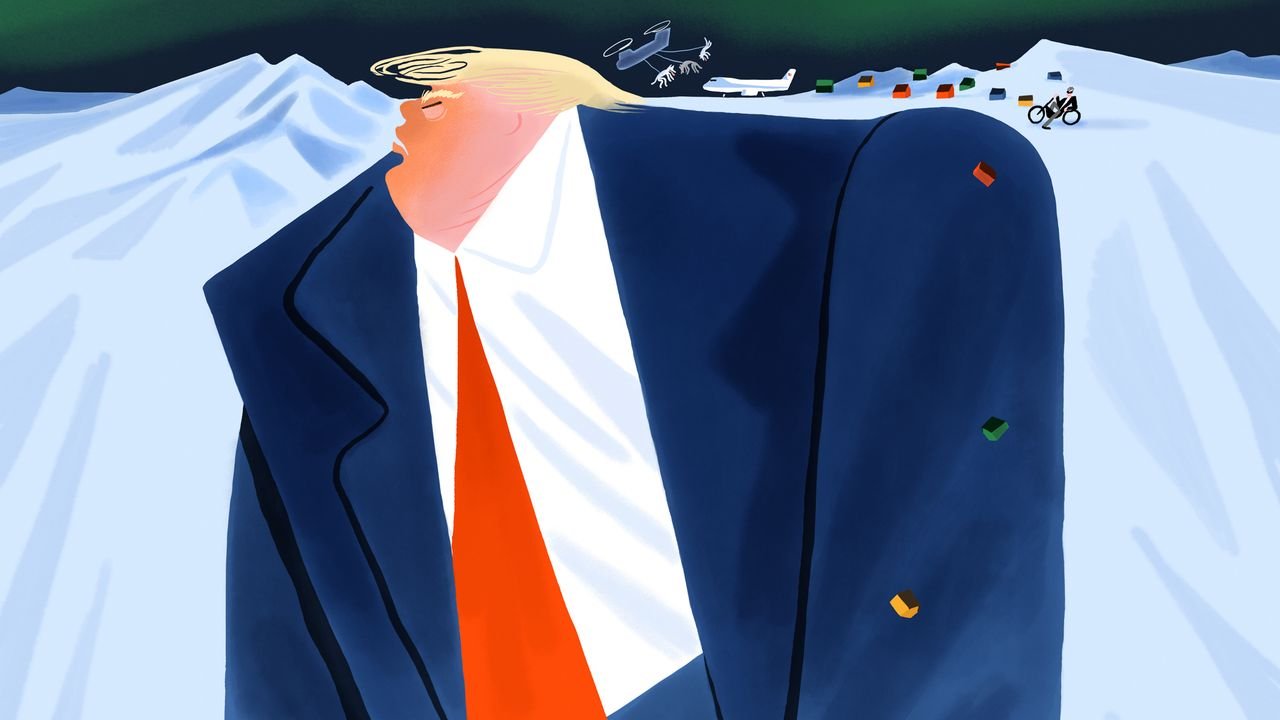
The transatlantic alliance reflected a world that was designed and largely enforced by American power. Now, as American primacy fades, the U.S. government has embraced the predatory world view of its traditional opponents. Firepower matters more than values or alliances, and everything is in play. In December, the Danish Defence Intelligence Service noted that the U.S. has transformed into a nation that “uses economic power, including threats of high tariffs, to enforce its will, and no longer rules out the use of military force, even against allies.” Weeks later, Danish soldiers prepared to blow up Greenlandic runways, in case of a U.S. invasion.
“If the United States chooses to attack another NATO country militarily, then everything comes to an end—including NATO and, with it, the security that has been provided since the end of the Second World War,” Denmark’s Prime Minister, Mette Frederiksen, warned. She later added, “The world order as we know it—that we have been fighting for, for eighty years—is over, and I don’t think it will return.”
Around that time, Trump texted the Prime Minister of Norway, Jonas Gahr Støre; since he had not received the Nobel Peace Prize, he wrote, “I no longer feel an obligation to think purely of Peace.” He then pivoted to Denmark’s claim to Greenland, which predates the founding of the U.S.: “Why do they have a ‘right of ownership’ anyway? There are no written documents, it’s only that a boat landed there hundreds of years ago, but we had boats landing there, also.” The message concluded, “The World is not secure unless we have Complete and Total Control of Greenland.”
During Trump’s first term, “Make America Great Again” primarily meant that the U.S. would withdraw from the world and shield against what he and his supporters perceived as external threats. But in his second term Trump has looked outward. In his Inaugural Address, he pledged to expand U.S. territory and to carry “our flag into new and beautiful horizons.” It is harder to remake what is already America into Trump’s vision of “greatness” than it is to make America merely bigger.
Greenland is the largest island in the world, but it has fewer than fifty-seven thousand residents, who are mostly scattered among settlements and towns along its western coast. Although it belongs to the Kingdom of Denmark, it lies to the west of the Mid-Atlantic Ridge, and is part of North America. The latest articulation of the U.S.’s National Security Strategy, published in November, frames Trump’s imperial ambitions as an extension of the Monroe Doctrine, the assertion by President James Monroe, in 1823, that any attempt by European powers to further colonize the Americas would be treated as “dangerous to our peace and safety.” Under Trump’s leadership, the N.S.S. says, “we will deny non-Hemispheric competitors the ability to position forces or other threatening capabilities, or to own or control strategically vital assets, in our Hemisphere.”
But the elevated language of the N.S.S. obscures the fact that Trump’s pursuit of Greenland has always been in the hands of a few ideologues and opportunists. Along with Cox, the Danish government has identified two other Americans as running private “influence operations” in Greenland: a former venture capitalist and pecan farmer named Tom Dans and a former Army Special Forces commander named Drew Horn, who has sought to dominate Greenland’s rare-earth-mining sector. Both men served in Trump’s first Administration—Dans at the Treasury, Horn in the Office of the Vice-President, the Office of the Director of National Intelligence, and the Departments of Energy and Defense. But the Danish and Greenlandic governments were unaware that, during Trump’s first term, they had also represented their respective agencies on a secret National Security Council task force whose focus was the acquisition of Greenland.
A fourth man, Jørgen Boassen, is one of the very few Greenlanders who loudly support Trump; he spent much of the past year in self-imposed exile, floating between far-right American and European political gatherings, his travel and living expenses covered by American benefactors whom he refuses to identify. And then there is Trump himself, whose stated reasons for coveting Greenland do not stand up to scrutiny—except that he considers it “psychologically important,” as he recently put it to the New York Times, to own the territory rather than merely have military access to it, as the U.S. has had continuously, under a treaty with Denmark, since 1951.



