
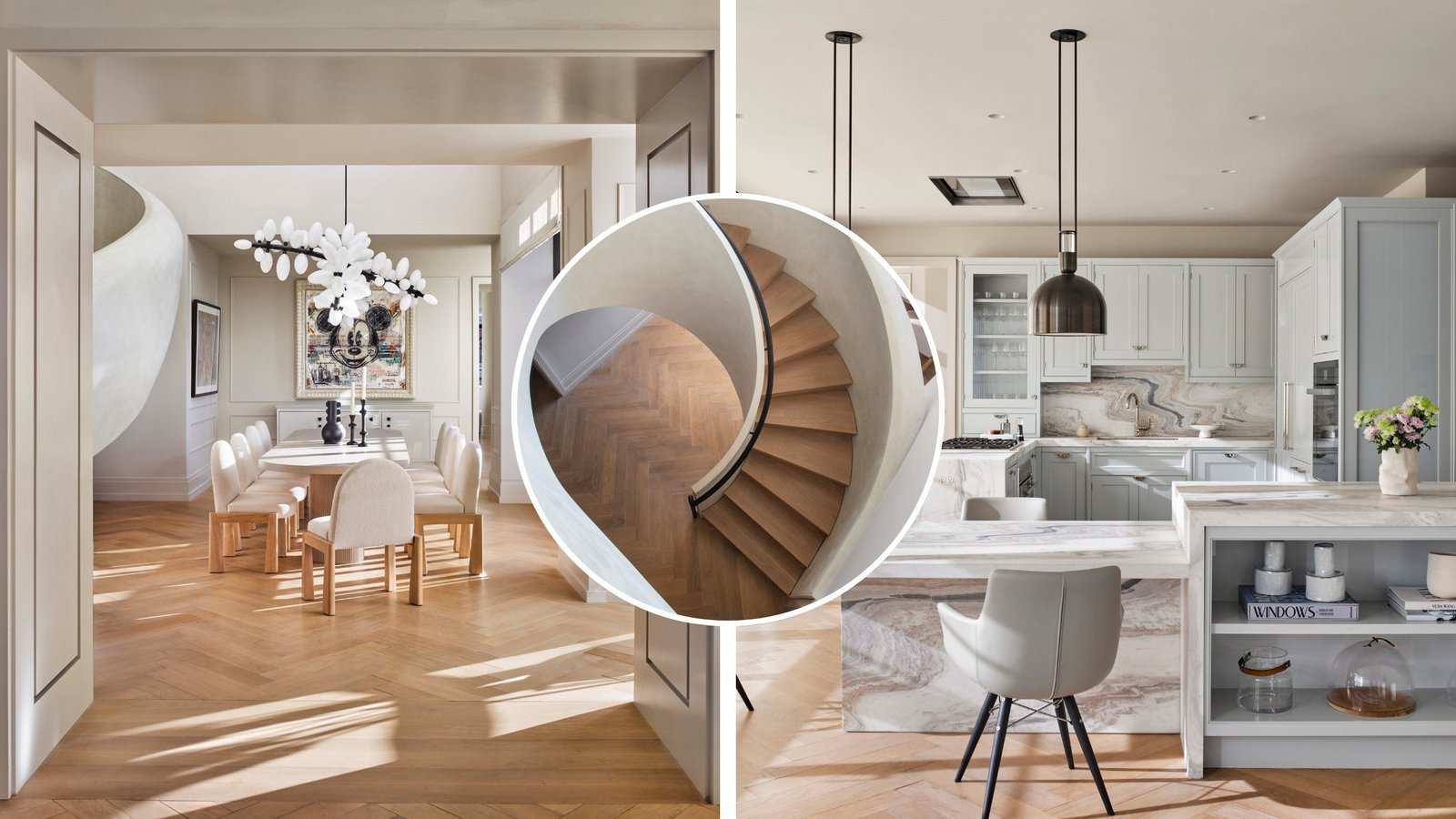
When a 5,840-square-foot duplex penthouse in New York’s exclusive West Village sold last year for $60 million, the real estate world stood up and took notice.
At more than $10,000 per square foot, the sale came in at nearly three times the neighborhood average price per square foot for luxury condos—and represented a 106% increase on the $29 million the owner paid for the apartment in 2016.
The off-market transaction set a new record for the highest-priced apartment in downtown Manhattan, toppling the $59 million benchmark previously set by a Chelsea penthouse.
But what ended as a history-making real estate transaction began with something much simpler: the seller’s desire to overhaul just one element of the property. Its staircase.
Several years ago, interior designer Purvi Padia, founder of REVELRY and owner of the duplex, wanted to set out to redesign her staircase and entryway in order to make it feel more welcoming to guests.
What followed was a two-year, $6 million transformation of the five-bedroom home, which includes 3,207 square feet of exterior terrace space.
The prestigious penthouse, which was previously featured on Netflix’s “Owning Manhattan,” is located on Charles Street, in a 2015 development that made use of the bones of a former warehouse. Its brick façade, industrial grid windows and some of the raw materials were well preserved, and very much in vogue at the time, but Padia felt more warmth and style would add to its livability—and value.
Those involved with the sale believe that the secret to the success of this stylish property resides entirely in its luxury redesign, which not only brought a fresh perspective to the already-lavish abode, but also helped it to stand out as masterpiece of architecture and design.
“The timeless design by The Turett Collaborative (TTC) played a significant role in the record-breaking sale,” seller’s agent Peter Zaitzeff of Serhant explains. “The building’s architecture and refined interiors are defined by an exceptional level of detail. It’s a space that feels both iconic and entirely livable, a combination that resonated with the buyer.”
Unlocking potential: a staircase becomes a catalyst
The Turett Collaborative partner Alex Nizhikhovskiy notes that the residence had all the raw ingredients of a world-class home—soaring ceilings, Hudson River views, generous square footage across two floors—but was finished with builder-grade materials and no overarching design vision.
As Padia requested, they began by reenvisioning the staircase.
“What started with the staircase developed into a full home renovation. The flow, the finishes—all of them needed love,” says Nizhikhovskiy.
Drawing inspiration from British-Indian artist Anish Kapoor’s explorations of volume and organic form, the spiral staircase was conceived as a flowing, undulating counterpoint to the building’s sharp industrial angles.
“The design of the staircase was a response to the building’s industrial sharp angles and grid windows,” explains Nizhikhovskiy.
The staircase would have voluptuous curves and be constructed of matte Venetian plaster, painted steel and white oak herringbone floors that would create a material warmth and transform the double-height stair hall into the emotional heart of the home, he explains.
In fact, staircases have become a “signature intervention” in The Turett Collaborative’s portfolio.
“A staircase is a way to make a unique intervention and a space organizing tool,” Nizhikhovskiy adds. “It is something that the owner experiences on a daily basis.”
Beyond the staircase
Once the staircase was finished, everyone agreed that it was essential to reimagine the rest of the duplex. A reorganized entry space with a proper vestibule, additional closet storage, and a redesigned powder room shifted the experience of arriving home from a simply transactional procedure to a grand and welcoming event.
In addition, deep architectural portals were added throughout the apartment—wide, thick case openings between rooms that frame open vistas down the length of the home, offering views of Lower Manhattan,
“This design feature had a practical use,” Nizhikhovskiy explains, “allowing us to conceal mechanical equipment and ductwork while also making the walls seem intentionally thicker.
“The portals gave each room a distinct feel, providing a balance between a traditional broken-up space and a modern, open, and flowing apartment.”
The primary suite also received meticulous attention. By absorbing an adjacent bedroom and en suite bathroom, the “wing” now features its own study, expansive his-and-hers closets, a secondary entrance. A long hallway within the suite frames a view over the Hudson River on one end, and on the other, a Juliet balcony overlooks the stair hall below, drawing light deep into the interior.
Nizhikhovskiy considers it “likely the largest and nicest primary suite in the building—better than any of the primary suites in the bigger units upstairs.”
In addition, the kitchen was redesigned and upgraded to embrace the views of downtown Manhattan, with large windows flooding the pale blue, marble-clad kitchen with light and warmth, highlighting the luxurious, airy feel of the duplex. Top-of-the-line appliances were also added.
New and elegant flooring, wall tile, and fixtures were added to additional bedrooms and baths.
The dining area was absolutely transformed with a flood of lighting, and the living room received the same sophisticated treatment.
Padia, who served as both the interior designer and the collaborating homeowner throughout the renovation process, was another asset to the project. Her dual role as client and creative produced the kind of seamless coherence that is rarely achieved when those perspectives are separated.
The result was a home where every material choice, from the warmly veined kitchen marble to the matte plaster walls, felt inevitable rather than arbitrary.
The construction was not without its challenges. The project coincided with the height of the COVID-19 pandemic, requiring negotiated protocols and a temporary work stoppage. The steel staircase structure, too large to transport intact to the ninth and 10th floors, had to be brought up the elevator in pieces, with a hoist rigged inside the stair hall to lift and weld each section into place.
Design: a recession-proof asset?
The $60 million sale raises a question that ultrahigh-net-worth buyers are increasingly asking: In a market defined by volatility, is thoughtful architectural design the most durable investment of all?
“Good design and architecture will always stand apart,” Nizhikhovskiy says. “Investing in design expertise is beneficial, particularly from a return on investment perspective, because designers bring a deeper well of knowledge and fresh perspective that complements the views of developers and contractors.”
He goes on to explain, “Architecture is a problem-solving exercise, a skill set we have that doesn’t translate to other disciplines in the same way; where a builder sees a structural challenge and a designer sees an aesthetic one, we have to solve for both.”
The numbers on this off-market transaction seem to prove that that thoughtful design adds to the value of a property in a big way. In essence, a $6 million renovation investment applied to a $29 million acquisition produced a $60 million outcome.
It seems the buyers were not simply purchasing square footage or views. They were investing in a carefully conceived vision—one that balanced the demands of daily living with the sensual beauty of fine art.
Get real estate news in your inbox



