
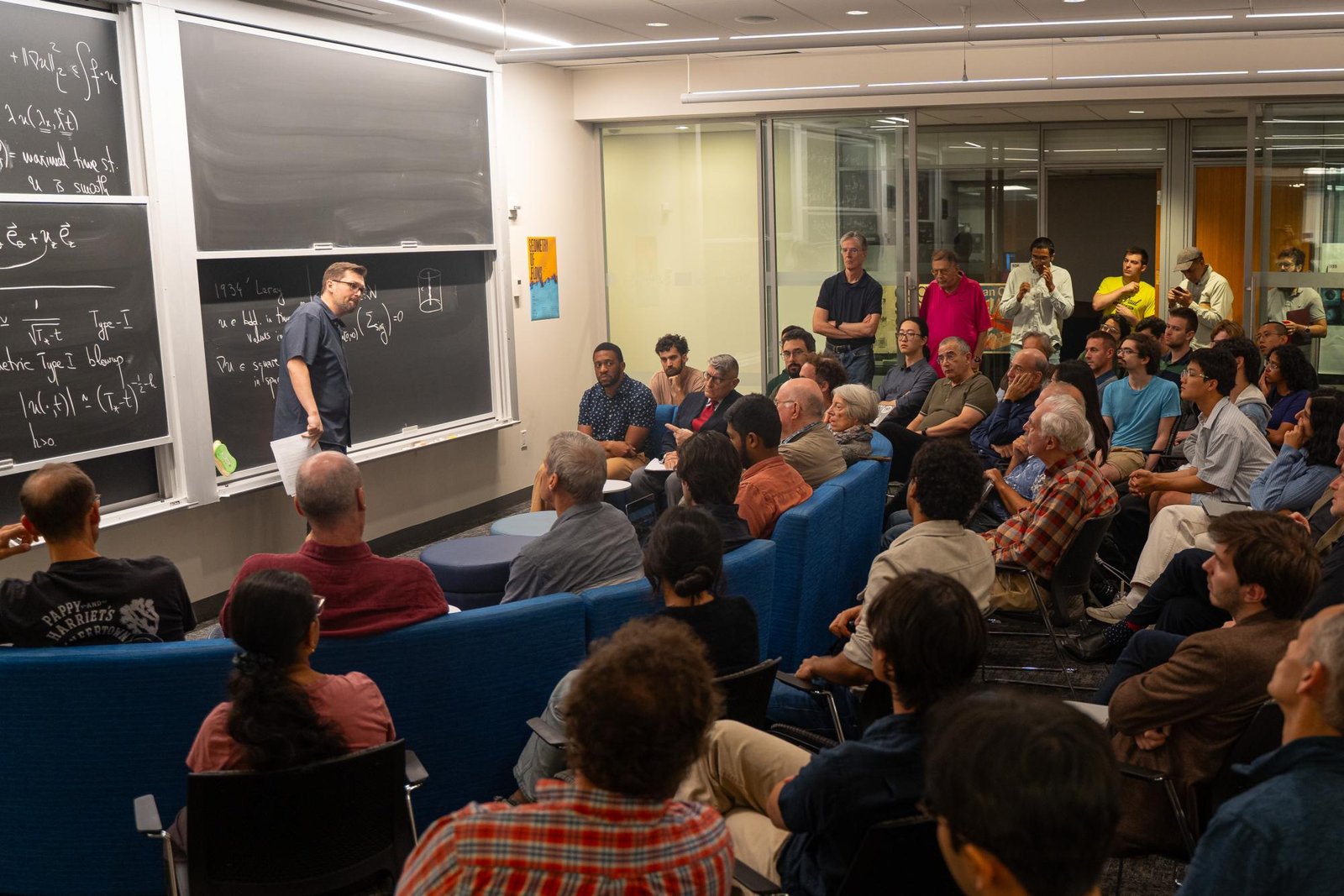
Over 100 NYU faculty and students attended a talk on OpenAI’s recent math proof by Vlad Vicol — chair of NYU’s Department of Mathematics — on Thursday, where he praised the solution’s ingenuity while acknowledging its limitations in the real world.
At the hour-long explainer and Q&A, Vicol walked through the Navier-Stokes existence and smoothness problem. This equation is one of the seven Millennium Prize Problems — questions at the frontier of mathematics put forth by the Clay Mathematics Institute in 2000, each with a $1 million reward for the first correct solution. Navier-Stokes asks whether the equations governing fluids will always produce smooth, physically realistic flows, or if they can mathematically break down by causing fluid to speed up to infinity in a finite amount of time.
After reviewing the proof for a month, Vicol admitted that though he doesn’t fully understand it, he is impressed by the work and the depth of knowledge the artificial intelligence pulled from.
“It is incredibly innovative. The machines are good, they have incredible ideas,” Vicol said in his talk. “It just ate all of mathematics.”
On Sept. 8, OpenAI published its solution, the result of 10,000 concurrent agents operating for 88 hours straight. This result quickly faced controversy after Tristan Buckmaster, a professor of mathematics at NYU, alleged that his unpublished private research using OpenAI’s tools may have been leaked or fed into OpenAI’s training data prior to the breakthrough and incorporated into the company’s proof.
While Vicol declined to comment during the talk on the credit dispute and deferred to Buckmaster’s statement on the situation, he concluded that the solution — despite its innovation — solves the equation under conditions that do not reflect the real world.
“To me this is not satisfactory at all,” Vicol said in reference to OpenAI’s proof. “This kind of construction will never work with a large-scale flow.”
In the talk, Vicol said the proof only works because the researchers added an artificial outside push on the fluid, one that stirs it at a very small scale. Real fluids, and the computer models scientists use to study them, are pushed by large, smooth forces like wind or a spinning paddle, or by nothing at all. Vicol and mathematician Peter Constantin have since proven that under those more realistic conditions, the method behind OpenAI’s proof cannot work.
Tony Wang, a sophomore studying mathematics and physics at NYU, pointed out that the problems with the methodology have a lot to do with the race among OpenAI and competing AI companies to reach a solution first.
“They’re scrambling to try to solve this problem — because it’s a major open problem — without actually understanding what the problem is and what all the math behind this is,” Wang said in an interview with WSN. “That thinking is damaging to how we actually learn things; it’s not how we do things when we solve the math problem.”
During the talk, Vicol pushed back on concerns that AI-generated proofs teach mathematicians less than working through problems slowly, noting that a complicated proof can still be useful, he said, even if it takes people a while to grasp it.
The proof itself was first written in Lean, a programming language that checks every step of an argument against the basic rules of logic. Only after the computer verified the proof was it translated into a paper humans could read.
For Monica Pate, an assistant professor of physics at NYU, that kind of rigid, checkable logic is only half of how science works. The other half, she said, is the creative problem-solving that machines have yet to prove they can do.
“The realm of science is somewhere between being fuzzy and sharp,” Pate told WSN. “It’s a fine line to balance; Humans seem to be doing a really good job of it. The extent to which AI does that is unknown.”
Contact Paige Tang at [email protected].



