
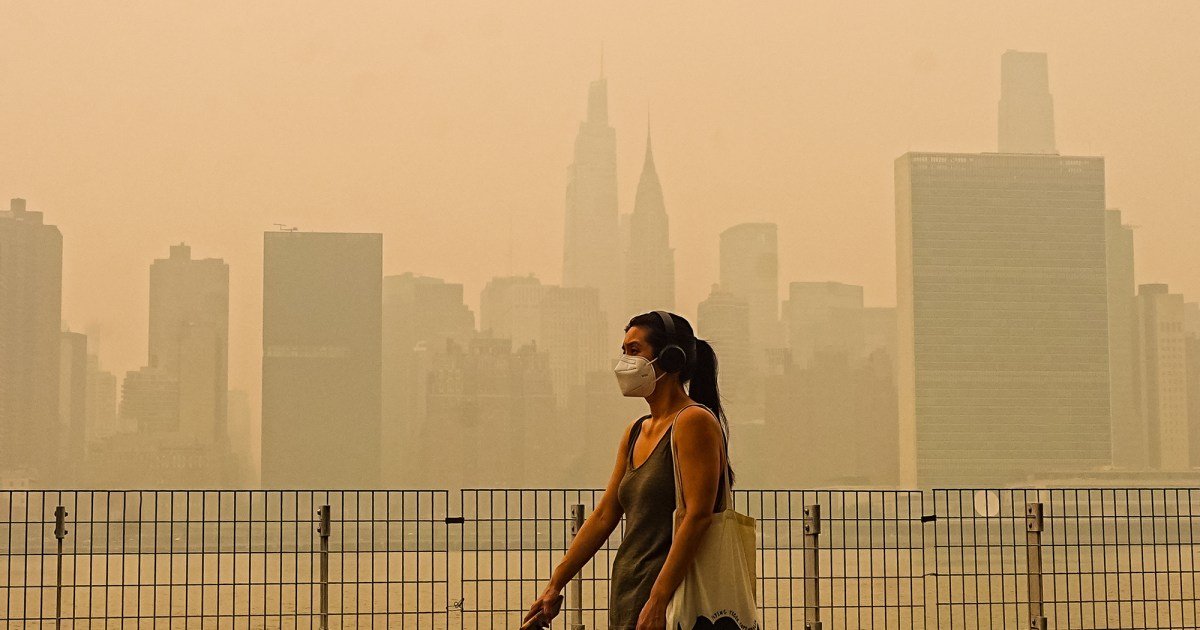
Smoke from massive wildfires in Canada engulfed the New York City skyline, reducing visibility and casting an orange haze over the city. Selcuk Acar/Anadolu/Getty
Deadly heatwaves in May smashed records in the UK, France, Spain, and parts of North Africa. India, Pakistan, and Bangladesh saw April temperatures soar to 113-122 degrees Fahrenheit. A late spring heat dome in the US marked the hottest March on record, and in a 1,000-year July storm, parts of Texas were left reeling after flash flooding killed multiple people. That same month, wildfires in Canada turned skies orange and exposed over 106 million North Americans to hazardous air quality. In the US alone, the catastrophic events of 2026 have killed approximately 17,377 people and cost over $3.2 trillion.
In terms of the sheer scope of heat and extreme weather, 2026 has been a year of climate disasters.
Meanwhile, the fossil fuel industry—by far the greatest contributor to global climate change, accounting for approximately 68 percent of greenhouse gas emissions and almost 90 percent of carbon dioxide emissions—is holding firm. In response to a growing tide of litigation seeking to hold it at least partly responsible for the climate crisis, oil and gas groups and their networks have accelerated their defenses, fighting with their all-too-familiar playbook of discrediting the science linking emissions to extreme weather events such as heatwaves, wildfires, flooding, heavy storms and hurricanes. With the help of the Trump administration and industry partners, oil and gas groups have lodged disinformation campaigns targeting specific studies and even individual climate scientists.
“How can you show proximate causation in injury?” asked Michael Buschbacher, a partner at Boyden Gray PLLC during an October 2025 Federalist Society panel on climate litigation. He has supported industry opposition to renewable energy mandates, state-level climate liability lawsuits, and SEC climate risk disclosure mandates. “Bad weather is of course not new. So how do you show that emissions from company X cause injury Y from a hurricane or whatever?” He then wondered about the consequences of the suits should they be successful. “Will they reduce global carbon emissions, or will it just be a payday for contingency fee lawyers and opportunity for virtue signaling from progressive politicians?”
“There is no level of emissions that does not contribute to changing climate impacts. Every ton matters.”
A new peer-reviewed study published earlier this month in Earth’s Future suggests that it is possible to demonstrate that “emissions from company X cause injury Y.” It also could potentially provide evidence so industry could be forced to answer for climate impacts. The new methodological framework has, for the first time, drawn a straight line from single corporate emitters like Exxon or Chevron, or even whole countries like the United States, to specific heatwaves and areas of extreme rainfall. By running over 150 simulations across 8 different climate models, the study’s author, Christopher Callahan—an Earth systems scientist and assistant professor at Indiana University’s O’Neill School of Public and Environmental Affairs—built a statistical model to figure out the relationship between the amount of carbon dioxide in the atmosphere and the odds of extreme heat or rain. He then used real emissions data to calculate the extent to which specific fossil fuel emitters increased the risk of extreme weather.
The study’s results are clear: “There is no level of emissions that does not contribute to changing climate impacts,” Callahan told me. “Every ton matters.”
The implications of this for an industry struggling to contend with the potential consequences of its actions could be dire. “Climate attribution research seeks to connect greenhouse-gas emissions to specific climate impacts, and increasingly, to particular industries or companies,” wrote Kyle Kohli in Energy In Depth, a blog associated with the Independent Petroleum Association of America. “That makes it especially valuable to climate plaintiffs attempting to overcome one of their biggest legal obstacles: proving causation.”
These new findings are part of a growing field of climate science known as source attribution, which examines “whether we can link an individual extreme climate event to any individual emitter who contributed to that event,” Callahan said. By looking at global extreme heat and at specific events like the 2021 Pacific Northwest heatwave and Pakistan’s extreme rainfall in 2022, for instance, Callahan used climate models to determine what might have taken place without the carbon dioxide released by certain fossil fuel companies and countries. His conclusions were stark: fossil fuel firms increased the likelihood of the 2021 Pacific Northwest heat wave by 31 percent and extreme rainfall in Pakistan in 2022 by 7 percent.
In the past, source attribution studies linked several climate models that were, in Callahan’s words, “computationally difficult,” sometimes taking months to run and requiring vast amounts of computing capacity. “The approach here is attempting to be particularly simple and particularly lightweight,” Callahan explained. Now, by knowing the proportions between climate change and cumulative emissions, he said, researchers can calculate changes to extreme events based on historical emissions. “What this science tells us is that there is a direct relationship between how much an entity emits and…[the] extreme events that alter people’s lives.”
Source attribution is a subset of the larger, well-established attribution science field, which has helped us understand how much climate change is shaping our world by comparing the climate conditions we face today to a hypothetical Earth devoid of human influence. In 2004, for example, a team of scientists found that human influence doubled the risk of the 2003 heatwave that had swept Europe. But source attribution helps answer more granular questions about what specific actions are having what specific effect.
For over half a century, industry has known of and misled the public about its role in human-caused planetary warming, deliberately sowing doubt to undermine scientific evidence. Now oil and gas groups are facing a wave of lawsuits. Over 40 cases in the United States filed by states, municipalities, and tribal governments have been brought against Big Oil since 2017. At least five of these lawsuits have entered the discovery phase—marking a turning point that could force oil executives to hand over key documents and testify under oath on what they knew about climate change and when they knew it. Grist reported in July that the American Petroleum Institute, the largest oil lobbying group, stated that one of its top priorities for 2026 was to “stop extreme climate liability policy.”
Callahan has no illusions about how his research fits into the current legal and political climate, describing it as “a pretty live question in conversations around climate liability lawsuits.” But how will attribution science play out in a legal context? Some experts argue that it will “‘[rock] the courtroom,” while others say key decisions will most likely hinge on legal issues rather than the science itself. “Our responsibility as scientists,” Callahan said, “is not to never do science that is relevant to the political conversation. We should follow the results of our questions wherever they lead and report them regardless of what they are.”
In recent years, industry has cast doubt on plaintiffs’ use of attribution science in the courtroom. “They have an attribution theory, but that’s just a crude measure of how much oil and gas companies sold,” said Chevron lawyer Theodore J. Boutrous Jr., in a 2024 litigation webinar, “but that doesn’t tell you anything about anything.” A recent National Academies of Sciences, Engineering, and Medicine report has inflamed that debate. A June investigation by Politico revealed a secret opposition campaign waged by oil industry allies to discredit the report’s findings. The campaign came just months after Republican attorneys general successfully forced the removal of a NAS climate sciences chapter from a reference manual for federal judges, which the Academies officially pulled earlier this month. A NASA scientist who asked to remain anonymous called the academy’s decision to pull the chapter “pathetic. If they cannot stand up for science, then who is going to?”
But the scientific consensus on the NAS extreme weather report is aligned. “I thought it was a great report,” said Michael Mann, a University of Pennsylvania climate scientist. “It didn’t pull any punches.” Others, like Kristina Dahl, a climate scientist and vice president for science at Climate Central, said the report was “a really excellent roundup of the state of the science.”
Reports like the Academies’ extreme weather event attribution study and Callahan’s research on emitter impacts help illustrate how far the field has come. “We all live in a world that’s been shaped by a fossil fuel-based economy,” Dahl said, “so I think studies like this can shed light on why we are where we are, and why we have the range of choices available to us that we have, and can also give us a sense of how different the world would be.”
Kim Cobb, an expert in observational climate studies at Brown University, says we’re gaining something “extremely valuable” in Callahan’s study. “This would have been a pipe dream 10 years ago; it simply wouldn’t be possible.” For Jim Hurrell, the chair of the Academies’ NAS report and a professor of atmospheric science at Colorado State University, there’s lots of room for advancement in the field, and that’s what excites him most. “This science could be really useful to help communities plan for the future,” he said.
Separating the future of attribution science from the politicization attached to it has proved to be impossible recently. The Trump administration’s cuts to funding for scientific programs, monitoring systems, and scientific personnel, alongside ongoing industry attacks, will continue to affect the field’s advancement. In the end, Yann Quilcaille, a climate scientist from ETH Zürich noted, “We need to act quickly, and we have the solutions.”



