
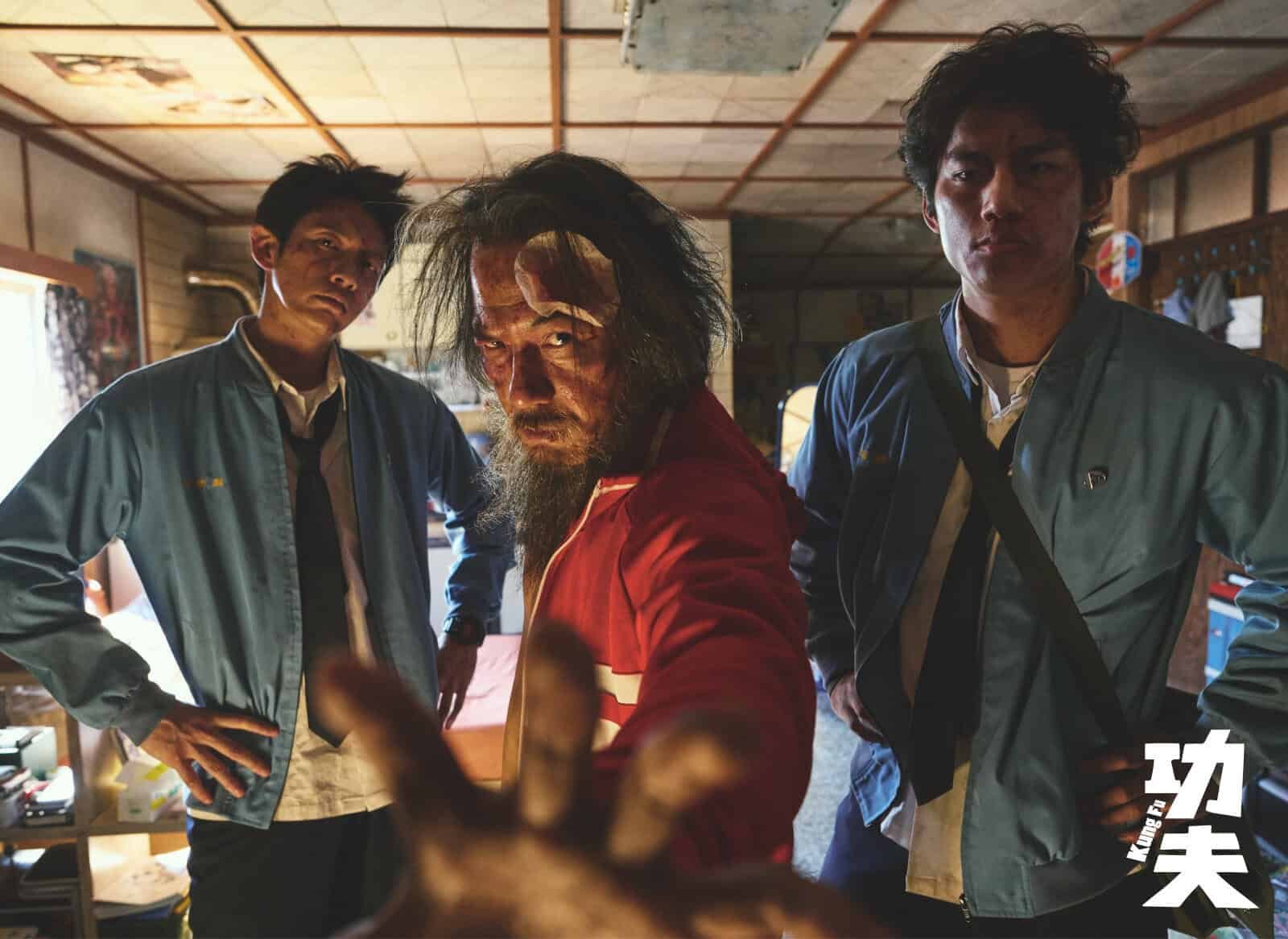
Adapted from a story that Giddens Ko published in 2001, “Kung Fu” concludes a project that spent well over a decade struggling toward the screen. Announced in an earlier form in 2013, suspended the following year and eventually revived, it was mounted on a reported budget approaching NT$300 million. Its scale is evident in more than 1,600 visual effects shots and the participation of Taiwan’s WWWind studio alongside the Korean Triple A action team. After competing at the Udine Far East Film Festival, the picture is scheduled to have its US premiere at the New York Asian Film Festival on July 23, 2026. It has also received five 2026 Taipei Film Awards nominations, including Best Supporting Actor for Berant Zhu and recognition for costumes, art direction, visual effects and technical achievement
Yuan is an unfortunate high school student whose home life is hardly ideal. After attempting to help a homeless man, he discovers that the apparently deranged vagrant is Huang Jun, a martial arts master who claims to have slept for 500 years. Huang appears outside Yuan’s elevated bedroom window and demands that the teenager accept him as his master. Yuan recruits his best friend Ah-yi, while their classmate Yi-jing eventually joins them. Their training allows the trio to leap across buildings, channel qi and punish local criminals. However, Huang’s former fellow disciple Lan Jin is supposedly returning, bringing an old conflict involving their master, a forbidden technique and a betrayal that has survived for centuries.
Ko initially embraces the material as a knowingly juvenile urban wuxia. The opening references “Fist of Fury” and “Once Upon a Time in China II”, before ticking off nearly every familiar genre element. There is the dishevelled, ridiculous-looking master who proves impossibly powerful, extended training passages, concealed techniques, the legendary final move and disciples of one teacher who become mortal enemies. “Kung Fu” clearly comes from genuine affection for martial arts cinema, and transplanting these conventions into contemporary Taiwan gives its first half considerable energy.
At the same time, Ko’s obsession with arrested adolescence remains both a defining characteristic and a major weakness. Romance, fantasy, violence and schoolboy humour are thrown together with little concern for tonal elegance. Yuan catches his mother having sex with Uncle Wang, Ah-yi openly moons over Yi-jing’s mother, and references along the lines of “Master of Cocksucker” appear as though vulgarity alone were enough to generate comedy. Some jokes amuse through their shamelessness, but their frequency gradually becomes exhausting. They also reduce characters who might have acquired emotional weight to vehicles for another crude punchline.
More interesting is the treatment of belief. Yuan and Ah-yi initially use their abilities like teenagers playing superheroes, intoxicated by the chance to punish bullies and protect ordinary people. Their master’s stories offer them a complete mythology: good and evil exist, justice can be delivered with one’s fists, and faith can unlock impossible strength. Ko then attempts to dismantle that certainty. The narrative veers away from straightforward fantasy and toward psychological horror, institutional abuse and questions concerning whether heroic myths are liberating fictions or dangerous delusions. This reversal recalls the darker tendencies that made “Mon Mon Mon Monsters” so effective.
Nevertheless, “Kung Fu” does not know when to stop. Every revelation is followed by another, each twist overturns the previous one, and the finale eventually enters full blown absurdity. What begins as an intriguing reconfiguration of wuxia mythology becomes an accumulation of split identities, conspiracies, reversals and sentimental resolutions. The movie tries to preserve every possible interpretation instead of committing to its strongest one. A measure of restraint would have allowed the central idea about belief to resonate far more powerfully. At the same time, the comments about corruption are here once more, in an element that seems to have a become a staple of local productions, but in this case, looking somewhat forced in the narrative.
The technical execution is similarly divided between ambition and excess. The rooftop movement, qi attacks and large scale confrontations possess a momentum rarely seen in contemporary Taiwanese commercial cinema. The sound design gives each release of energy a heavy, bass driven impact, while the camera finds dynamic angles for bodies moving through the city. However, the visual effects often become too glossy and animation-like, depriving the action of the tactile pleasure associated with classic kung fu. The editing is propulsive during the training and early battles, but becomes increasingly frantic once the twists begin, contributing to the sense that several movies are fighting for control.
The performances follow Ko’s maximalist direction. Kai Ko remains convincing as a teenager and gives Yuan an appealing mixture of insecurity and enthusiasm. Berant Zhu is more entertaining as the shameless Ah-yi, while Gingle Wang willingly participates in the broad comedy. Leon Dai and Liu Kuan-ting bring presence and eccentricity to the opposing masters, although nearly everyone performs excessively. This suits the parody and exaggerated wuxia passages, but weakens scenes that would have been better if drama was the main component.
“Kung Fu” is technically ambitious, energetic and occasionally very funny. Its affection for wuxia is undeniable, as is Ko’s commitment to bringing his adolescent fantasies to the screen on the largest possible scale. Yet the vulgar humour, excessive acting and preposterous succession of twists leave it far less affecting than intended. There is an enjoyable modern martial arts adventure buried inside, but a more disciplined approach would have known which excesses to cut. In the end though, it is definitely fun.



