
Hernaez, R. et al. Prevalence and short-term mortality of acute-on-chronic liver failure: a national cohort study from the USA. J. Hepatol. 70, 639–647 (2019).
Allen, A. M. et al. Time trends in the health care burden and mortality of acute on chronic liver failure in the United States. Hepatology 64, 2165–2172 (2016).
Agarwal, B. et al. Randomized, controlled clinical trial of the DIALIVE liver dialysis device versus standard of care in patients with acute-on-chronic liver failure. J. Hepatol. 79, 79–92 (2023).
Burke, L. et al. Plasma exchange does not improve overall survival in patients with acute liver failure in a real-world cohort. J. Hepatol. 82, 615–621 (2025).
Demetriou, A. A. et al. Prospective, randomized, multicenter, controlled trial of a bioartificial liver in treating acute liver failure. Ann. Surg. 239, 660–667 (2004).
Pascher, A., Sauer, I. M., Hammer, C., Gerlach, J. C. & Neuhaus, P. Extracorporeal liver perfusion as hepatic assist in acute liver failure: a review of world experience. Xenotransplantation 9, 309–324 (2002).
Czigany, Z. et al. Bridging therapies-ex vivo liver xenoperfusion and the role of machine perfusion: an update. Xenotransplantation 32, e70011 (2025).
Feng, S., Roll, G. R., Rouhani, F. J. & Sanchez Fueyo, A. The future of liver transplantation. Hepatology 80, 674–697 (2024).
Montgomery, R. A. et al. Physiology and immunology of a pig-to-human decedent kidney xenotransplant. Nature 650, 218–229 (2026).
Montgomery, R. A. et al. Results of two cases of pig-to-human kidney xenotransplantation. N. Engl. J. Med. 386, 1889–1898 (2022).
Moazami, N. et al. Pig-to-human heart xenotransplantation in two recently deceased human recipients. Nat. Med. 29, 1989–1997 (2023).
Porrett, P. M. et al. First clinical-grade porcine kidney xenotransplant using a human decedent model. Am. J. Transplant. 22, 1037–1053 (2022).
Griffith, B. P. et al. Genetically modified porcine-to-human cardiac xenotransplantation. N. Engl. J. Med. 387, 35–44 (2022).
Kawai, T. et al. Xenotransplantation of a porcine kidney for end-stage kidney disease. N. Engl. J. Med. 392, 1933–1940 (2025).
He, J. et al. Pig-to-human lung xenotransplantation into a brain-dead recipient. Nat. Med. https://doi.org/10.1038/s41591-025-03861-x (2025).
Schmauch, E. et al. Multi-omics analysis of a pig-to-human decedent kidney xenotransplant. Nature https://doi.org/10.1038/s41586-025-09846-7 (2025).
Ribas, G. T. et al. Immune profiling in a living human recipient of a gene-edited pig kidney. Nat. Med. 32, 270–280 (2026).
Shirini, K. & Meier, R. P. H. Systematic review and comparative outcomes analysis of NHP liver allotransplants and xenotransplants. Xenotransplantation 32, e70017 (2025).
Tao, K.-S. et al. Gene-modified pig-to-human liver xenotransplantation. Nature 641, 1029–1036 (2025).
Zhang, W. et al. Genetically engineered pig-to-human liver xenotransplantation. J. Hepatol. 84, 587–598 (2026).
Tønnesen, K. Cross-circulation in experimental hepatic failure in the pig. Liver 6, 262–267 (1986).
Wu, W. K. et al. Xenogeneic cross-circulation for physiological support and recovery of ex vivo human livers. Hepatology 78, 820–834 (2023).
Anand, R. P. et al. Design and testing of a humanized porcine donor for xenotransplantation. Nature 622, 393–401 (2023).
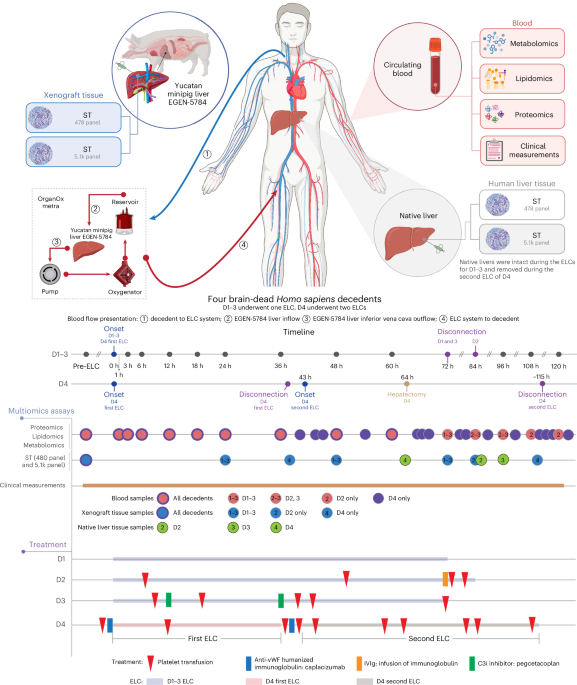
Shaked, A. et al. Extracorporeal liver cross-circulation using transgenic xenogeneic pig livers with brain-dead human decedents. Nat. Med. https://doi.org/10.1038/s41591-025-04196-3 (2026).
Schüssler-Fiorenza Rose, S. M. et al. A longitudinal big data approach for precision health. Nat. Med. 25, 792–804 (2019).
Shaked, A. et al. An ectopically expressed serum miRNA signature is prognostic, diagnostic, and biologically related to liver allograft rejection. Hepatology 65, 269–280 (2017).
Piening, B. D. et al. Whole transcriptome profiling of prospective endomyocardial biopsies reveals prognostic and diagnostic signatures of cardiac allograft rejection. J. Heart Lung Transplant. 41, 840–848 (2022).
Schmauch, E. et al. Integrative multi-omics profiling in human decedents receiving pig heart xenografts. Nat. Med. 30, 1448–1460 (2024).
Pan, W. et al. Cellular dynamics in pig-to-human kidney xenotransplantation. Med 5, 1016–1029 (2024).
Piening, B. D. et al. Integrative personal omics profiles during periods of weight gain and loss. Cell Syst. 6, 157–170 (2018).
Ricklin, D. & Lambris, J. D. Complement in immune and inflammatory disorders: therapeutic interventions. J. Immunol.190, 3839–3847 (2013).
Thorgersen, E. B. et al. The role of complement in liver injury, regeneration, and transplantation. Hepatology 70, 725–736 (2019).
Burlak, C. et al. The fate of human platelets perfused through the pig liver: implications for xenotransplantation. Xenotransplantation 17, 350–361 (2010).
Xiao, X., Nie, Y. & Leng, Y. Asialoglycoprotein receptor 1: a multifaceted receptor in the liver and cardiovascular system. Front. Med. 12, 1653452 (2025).
Tao, K.-S. et al. Immune cell landscape in a human decedent receiving a pig liver xenograft. Nat. Med. 31, 2611–2621 (2025).
Takahashi, K., Nagai, S., Safwan, M., Liang, C. & Ohkohchi, N. Thrombocytopenia after liver transplantation: should we care?. World J. Gastroenterol. 24, 1386–1397 (2018).
Shah, J. A. et al. Prolonged survival following pig-to-primate liver xenotransplantation utilizing exogenous coagulation factors and costimulation blockade. Am. J. Transplant. 17, 2178–2185 (2017).
Andrijevic, D. et al. Cellular recovery after prolonged warm ischaemia of the whole body. Nature 608, 405–412 (2022).
Mazzucato, M., De Marco, L., Pradella, P., Masotti, A. & Pareti, F. I. Porcine von Willebrand factor binding to human platelet GPIb induces transmembrane calcium influx. Thromb. Haemost. 75, 655–660 (1996).
Gaca, J. G. et al. The role of the porcine von Willebrand factor: baboon platelet interactions in pulmonary xenotransplantation. Transplantation 74, 1596–1603 (2002).
Connolly, M. R. et al. Humanized von Willebrand factor reduces platelet sequestration in ex vivo and in vivo xenotransplant models. Xenotransplantation 28, e12712 (2021).
Zhao, L. et al. Graft-derived VWF drives platelet activation and thrombocytopenia during porcine liver xenotransplantation to brain-dead human recipients. J. Clin. Invest. 136, e200800 (2026).
Merten, M. & Thiagarajan, P. P-selectin expression on platelets determines size and stability of platelet aggregates. Circulation 102, 1931–1936 (2000).
Frenette, P. S., Johnson, R. C., Hynes, R. O. & Wagner, D. D. Platelets roll on stimulated endothelium in vivo: an interaction mediated by endothelial P-selectin. Proc. Natl Acad. Sci. USA 92, 7450–7454 (1995).
Larsen, E. et al. PADGEM protein: a receptor that mediates the interaction of activated platelets with neutrophils and monocytes. Cell 59, 305–312 (1989).
Lee, H. T. et al. High-resolution structure of the vWF A1 domain in complex with caplacizumab, the first nanobody-based medicine for treating acquired TTP. Biochem. Biophys. Res. Commun. 567, 49–55 (2021).
Akiyama, M., Takeda, S., Kokame, K., Takagi, J. & Miyata, T. Crystal structures of the noncatalytic domains of ADAMTS13 reveal multiple discontinuous exosites for von Willebrand factor. Proc. Natl Acad. Sci. USA 106, 19274–19279 (2009).
Lenting, P. J., Christophe, O. D. & Denis, C. V. von Willebrand factor biosynthesis, secretion, and clearance: connecting the far ends. Blood 125, 2019–2028 (2015).
Grafals, M. & Thurman, J. M. The role of complement in organ transplantation. Front. Immunol. 10, 2380 (2019).
Mullard, A. First approval of a complement C3 inhibitor opens up autoimmune and inflammatory opportunities. Nat. Rev. Drug Discov. 20, 496 (2021).
Rother, R. P., Rollins, S. A., Mojcik, C. F., Brodsky, R. A. & Bell, L. Discovery and development of the complement inhibitor eculizumab for the treatment of paroxysmal nocturnal hemoglobinuria. Nat. Biotechnol. 25, 1256–1264 (2007).
Kaltenmeier, C. et al. Role of immuno-inflammatory signals in liver ischemia–reperfusion injury. Cells 11, 2222 (2022).
Lamers, C. et al. Insight into mode-of-action and structural determinants of the compstatin family of clinical complement inhibitors. Nat. Commun. 13, 5519 (2022).
Fosbury, E., Drebes, A., Riddell, A. & Chowdary, P. Review of recombinant anti-haemophilic porcine sequence factor VIII in adults with acquired haemophilia A. Ther. Adv. Hematol. 8, 263–272 (2017).
Van De Poll, M. C. G. et al. Intestinal and hepatic metabolism of glutamine and citrulline in humans. J. Physiol. 581, 819–827 (2007).
Bernal, W. Lactate is important in determining prognosis in acute liver failure. J. Hepatol. 53, 209–210 (2010).
Neinast, M., Murashige, D. & Arany, Z. Branched chain amino acids. Annu. Rev. Physiol. 81, 139–164 (2019).
Kaabia, Z. et al. Plasma lipidomic analysis reveals strong similarities between lipid fingerprints in human, hamster and mouse compared to other animal species. Sci Rep. 8, 15893 (2018).
Yin, W. et al. Plasma lipid profiling across species for the identification of optimal animal models of human dyslipidemia. J. Lipid Res. 53, 51–65 (2012).
Ghadir, M. R., Riahin, A. A., Havaspour, A., Nooranipour, M. & Habibinejad, A. A. The relationship between lipid profile and severity of liver damage in cirrhotic patients. Hepat. Mon. 10, 285–288 (2010).
Janesick, A. et al. High resolution mapping of the tumor microenvironment using integrated single-cell, spatial and in situ analysis. Nat. Commun. 14, 8353 (2023).
Palla, G. et al. Squidpy: a scalable framework for spatial omics analysis. Nat. Methods 19, 171–178 (2022).
Wolf, F. A., Angerer, P. & Theis, F. J. SCANPY: large-scale single-cell gene expression data analysis. Genome Biol. 19, 15 (2018).
McInnes, L., Healy, J., Saul, N. & Großberger, L. UMAP: Uniform Manifold Approximation and Projection. JOSS 3, 861 (2018).
Traag, V. A., Waltman, L. & Van Eck, N. J. From Louvain to Leiden: guaranteeing well-connected communities. Sci Rep. 9, 5233 (2019).
Hao, Y. et al. Integrated analysis of multimodal single-cell data. Cell 184, 3573–3587 (2021).
Teng, J. et al. A compendium of genetic regulatory effects across pig tissues. Nat. Genet. 56, 112–123 (2024).
Guilliams, M. et al. Spatial proteogenomics reveals distinct and evolutionarily conserved hepatic macrophage niches. Cell 185, 379–396 (2022).
Otasek, D., Morris, J. H., Bouças, J., Pico, A. R. & Demchak, B. Cytoscape automation: empowering workflow-based network analysis. Genome Biol. 20, 185 (2019).
Beimers, W. F. et al. Technical evaluation of plasma proteomics technologies. J. Proteome Res. 24, 3074–3087 (2025).
Gajadhar, A. S. et al. Abstract 6348: a cloud-scalable software suite for large-cohort proteogenomics data analysis and visualization. Cancer Res. 82, 6348 (2022).
Demichev, V., Messner, C. B., Vernardis, S. I., Lilley, K. S. & Ralser, M. DIA-NN: neural networks and interference correction enable deep proteome coverage in high throughput. Nat. Methods 17, 41–44 (2020).
The UniProt Consortium et al. UniProt: the universal protein knowledgebase in 2023. Nucleic Acids Res. 51, D523–D531 (2023).
Bürkner, P.-C. brms: An R package for Bayesian multilevel models using Stan. J. Stat. Soft. 80, 1–28 (2017).
Madeira, F. et al. The EMBL-EBI search and sequence analysis tools APIs in 2019. Nucleic Acids Res. 47, W636–W641 (2019).
Apweiler, R. et al. InterPro—an integrated documentation resource for protein families, domains and functional sites. Bioinformatics 16, 1145–1150 (2000).
Fuhrer, T., Heer, D., Begemann, B. & Zamboni, N. High-throughput, accurate mass metabolome profiling of cellular extracts by flow injection–time-of-flight mass spectrometry. Anal. Chem. 83, 7074–7080 (2011).
Johnson, W. E., Li, C. & Rabinovic, A. Adjusting batch effects in microarray expression data using empirical Bayes methods. Biostatistics 8, 118–127 (2007).
Kumar, L. & Futschik, M. E. Mfuzz: a software package for soft clustering of microarray data. Bioinformation 2, 5–7 (2007).
Kanehisa, M., Furumichi, M., Sato, Y., Matsuura, Y. & Ishiguro-Watanabe, M. KEGG: biological systems database as a model of the real world. Nucleic Acids Res. 53, D672–D677 (2025).
Pang, Z. et al. MetaboAnalyst 6.0: towards a unified platform for metabolomics data processing, analysis and interpretation. Nucleic Acids Res. 52, W398–W406 (2024).
Wu, T. et al. clusterProfiler 4.0: a universal enrichment tool for interpreting omics data. Innovation 2, 100141 (2021).
Yu, G. & He, Q.-Y. ReactomePA: an R/Bioconductor package for reactome pathway analysis and visualization. Mol. Biosyst. 12, 477–479 (2016).
Ashburner, M. et al. Gene Ontology: tool for the unification of biology. Nat. Genet. 25, 25–29 (2000).
Milacic, M. et al. The Reactome Pathway Knowledgebase 2024. Nucleic Acids Res. 52, D672–D678 (2024).
Szklarczyk, D. et al. The STRING database in 2023: protein–protein association networks and functional enrichment analyses for any sequenced genome of interest. Nucleic Acids Res. 51, D638–D646 (2023).
Brodersen, P. J. N. Netgraph: publication-quality network visualisations in Python. JOSS 8, 5372 (2023).
Qian, G. et al. Datasets for the paper: Longitudinal multi-omics profiling of extracorporeal cross-circulation with pig liver xenografts in human decedents. Zenodo https://doi.org/10.5281/zenodo.20421574 (2026).
Qian, G. et al. Scripts for the paper: Longitudinal multi-omics profiling of extracorporeal cross-circulation with pig liver xenografts in human decedents. Zenodo https://doi.org/10.5281/zenodo.20432859 (2026).



