
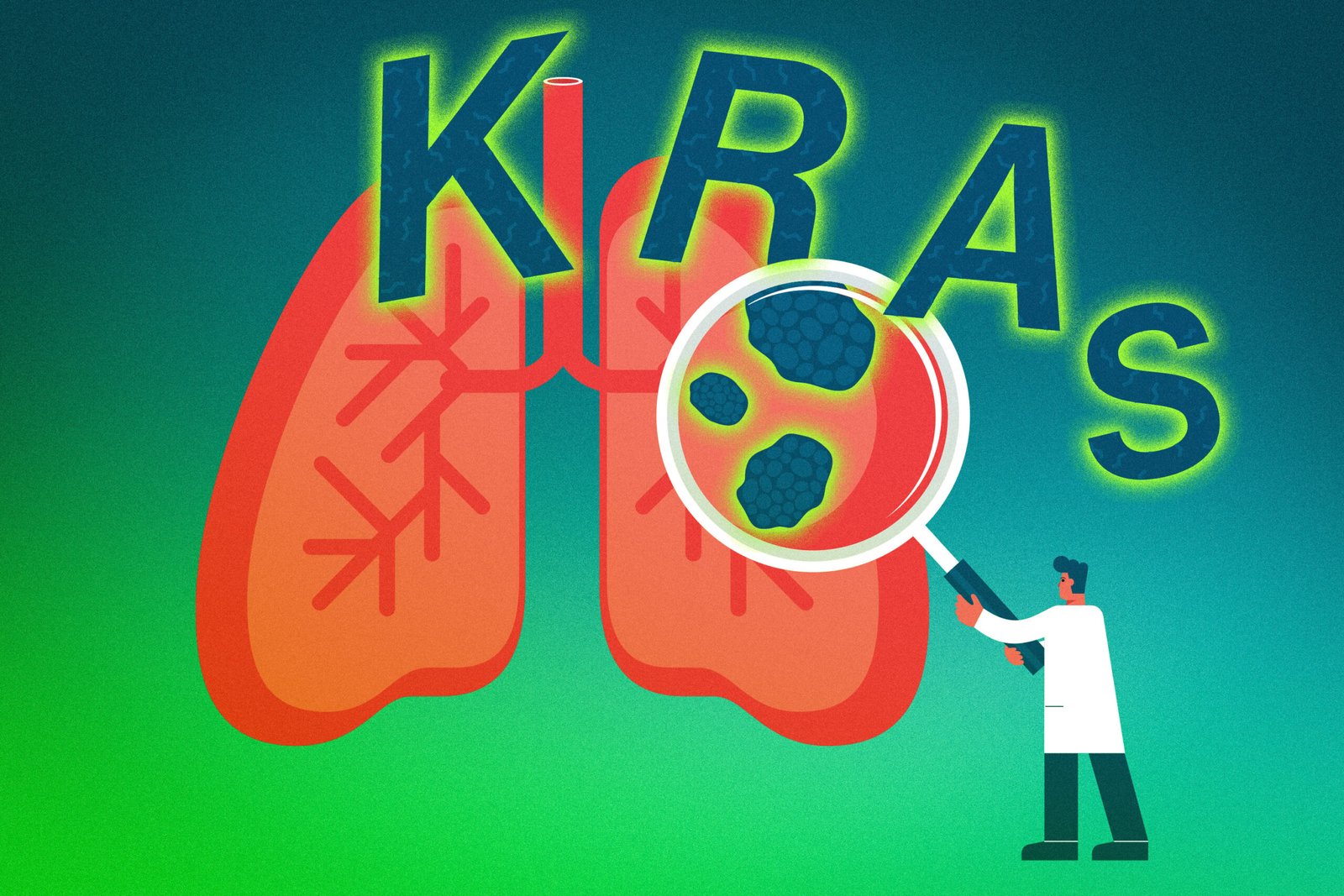
About 25 percent of lung adenocarcinomas have mutations of the gene KRAS, which drives uncontrolled cell growth. In recent years, the FDA has approved two KRAS inhibitors to treat patients with KRAS mutations. While these drugs can work well initially, tumors almost always develop resistance to them.
Usually, resistance emerges because cells reactivate KRAS activity, through mutations that prevent drug binding or by increasing KRAS expression that overpowers the effects of the inhibitor. However, in a new study, MIT researchers have modeled an alternative mechanism that cancer cells can use to become resistant to KRAS inhibition.
The researchers found that in some cases, lung tumors undergo transformation from adenocarcinoma to squamous cell carcinoma. Both of these tumor types are commonly found in the lungs, but they are thought to arise from different cells and have different genetic profiles.
When this transition occurs, tumor cells no longer require KRAS, and appear to turn on alternative signaling pathways that help them continue to grow. Ongoing work to identify those pathways may reveal targets for new drugs that could help prevent resistance to KRAS inhibitors.
“The main takeaway is that there seem to be different routes of resistance to KRAS inhibitors, and so we need to be thinking about how we can address this,” says Carrie Rodriguez, an MIT graduate student and one of the lead authors of the paper.
Nicolas Mathey-Andrews PhD ’25 is also a lead author of the study, which appears today in the journal Nature Genetics. The paper’s senior author is Tyler Jacks, the David H. Koch Professor of Biology and a member of MIT’s Koch Institute for Integrative Cancer Research.
Tissue transformation
The two FDA-approved KRAS inhibitors both target a mutation called KRAS-G12C. These drugs are approved only for use in patients whose tumors have failed to respond to other drugs, and these patients usually have cancer that has spread beyond the lungs.
KRAS inhibitors are effective in about 35 percent of the patients who receive them. However, in those cases, the tumors almost always end up becoming resistant by generating additional copies of the KRAS gene or finding other ways to turn on the MAP kinase signaling pathway, which is usually triggered by KRAS and stimulates cell growth.
“Resistance to targeted therapies is a very serious problem,” Rodriguez says. “Sometimes these KRAS inhibitors can hold cancers at bay, but most cases do end up relapsing.”
A 2021 study from researchers at Dana-Farber Cancer Institute, which analyzed tumors from 17 non-small cell lung cancer patients treated with KRAS-G12C inhibition, identified secondary resistance mutations in a majority of patients. In two of these patients, however, the researchers found that tumors transformed from adenocarcinomas to squamous cell carcinomas, but they did not harbor obvious resistance mutations.
Both adenocarcinomas and squamous cell carcinomas are classified as non-small cell lung cancers (NSCLCs), which are the most common type of primary lung cancer. Adenocarcinomas, the most common type of NSCLCs, often originate from the surfactant-producing cells that line the lungs, while squamous cell carcinomas originate in the cells that line the central airways of the lungs.
Mutations of KRAS are found much more frequently in adenocarcinomas than in squamous cell carcinomas
In this study, the researchers set out to model the factors that might drive the transition from adenocarcinomas to squamous cell carcinomas. To do that, they engineered a mouse lung cancer model to express the mutation that is targeted by the FDA-approved KRAS inhibitors.
Following treatment with a KRAS-G12C inhibitor, tumors with genetic loss of Nkx2-1, which normally helps maintain alveolar epithelial identity, were able to undergo adeno-to-squamous transition. Turning on a transcription factor called DeltaNp63, which is overactive in many squamous cell carcinomas, also made this transition more likely. Another transcription factor known as SOX2 also helped stimulate the transition, but this gene could not initiate the transition on its own.
Paths to resistance
Tumors that underwent these tissue transformations did not acquire the mutations that typically boost KRAS expression in adenocarcinomas. Instead, KRAS signaling was shut off. The researchers hypothesize that these cells may turn on another signaling pathway that helps them to continue growing.
“There seem to be several different routes where you can get to squamous transformation, either through loss of lung-lineage-defining transcription factors, or overexpression of these squamous master regulators, SOX2 or DeltaNp63. Those resistant squamous tumors no longer respond to KRAS inhibition because they shut off the signaling or at least dampen it significantly,” Rodriguez says.
The researchers are now further exploring what happens to tumor cells as they transition to a squamous state, in hopes of identifying vulnerabilities that could be targeted with new drugs.
“Fundamentally this is a transition that’s poorly understood, and we were happy to see that we were able to model it,” Mathey-Andrews says. “Future directions that have an eye toward translation will utilize those models to understand the process and conditions by which histologic transformation occurs, and then also nominate potential targets downstream.”
The research was funded, in part, by the Koch Institute Support (core) Grant from the National Cancer Institute, a Ruth Kirschstein National Service Research Award, the National Institute of General Medical Sciences, and the Ludwig Center at MIT.



