
Published November 13, 2026 06:50AM
How we reported this: Triathlete contributor Travis Mundell interviewed Magnus Ditlev following the Dane’s fastest Ironman time of 7:19:17 at Ironman Florida to hear about what his training looked like after a DNF in Kona one month prior.
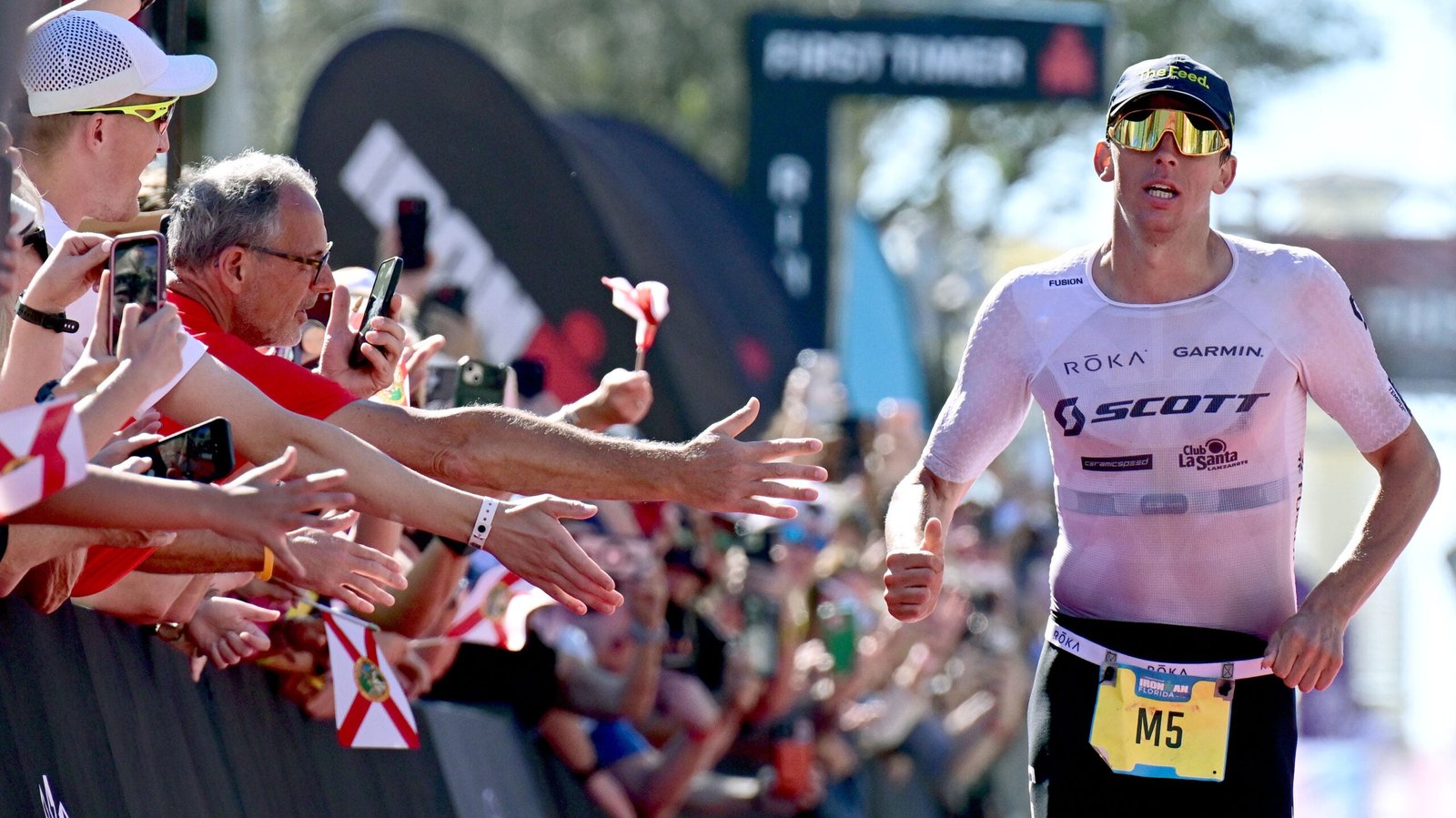
Thirty years after Lothar Leder became the first person to go under the eight-hour barrier at the full distance, Magnus Ditlev (DEN) set a new fastest-ever time of seven hours and 19 minutes at Ironman Florida. Ditlev’s performance is even more impressive given it came just one month after imploding and pulling out roughly 30 minutes from a likely Ironman World Championship victory. But does it feel like retribution for the 29-year-old?
“What happened in Kona is still very much in my mind, and I’m probably thinking more about what happened in Kona right now than the world record, to be honest, because that was my big shot at a world championship title there, and being so close was very heartbreaking,” he told Triathlete, just days after his headline-grabbing race in Florida.
From Kona to Florida
After finishing second at the Hawaii Ironman World Championship in 2024 and then winning Ironman South Africa in early 2025, Ditlev struggled to consistently reach the level that those performances suggest. And when a bout of shingles early in 2026 left him on the sidelines ahead of Ironman Texas, it seemed as if another season was in jeopardy.
“I wasn’t in a good space because of all the sickness, and I think that was maybe still in the body somehow. Even though I was training OK, I wasn’t performing at races. And when I had to really push, I wasn’t able to do so,” Ditlev said, of his 11th-place finish at Ironman Frankfurt, where he narrowly secured a Kona qualifying slot. A sixth-place finish at Roth immediately followed, in a race where Sam Laidlow stopped the clock at a world’s best time of 7:21:04.
“That was hard to watch, especially because I was in the race, and I got absolutely humiliated in the race that has given me the most throughout my career, so that was really tough.”
(Now that Ditlev has the record once more, Laidlow has since teased on Instagram that he is back in training to reclaim it).
Still, seeing the level of the competition gave Ditlev something to take away from the experience.
“Being in that race and seeing the level of Sam and the level of Kristian, it was good to get that kick in the butt,” he said. “That gave me that last little bit of motivation and push to try to get better.”
Despite that added motivation, returning to the standards Ditlev had set for himself didn’t come without uncertainty.
“There were doubts every day, to be honest. I was doubting basically every step I took along the road, but I didn’t, or very rarely did I, change the plans because of those doubts.”
That ability to stay the course is something he looks back on with pride.
“That’s one of the things I’m proud of the most – that I never really veered off too much from that plan. I just tried to really work hard and do my best.”
Sticking to the plan slowly began to pay off behind the scenes: Ditlev headed to altitude in Nederland, Colorado, as he had before Kona in 2024 for his final training block. Finally, he saw some of the best training numbers of his career appearing across the swim, bike, and run.
“It was so simple where we were staying. It was just me, my girlfriend, and a coach some of the time, and we were just really focused on all the small things and living a simple life,” he explained. “I think going a bit away and not having too much to focus on apart from training and really trying to prepare for a good performance was definitely the thing I needed at that time.”
And for most of the race in Kona, those training numbers translated into exactly the performance he had hoped for. Ditlev led off the bike and maintained a commanding lead of more than four minutes throughout the run before his race unraveled under the heat and humidity in the final miles. Seemingly out of nowhere, he found himself seated on a barrier on the Queen K, having come so close to achieving his biggest goal.
Physically turning things around to race another Ironman in Florida in four weeks’ time was one type of challenge; mentally overcoming such a blow was another. Instead of returning home to Denmark, he flew back to Boulder, Colorado, to recover and restart training.
“To be honest, it was quite tough. I had some days where I was really struggling to get out of the door because I was not really motivated and really had to push myself just to get out on the bike and ride,” he shared.
He acknowledged that it took more than his own resolve to get back out training.
“It was just the people around me that were so supportive, and they were trying to tell me that: ‘Yeah, look, you’re in amazing shape. If you manage to put yourself up to it mentally, then we think you can do amazing in Florida.”’
At the same time, there was a physical concern in the back of everyone’s mind: whether the effects of the heat stress would linger — knowing Ditlev had gone deep into the well and far into the notoriously brutal 140-mile race.
“You hear those horror stories of people that have had heat injuries; they are out for long periods, and it could really sit in the system for a long time. So we were quite careful the first couple of days with the training to make sure that I was recovered, and then just didn’t do too much training in between [Kona and Florida].”
Ditlev moved toward Florida with a lower total training volume, keeping a few bigger, specific sessions while focusing mainly on arriving fresh.
It worked, and the shape was still there. However, that freshness didn’t translate into race-day excitement. Instead, he was focused on qualifying for Kona and earning another chance to put things right.
“I wasn’t too hyped up on the race as I’ve been before Kona, where I’m really looking forward to it so much. Whereas here I was just really relaxed. I think I knew I was in great shape and I wanted to execute, but I was not stressed or nervous that sometimes you can be before big races.”
Inside the Race in Florida
The day began perfectly for Ditlev. One of the best swims of his career even saw him briefly take the lead after the Australian exit heading into the second lap.
“When you have that swim, for me, then I know it’s gonna be a good day. It felt super easy and relaxed.”
That set the tone for the rest of the race.
“I just felt like I was not working really hard the whole day, and that was the same for the bike and run. I was just doing my own race in control.”
That feeling of “not working really hard” produced the fastest bike split in Ironman history, averaging 29.3 mph — a number age groupers can’t even comprehend for an Olympic-distance race, let alone a full Ironman. To almost any age-group athlete, flying through the course in peak shape would sound like pure bliss. For Ditlev, it brought another sensation.
“It was quite boring, to be honest, because it was a one-loop course and I didn’t see anyone at all. There was not even a motorbike or anything because the race wasn’t broadcast. So it was super lonely out there. I just tried to make time go by.”
Thankfully for him, time went by quickly whether he felt it or not. Averaging 345 watts without dropping off power toward the end, he arrived in T2 with a 3:51:16 bike split and an 11-minute gap over the American chasers, including Sam Long, Rudy von Berg, and Ben Kanute.
After that swim and bike, Ditlev knew the fastest Ironman time was within reach. Before starting the run, he asked his girlfriend what marathon time he needed to secure it.
“2:35,” she replied.
“I thought, ‘I can definitely do that, given how I’m feeling.’”
Recounting the moment, Ditlev laughed as he described briefly debating whether to chase the record or take it easy with such an immense lead. Once again, the prospect of it being “too boring” helped him decide to “at least make the effort.”
Starting at 3:35 per kilometer, or 5:46 per mile, he described the run as feeling “really smooth” until the final 8K, when he had to slow slightly. In the end, he still finished with a career-best 2:33:31 marathon. Despite that, and a new world’s best time, the specter of the Big Island tempered his elation.
“It’s probably because of Kona, but I wasn’t too hyped or too excited because it’s also in the back of my mind. This is what should have happened in Hawaii. So it’s a bit of a weird feeling.”
The Visor, the Cooling, and the Carbs

One of the biggest headline pieces of gear Ditlev debuted in Kona was his new, full-face-covering visor, which returned in Florida. Beyond its appearance, some questioned its practicality, wondering whether it would make the heat harder to manage. Ditlev quickly dismissed that concern, saying, “It doesn’t make a big difference in how hot I feel.”
But it wasn’t the visor that stole the attention in Florida; the biggest question about his setup was the lump in the center of his chest, with many speculating that it was some sort of new cooling strategy.
“It’s not for cooling. It’s just been a long time since I did a smaller Ironman race, and I found out there are no personal needs or pro fluids like there are in Kona, Roth, and Frankfurt that I’ve done this year.”
The explanation was more practical than it looked.
“So I was having a hard time figuring out how I should carry my nutrition around the course. So actually, it’s just two 500 milliliter bottles with all my nutrition for the run.”
After seeing the footage, however, he acknowledged the unusual appearance.
“It feels pretty natural, even though when I saw the videos, I can obviously see that it looks quite stupid.”

When you’re aiming for 200 grams of carbohydrate per hour on the bike, and 150-160 grams on the run, carrying the nutrition took priority over appearances. But these insane grams-per-hour levels weren’t even the highest intake his team tested.
“We did some tests with 220 actually, and it’s not the ceiling. It’s just becoming a diminishing return, if you can say it that way,” he explained. “I could probably add some more, but we are starting to go into really small potential benefits, and the consequences of it going wrong, or the risks, start to outweigh the potential rewards.”
Age-Group Magnus, Kona, and Wanting to Race Vincent Luis Again
A performance like this makes it easy to imagine Ditlev as a childhood triathlon prodigy. Yet just 10 years ago, he was competing in his first age-group triathlon, with his only athletic background in football and badminton. Asked what he would tell that younger, 19-year-old Magnus, he laughed.
“Age-group Magnus didn’t even know that there was actually something called professional Ironman racing,” he said, before continuing, “Make sure that you are enjoying what you’re doing. If I didn’t enjoy it, I wouldn’t be doing it now. So just try to surround yourself with people that give you energy and stay curious about the process.”
His latest time also raises an inevitable question: How much faster can he go?
First, Ditlev quickly kept the story straight: “It’s fun to set a fast time, but we are racing for wins,” before entertaining the thought experiment.
“I don’t know if Florida is the fastest course in the world. It’s definitely a fast course. But some years it has been a wetsuit; then you are at least two minutes, maybe even three minutes quicker. Then, if you apply the transition zone that they have in Roth, which is something like four or five minutes quicker combined T2 time and T1, then we are somewhere between seven and eight minutes just from that.”
The bike offered another potential saving.
“My bike engineer actually had me at 3:48 bike split before the race, but the wind conditions weren’t ideal on race day. So if you take a day with no wind, then I would probably be around 3:48, which is another three minutes. So then we are at about 10 minutes.”
On the run, he had a wry smile as he pointed to third-place finisher Matt Hanson’s 2:28 marathon, not suggesting he could go that fast; he believed he could still squeeze out “a little bit more.”
His overall assessment?
“I mean, probably 10 minutes, quite easily, quicker.”
For now, Ditlev is finally spending some time at home in Denmark after an extended stretch away. Not everyone embraces the off-season quite so readily – we’re looking at you, Taylor Knibb – but Ditlev says he is known among those close to him for being able to switch from some of the biggest training hours in the sport to almost none in a short space of time.
Amid the downtime, the fire still burns for a Kona title, with middle-distance and Ironman Pro Series racing taking a back seat to his preference for building toward specific goals.
Asked whether he wishes he could have a rematch against the now-retired Kona champion Vincent Luis, his answer was clear.
“Of course. You want to beat the best people, and Vince was the best athlete in Kona that day. And I have to admit, when I saw that Vince was the guy that passed me first after I almost collapsed, I thought, ‘Okay, that’s actually pretty cool if he goes ahead and wins this race.’”
Having spent time with Luis at altitude earlier in the year, Ditlev was happy to see him take the title off into retirement, even if it means missing the chance to race him again.
“He’s a really, really good guy, so I was super happy for him. And I thought it’s gonna be absolutely epic if he manages to keep it to the line. But yeah, of course, I’m sad that he’s retiring. It would be nice to race him next year as well.”



