
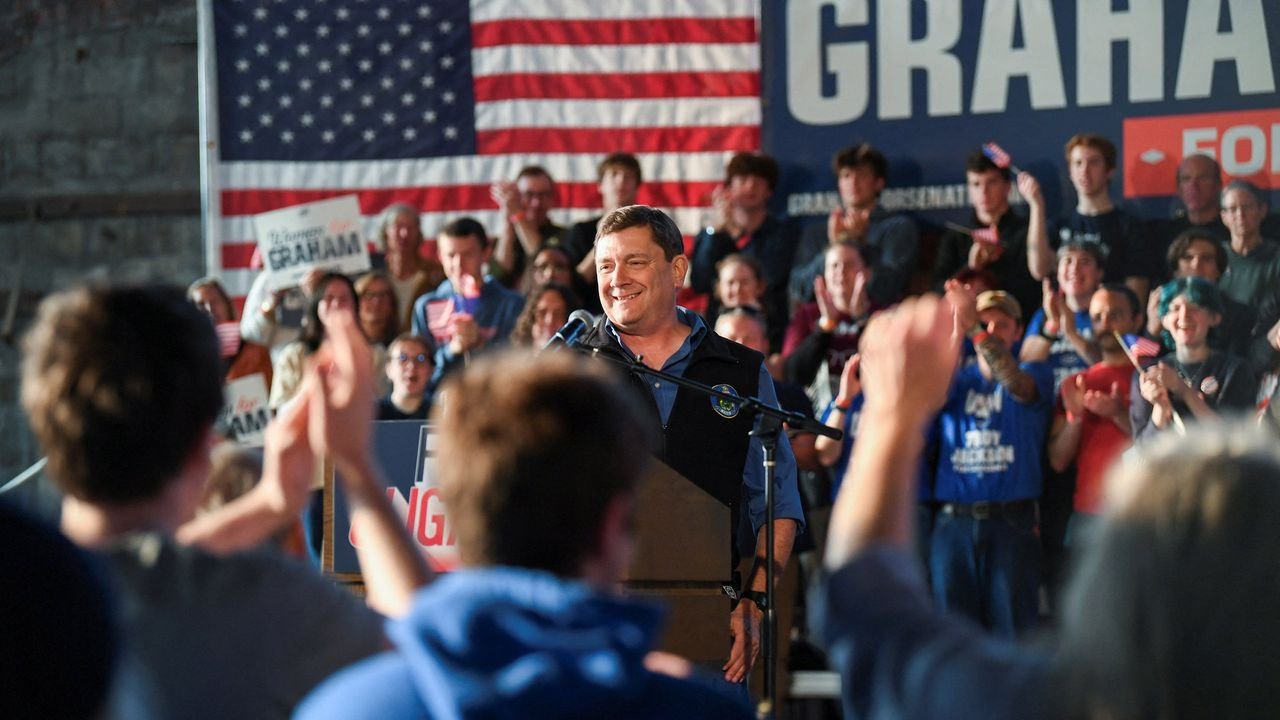
Bellows also spoke at the vigil. At one point, she mispronounced Guerrero’s name; later, she talked so much about the Senate race that a heckler shouted, “This is about Joan! Not about your campaign!” Wood called Bellows’s speech “laugh-out-loud cringey.” But he was more energized by how the shooting had shifted attention away from Platner—and toward what’s at stake in the race. “We were in mourning after this primary debacle,” he told me. “But, after Monday morning, it was, like, O.K., we got to pick ourselves back up. We got to beat Susan Collins. She could have stopped this. It just moved people to refocus on why this election matters, and that’s what people are talking about.”
When Wood wasn’t working the phones or attending vigils, he was preparing for a televised debate scheduled for July 16th—two days before the start of the county caucuses—in Portland. Standing behind a lectern and facing a laptop perched on the mantel in his living room, he workshopped his opening statement and answers to various questions with his debate coach, Reed Adamson, who was Zooming in from Oregon. “Jordan, you ate your Wheaties last night!” Adamson said. “Great job!”
The debate’s host, News Center Maine, had originally invited just Bellows, Jackson, Shah, and Wood—all of whom had received at least twenty per cent of the vote in their respective primaries, in June—to participate, but Jackson, the former state-Senate president, protested that the debate should be open to all twelve declared candidates. He said that it was about respecting the democratic process; Wood suspected that Jackson, who is not a particularly gifted orator, had ulterior motives. “He wants it to be as many people up there as possible so he won’t be scrutinized,” Wood said.
In the end, News Center Maine compromised. It would host two separate, back-to-back debates: one featuring Wood and the other original three candidates, informally dubbed “the big-kids’ table,” and a second featuring Kleban, Webb, and two additional candidates, referred to as “the little-kids’ table.” Instead of one ninety-minute debate, each one would be sixty minutes—meaning that, while Jackson wouldn’t have a crowded stage, he’d at least have less time on it.
Some of the candidates seemed eager to debate—in part to promote their candidacies but also to promote themselves. The News Center Maine event “could be one of the highest-viewed Senate Democratic primary debates in the country,” Wood said. He was even more jazzed that CNN had announced it would host another debate the following week, two days before the convention in Bangor. “Dana Bash and Jake Tapper, who do the Presidential debates, are going to be moderators,” he marvelled. But there was, admittedly, something odd about having televised debates when the contest was ultimately going to be decided by just six hundred and one people—who, presumably, would have the opportunity to speak directly with the candidates themselves. Wood seemed to acknowledge the disconnect. In a call with a state representative who was running to be a delegate, he’d made a detailed, granular case both for his candidacy and against his opponents’. After hanging up, he told Lipsett, “I think I convinced her. She said, ‘I just want the best candidate to beat Susan,’ and she seemed sold by the argument. The only problem is, I don’t have the time to make that argument in the debate or on TV. It’s very insider-y.”
An hour before the first debate began, the eight candidates gathered in a greenroom at the News Center Maine studios, in Portland. Webb, a transgender singer and writer, kept to herself, eating a piece of pizza with a knife and a fork. Wood, Jackson, Shah, and Kleban glad-handed, recounting where they were when they first heard the news that Platner was likely finished. Bellows sat in an adjacent office, flipping through a briefing binder. Mike Redding, the station’s news director, told the candidates that, unlike the gubernatorial and House debates that News Center Maine had hosted earlier in the year, all of which were recorded, this one was going to be broadcast live. “No cussing,” he reminded them. “Troy, that’s not going to be a problem for you, right?”



