
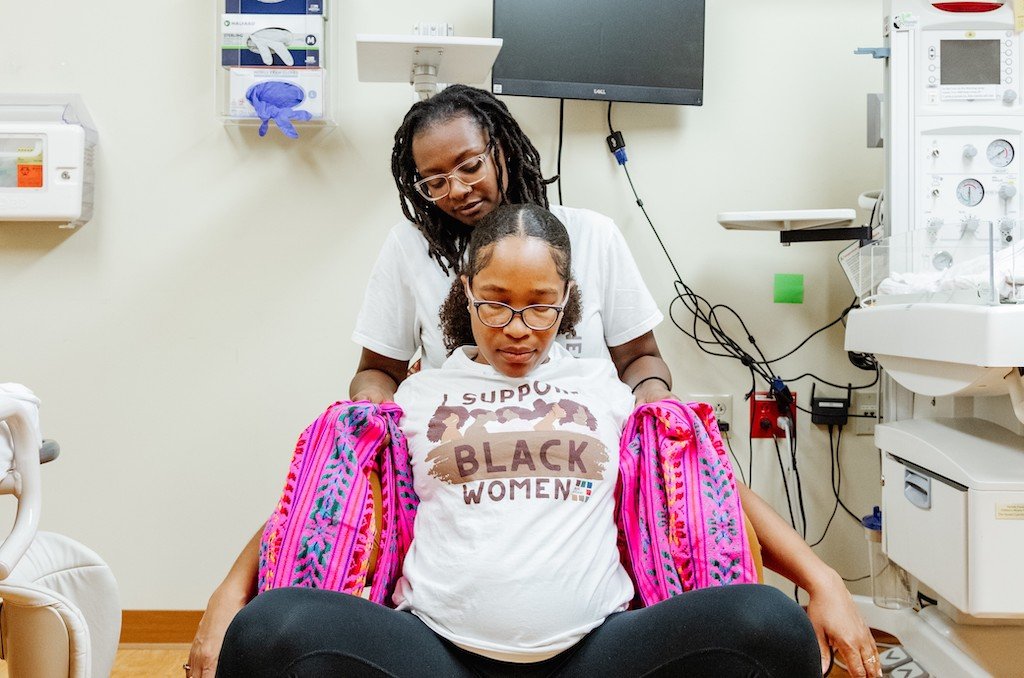
More than 2,000 people who were pregnant, recently gave birth or are part of the perinatal workforce benefited from a free ride to a healthcare appointment or social service agency in the Trenton area over the past six months, thanks to a government partnership that aims to boost maternal health outcomes.
The rideshare program — which is now expanding to Hamilton and Ewing — is just one way the New Jersey Maternal and Infant Health Innovation Authority is looking to drive down the state’s above-average maternal mortality rate and reduce racial disparities that leave Black moms nearly seven times more likely to die than white moms in New Jersey, according to the latest state analysis.
“People ask, ‘why launch a transportation program?’ They think that it’s all happening in the healthcare setting, in the hospital or in the clinic. But transportation remains one of the most overlooked barriers to maternal health and, I would say, health in general,” Lisa Asare, president and CEO of the authority, told the New Jersey Monitor.
Assemblywoman Verlina Reynolds-Jackson (D-Mercer), who represents the area and sponsored legislation to create the authority, called the transportation program a ‘big win.’ “It may sound like a small thing until you are the mother missing a prenatal appointment because there is no ride available and no flexibility in your work schedule,” she said.
Founded in 2023 to oversee a portfolio of mental health work prioritized by then New Jersey first lady Tammy Murphy, the authority hosts a growing number of programs designed to increase access to care for moms and babies, strengthen the perinatal workforce and connect maternal health programs run by other state agencies, local government and nonprofit organizations.
The agency is funded with $5.2 million in annual state appropriations, agreements with other agencies valued at more than $670,000, and $475,000 in philanthropic contributions, according to the second annual report, released in March. The authority is one of multiple steps New Jersey has taken to improve its maternal mortality rate, which exceeds the nation at large and other states in the region.
Asare said the authority serves as a catalyst and convener, looking for promising programs — like the rideshare initiative, which relies on GoTrenton!, a local zero-emissions service accessible through a QR code — that could be scaled to other cities or counties in New Jersey. It also seeks to ensure state laws are working as intended, she said, adding that “the details are where MIHIA comes to life.”
Reynolds-Jackson said the authority’s work is helping to address chronic health issues, like high blood pressure, obesity and diabetes — conditions that affect Black women at higher rates than white women – by connecting women with existing services and supports, like programs that provide healthy food options.
“This is what good government looks like,” she said in an email to the New Jersey Monitor.
Construction began last summer on an $87 million maternal health center on the corner of Pennington Avenue and North Warren Street, in Trenton, which will be home to the authority starting next year. The building will also house an OB/GYN clinic run by Capital Health, a social-service hub overseen by the nonprofit Trenton Health Team, a research space led by Rutgers School of Nursing, and an innovation space overseen by Rowan University and others.
“It’s really designed to eliminate some of those silos and have us live together and collaborate in real time,” Asare said.
Increasing access to doulas
The authority is also collaborating with the Greater Mt. Zion Trenton Community Development Corporation, a faith-based nonprofit that is building an independent birthing center just across Pennington Avenue. Mothers who are low-risk and want to avoid a hospital birth can be referred to the Mt. Zion birthing center, Asare said.
Mt. Zion’s center, called Back in Our Hands, will also offer prenatal and post-natal services, lactation assistance, programs for fathers and children, fitness classes, and other wellness options, according to Diana Rogers, the corporation’s executive director. Expected to open next fall, it will be Trenton’s first birthing option in more than a decade, Rogers said.
Mt. Zion leaders are now spreading the word about the future birthing center, Rogers said, and Trenton residents are excited about maternal health options closer to home and staffed by providers who share their racial and cultural background. Most local women now deliver at Capital Health’s hospital in Pennington, about 15 minutes away.
“We’re very excited to be moving forward. We’re excited for the community. We’re excited to provide for them exactly what they’ve been asking for — to be able to birth again in the city of Trenton,” Rogers told the New Jersey Monitor.
Input from Trenton residents, predominantly people of color, also shaped the authority’s charge, Asare said, noting that many Black women said they wanted more support during pregnancy and birth. That led the agency to focus on expanding access to doulas, non-clinical, trained professionals who provide physical, emotional and educational support for pregnant, birthing and postpartum women.
A doula’s presence during delivery has proven to reduce the need for surgical or cesarian births, limit the use of epidural pain-blockers, improve the health of the baby, and improve the overall experience for mothers, according to an analysis published in 2022.
Asare said the authority has trained 50 doulas, some of whom will train others to continue to increase their numbers, and will host its next doula town hall on Thursday, July 9. It has also worked to strengthen the state credentialing system for these professionals; streamline the registration process for the Medicaid program, which pays for roughly 40% of births here and covers doula care; and identify the best doula-training curriculum and localize the lesson plan to better fit New Jersey.
“We have invested considerable time, resources, and just energy into really building that [doula] workforce, but our work has really extended beyond training; we’re really trying to build the workforce and to sustain the workforce,” Asare said.
In February, the authority launched a grant program that will provide up to $50,000 for small businesses and community organizations focused on women’s health and birthing services. It also created a program to train recipients on how to manage the funding, track and report progress, and sustain their work in the future. The authority will soon announce the first 15 awardees, who Asare said represent communities around the state.
Reynolds-Jackson praised the authority’s work to create career opportunities and strengthen the maternal care workforce within Trenton, where the median income is less than $53,000 a year. The OB/GYN clinic and Mt. Zion’s birthing clinic will also be a “tremendous benefit” to the community, she said.
Some metrics are starting to improve, but big declines in New Jersey’s maternal mortality rate — and reductions in the racial gaps in outcomes — will take time, Asare said, noting that 80% of pregnancy-related deaths here were found to be preventable.
“We understand what some of the underlying drivers are, but we also know that this is a long game,” Asare said.



