
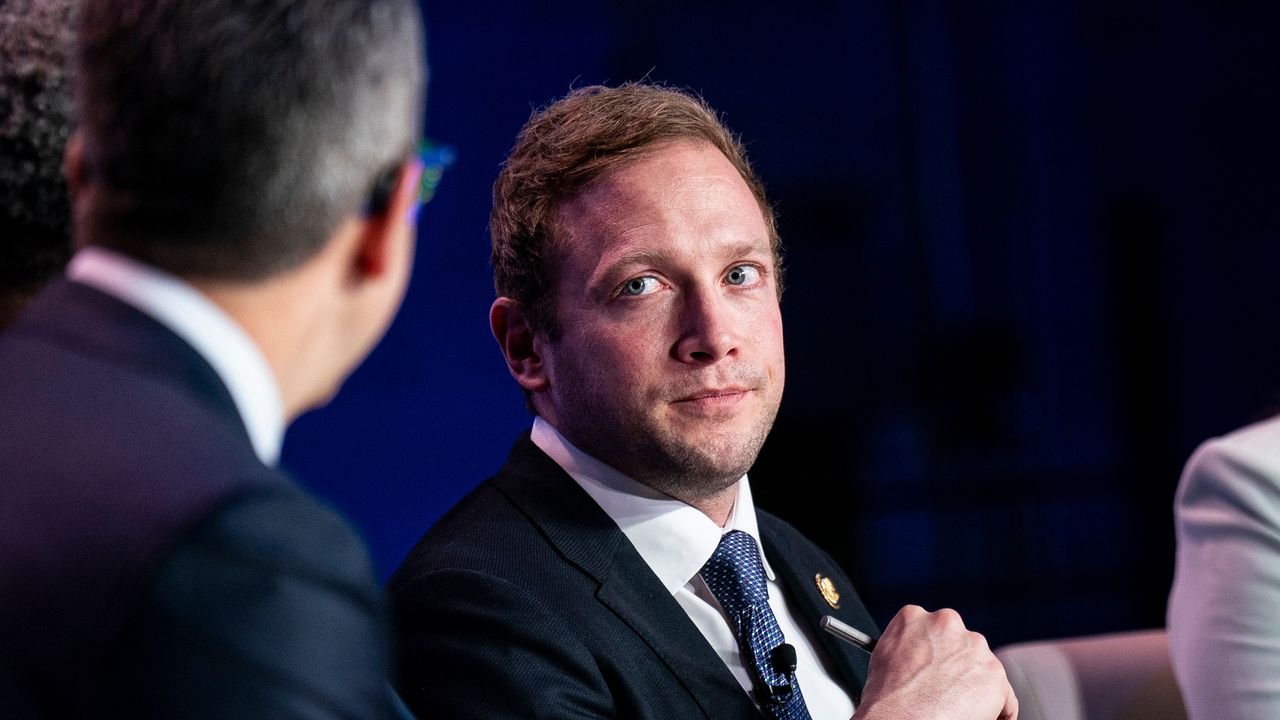
One complication for this posture is that Miller was previously accused of domestic violence by Stephanie Grisham, whom he had dated during Trump’s first term, when Grisham was Melania Trump’s press secretary, and whom he briefly sued for defamation. Another is that his ex-wife’s father is Bernie Moreno, a U.S. senator from Ohio, who is at least as important a figure to the White House as his son-in-law. On Sunday, Miller held a live stream during which he announced that he would release documents that would exonerate him. The trove included an audio exchange he had with his ex-wife in which she confronted him after finding needles by his bedside (Miller claimed that they were for testosterone-replacement therapy); Miller also accidentally released a shirtless picture of the two-year-old daughter he and Moreno share.
As with many rising figures in the Republican Party, Miller and Trump have a history; the congressman served as a White House aide during the President’s first term in office. On Monday, Trump stuck up for Miller in public, in his own way. “He’s a good person,” the President told reporters, before amending, “I mean, I always thought he was a very good person.” Privately, according to Axios, Trump told Miller in a call that same day that “things aren’t looking good.” On Sunday, Moreno, who had long been silent, said that Miller should no longer serve in Congress. “He is a danger to my daughter, and I hold my breath every minute he has custody of my granddaughter,” Moreno said. Later that week, the senator mentioned that he’d spent part of Sunday afternoon in a suburban Cleveland police station, helping with the transfer of his two-year-old granddaughter, per the custody agreement. (According to Moreno, during the encounter, Miller had refused to hand over his daughter’s favorite stuffed blue bunny.) His family, Moreno went on, had endured “the seventh level of hell.”
Compared with the overlapping crises threatening Trump’s political position—the Iran war, his failure to manage the cost of living, his multiplying corruption scandals—the Miller-Moreno conflict is a smaller matter. But much of Trump’s power has come from his command of his party, and so much of that control has come from his practice of excusing heinous behavior, beginning with his own. If the Democrats, who are promising to launch all manner of investigations, manage to win at least one chamber of Congress in the midterms, then the last two years of the Trump era are likely to focus on the question of the impunity of the President’s allies, and his power to preserve it. And so it was at once a moral abdication and perhaps a hint of how this is likely to end when Trump said, on Monday, “I’m going to let the families figure that out.”
When politicians are caught doing inexcusable things, they often gesture at their own supposed political indispensability. On his phone call with Trump, Miller had reportedly cited some promising polling on his reëlection campaign; on Monday, he insisted to reporters, “I can win.” (It is a scandal in itself that Republicans have downplayed the allegations against Miller for so long, as it was when Democrats declined to act decisively amid the mounting evidence against the Maine Senate candidate Graham Platner.) But most politicians are pretty easily replaced, a truism that Moreno reinforced by going public. It is almost tautological that the Republican candidate with the best chance of winning Ohio’s Seventh Congressional District in November is not the person who has been deemed unfit to serve by one of his party’s most senior figures in the state, who has also called on him to “end the clear pattern of abuse left in his wake.”
On Tuesday night, Miller spent twenty-three minutes defending himself on Jake Tapper’s CNN show, an appearance during which several minutes were spent on whether Miller had, in fact, held a blue bunny hostage. But a deadline is approaching for Miller, against whom a congressional ethics probe opened this week. If he steps down from his reëlection race by next Monday, local Republican Party chairs in his district can select a replacement candidate; if not, Miller stays on the ballot. In the meantime, the G.O.P.’s internal frictions—this week, Trump also clashed with Jeanine Pirro, his previously loyal U.S. Attorney for Washington, D.C., after she withdrew charges against an ex-Olympic canoeist who was accused of damaging the lining to the National Mall’s reflecting pool (Pirro “folded like an umbrella,” Trump fumed)—are not just a concern for the G.O.P.’s chances in the midterms; they are also operating as glimpses of how Trump assesses his own strength: whether he believes his political position is still strong enough to defend his indefensible allies, or whether he will accede to Miller’s inevitable dispensability. ♦



