
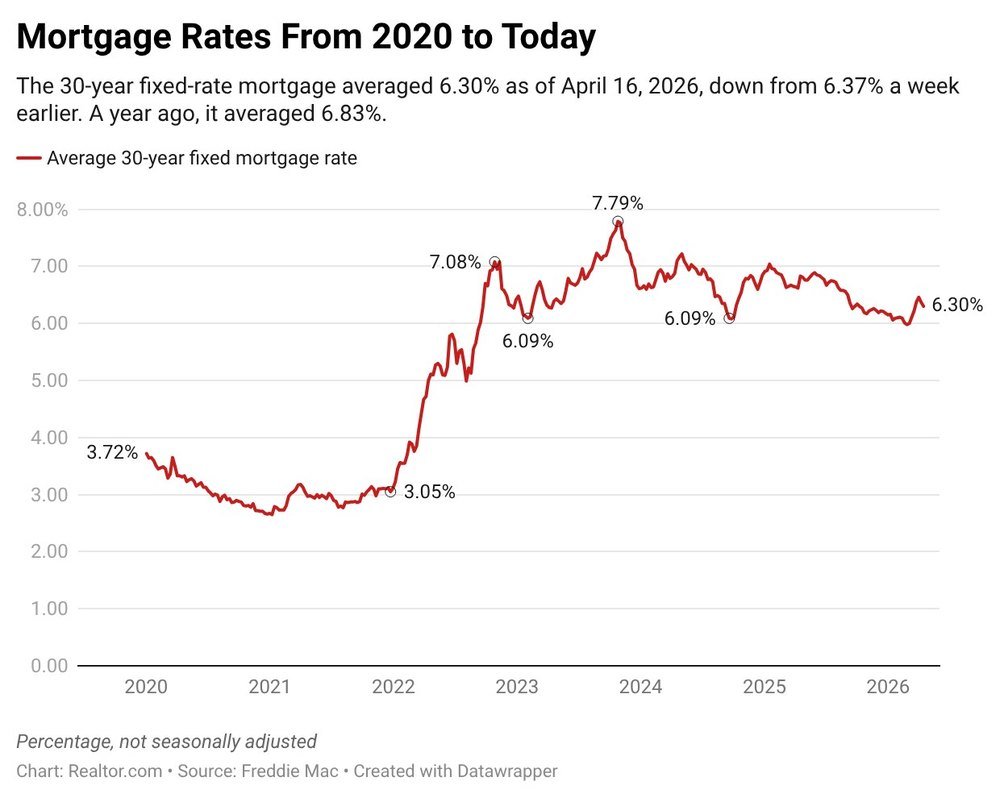
Mortgage applications jumped this week as easing mortgage rates prompted an increase in both refinancing and purchase activity.
For the week ending April 17, Mortgage Bankers Association’s weekly Mortgage Applications Survey found that overall mortgage applications increased 7.9% from one week earlier as the average mortgage rate decreased to 6.43% from 6.48%.
“Mortgage rates declined last week as financial markets responded positively to the Middle East ceasefire and the lower trend in oil prices, with the 30-year fixed rate decreasing to 6.35 percent,” says MBA Chief Economist Mike Fratantoni. “Despite the geopolitical uncertainty, housing demand is being supported by a still resilient job market, and homebuyers are experiencing a buyer’s market in most of the country given the higher levels of inventory relative to last year.”
The seasonally adjusted index tracking purchase applications increased 10% from one week earlier. On an unadjusted basis, the purchase index rose 12% on the week and was up 14% from a year ago.
The index tracking refinance activity increased 6% from the previous week and was 52% higher than the same week one year ago.
“Refinance application volume increased by 6%, while purchase application volume increased an even stronger 10% and was up 14% compared to last year’s pace,” says Frantantoni. “This increase was led by conventional purchase loans up 11% over the week.”
A tentative ceasefire in the Iran war has led oil prices lower, easing inflation fears and relieving recent upward pressure on mortgage rates.
According to Freddie Mac, mortgage rates had reached a three-year low of 5.98% in late February, before the U.S.-Israeli war with Iran began.
Rates jumped last month as high as 6.46% but have been trending lower for the past two weeks. Freddie Mac will report new weekly averages on Thursday.
Mortgage rates calculated
Mortgage rates are calculated based on various factors in the economy, and the length of your loan will also figure into the mortgage rate you qualify for.
The 30-year mortgage rate is tied to the yield of the 10-year Treasury note, according to Fannie Mae. As the yield on the 10-year Treasury note moves, mortgage rates follow.
The yield on the 10-year Treasury note is determined by expectations for shorter-term interest rates in the economy over the duration of a bond, plus a term premium.



