
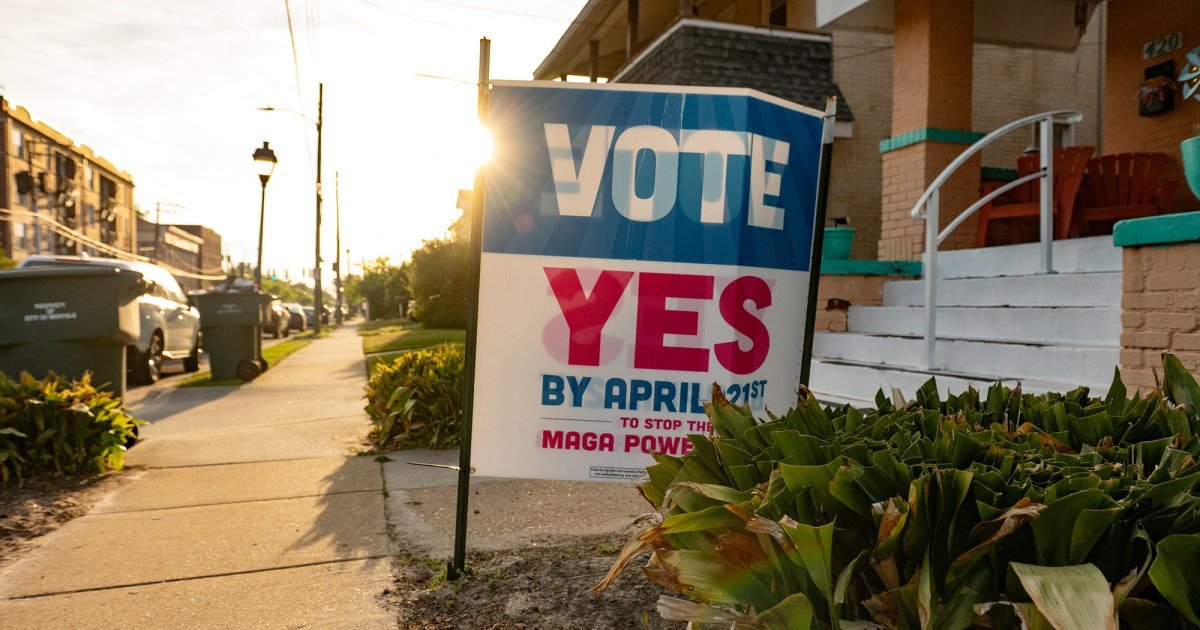
A sign supporting Virginia’s redistricting referendum in NorfolkZach D Roberts/NurPhoto/AP
Last summer, when Donald Trump began pressuring GOP-controlled states to redraw their congressional maps mid-decade, Republicans had a lofty goal: pick up a dozen or more seats in an effort to fend off a coming blue wave and retain the House in the midterms.
Trump scored early wins in Texas, Missouri, and North Carolina. But the gerrymandering arms race he started hasn’t resulted in the lopsided victory the White House envisioned. The approval by voters in Virginia on Tuesday of a new congressional map that could net Democrats up to four new seats shows how Democrats have fought Trump to a surprising draw in the redistricting wars.
Right now, the parties are basically even in the states that have redrawn their maps since last summer. The new map in Virginia makes it even more likely that Republicans will lose the House in November, given Trump’s tanking approval numbers and the fact that Cook Political Report forecasts that Republicans have to win three-quarters of toss-up races to remain in control, calling Democrats “substantial favorites.”
This is not how Trump and his allies envisioned things going. After easily securing the new maps in Texas, Missouri, and North Carolina, Trump suffered a humiliating defeat when Indiana Republicans refused to redraw their districts. Other GOP-controlled legislatures, including Kansas and Nebraska, also balked. Ohio passed a compromise map that, while favoring Republicans, could have been much worse for Democrats. The courts in Utah struck down the state’s existing map, leading to a likely Democratic pickup. And Missouri voters could have a chance to block that state’s new gerrymander at the polls in November, all of which helps Democrats.
Democrats in California, meanwhile, pulled off an improbable ballot measure to offset the Texas gerrymander by redrawing the Golden State’s maps. Now, Virginia Democrats have followed suit, despite the fact that the process in Virginia was actually much trickier. Democrats had to retake control of the legislature and governorship last November in order to kickstart the redistricting process. Then they had to convince voters in a state that is much less blue than California to pass a constitutional amendment authorizing the very type of partisan gerrymandering that Virginia voters had sought to limit just six years earlier, when they passed a separate constitutional amendment giving a bipartisan commission the power to draw congressional maps. The takeaway is that voters dislike gerrymandering, but they now seem to hate Trump even more.
That said, the redistricting wars are far from over. Florida is planning to convene a special session next week to redraw its congressional map, which could net Republicans between two and five more seats. The Supreme Court could issue a decision any day now striking down the key remaining section of the Voting Rights Act, which could shift a handful of seats toward the GOP—though whether those maps would take effect before November’s elections depends partly on the timing of the decision. (It’s probably too late for most Southern states to draw new maps before the midterms.) And the Virginia Supreme Court could still strike down the new voter-approved map; the court allowed the referendum to proceed after Republicans challenged it but has yet to issue a final decision on the constitutionality of the redistricting effort.
Trump has threatened to “take over” the election system, and the mid-decade gerrymandering spree he started is part of a multi-faceted plan to interfere in the midterms. But while that has deeply destabilized American democracy, the president hasn’t succeeded in stopping Democrats from racking up a series of electoral victories over the past year. The passage of the redistricting referendum in Virginia is the latest sign of Democrats successfully fighting back.



