Mortgage Rate Predictions for the Next Five Years (2026–2030): AI Forecast and Housing Market Outlook
Mortgage interest rates have been one of the most influential factors in the housing market over the past few years. After reaching historically low levels during the pandemic, rates surged sharply in 2022–2023 as central banks raised interest rates to combat inflation. As a result, many prospective homebuyers delayed purchases while homeowners held onto existing low-rate mortgages.
A recent analysis using data and AI-based forecasting models attempts to project where mortgage rates may head over the next five years, through 2030. While predictions always carry uncertainty, the outlook suggests that mortgage rates may remain moderately elevated compared with the extremely low rates seen during the pandemic years. (www.srivax.com)
Current Mortgage Rate Environment
Mortgage rates peaked in recent years as the Federal Reserve tightened monetary policy to curb inflation. At one point, the average 30-year mortgage rate climbed above 7%. Since then, rates have gradually declined, dropping about 89 basis points from a high of roughly 7.04% in 2025, according to Freddie Mac data. (www.srivax.com)
Despite this decline, borrowing costs remain significantly higher than during the pandemic era when mortgage rates were near 3%. These elevated rates continue to shape buyer behavior, housing affordability, and the pace of home sales.
Currently, mortgage rates fluctuate mainly due to:
Federal Reserve monetary policy
Inflation trends
The yield on U.S. 10-year Treasury bonds
Labor market conditions
Global economic uncertainty
Among these factors, the 10-year Treasury yield is particularly influential, because mortgage lenders price loans based largely on long-term bond yields. (www.srivax.com)
AI Forecast: Mortgage Rates Through 2030
AI-driven models analyzed historical relationships between Treasury yields, inflation, and economic indicators to estimate the likely range for mortgage rates over the next five years.
The results suggest that mortgage rates are unlikely to return to pandemic-era lows anytime soon. Instead, they may remain relatively stable within a moderate range.
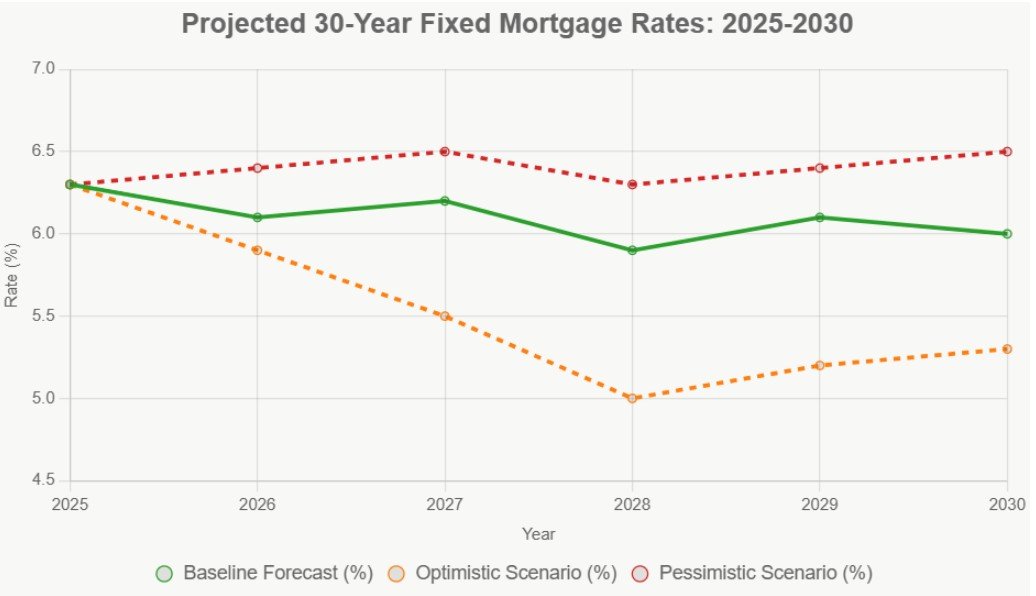
Estimated 30-Year Mortgage Rate Outlook
| Year | Estimated Rate Range |
|---|---|
| 2026 | ~5.9% – 6.3% |
| 2027 | ~6.28% – 6.48% |
| 2028 | ~6.0% – 6.4% |
| 2029 | ~5.8% – 6.2% |
| 2030 | ~5.5% – 6.0% |
Overall, the projections show slow and gradual improvement rather than dramatic declines. Rates may fluctuate within a narrow band for much of the decade.
Experts also emphasize that no major forecasts currently predict a return to 3% mortgage rates within the next five years. (www.srivax.com)
Why Mortgage Rates May Stay Elevated
Several long-term economic forces are expected to keep mortgage rates higher than in the 2010s.
1. Persistent Inflation
Although inflation has cooled from its peak, it remains a major concern for central banks. When inflation is high, lenders demand higher interest rates to compensate for reduced purchasing power.
2. Federal Reserve Policy
The Federal Reserve influences borrowing costs by adjusting short-term interest rates. Even if the Fed lowers rates gradually, mortgage rates may not fall dramatically because they depend more heavily on long-term bond markets.
3. Government Debt and Treasury Yields
The U.S. government’s large budget deficits could keep Treasury yields elevated. Because mortgage rates typically move in tandem with the 10-year Treasury yield, this could limit how far mortgage rates decline.
4. Housing Supply and Demand
Limited housing inventory continues to support home prices and maintain strong demand for mortgages. This supply imbalance can keep financing costs from falling rapidly.

Key Wildcards That Could Change the Forecast
Although forecasts suggest relatively stable mortgage rates, unexpected events could significantly alter the outlook.
Possible scenarios include:
Economic Recession
A recession could lead to aggressive Federal Reserve rate cuts and falling bond yields, which might push mortgage rates lower.
Financial Market Shocks
Events such as banking crises or global financial instability can rapidly shift interest rates.
Geopolitical Events
International conflicts or supply disruptions can affect inflation and global investment flows, indirectly impacting mortgage rates.
Technological and Policy Changes
Housing policy reforms or major financial innovations could reshape mortgage lending and affordability.
Because these factors are unpredictable, long-term forecasts should be viewed as guidelines rather than precise predictions.
Impact on Homebuyers and the Housing Market
Mortgage rates strongly influence affordability. When rates rise, monthly payments increase significantly, reducing purchasing power for many households.
For example, even a 1% increase in mortgage rates can raise monthly payments by hundreds of dollars on a typical home loan.
If rates stabilize around the 6% range:
Home sales may gradually recover
Refinancing activity will remain limited
Housing affordability will remain a challenge in many markets
However, if rates drop closer to 5% later in the decade, analysts expect stronger housing demand and increased market activity.
Will Mortgage Rates Ever Return to 3%?
Most economists believe the ultra-low mortgage rates of 2020–2021 were an extraordinary anomaly caused by:
Pandemic-driven economic stimulus
Emergency Federal Reserve policies
Massive bond purchases by central banks
Returning to those levels would likely require another severe economic crisis or similarly aggressive monetary intervention.
Therefore, the more realistic long-term expectation is mortgage rates between 5% and 6%, which historically is considered a normal range. (www.srivax.com)
Conclusion
Mortgage rate forecasts for the next five years suggest a period of relative stability rather than dramatic shifts. AI-driven projections indicate that rates may remain mostly between 5.5% and 6.5% through 2030, gradually easing but not returning to the record lows seen during the pandemic.
While this environment may feel expensive compared with recent history, it aligns more closely with long-term historical averages. For buyers, the key takeaway is that waiting for extremely low mortgage rates may not be practical. Instead, focusing on affordability, market timing, and financial readiness may be the better strategy as the housing market adjusts to a new interest-rate reality.