
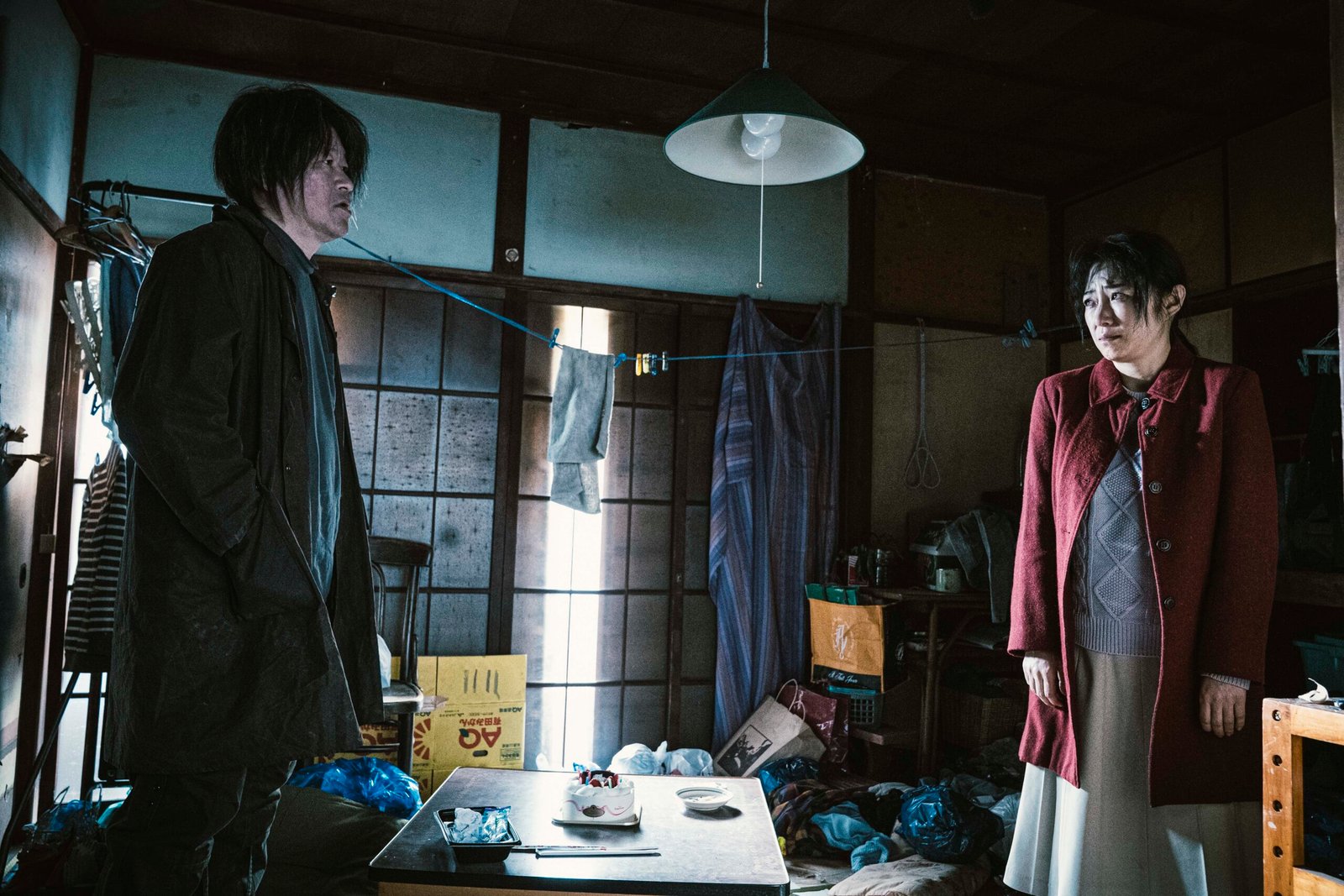
It is a bit strange that Jiro Sato is gradually becoming one of the faces of the serial killer in Japanese cinema. After his role as Suzuki Tagosaku in “Suzuki=Bakudan”, for which he won the Best Supporting Actor award at the 50th Hochi Film Awards, Sato returns to a somewhat similar territory with “Nameless”. This time, however, the concept is even more bizarre, since the actor is not only the protagonist, but also the original creator and screenwriter of the story.
“Nameless” is based on the manga written by Sato and illustrated by Ryo Nagata, which itself originated from a screenplay Sato had written for a live-action feature, before the project took a detour through manga and eventually returned to cinema. Hideo Jojo, a filmmaker whose recent output includes “A Bad Summer” and “Twilight Cinema Blues”, directs and co-writes, bringing his usual ability to move between exploitation, social drama and genre excess.
The story begins with a horrific incident in a family restaurant. In the middle of an ordinary afternoon, a bald, middle-aged man suddenly kills a number of people. However, the security footage shows something impossible. The suspect appears to approach and touch the victims, but there is no visible weapon in his hand, even though the bodies are cut, crushed or otherwise destroyed as if attacked by knives, bats or other instruments. As the police investigation begins, the authorities identify the man as Taro Yamada, someone who had been questioned years earlier in relation to a shoplifting case. When officers reach his home, they discover the decomposed body of a woman, adding another mystery to an already grotesque case.
From there, the narrative moves through three main axes. The first follows Taro’s present-day killing spree and the invisible weapon connected to his right hand. The second deals with his past, particularly the fact that, as a child, he had no name and no clear place in the world. The third focuses on the police investigation, led by Kunieda, as the authorities try to understand what is happening while also navigating internal politics. In between, the relationship between Yamada Hanako and Taro becomes crucial, since she appears to be both his greatest understanding presence and, in a sense, one of the triggers of his despair.
The central idea of the title is quite interesting. A name is not presented simply as a word, but as proof of recognition, affection and existence. Taro’s tragedy comes from the fact that he is a man who was not given this most basic sign of belonging, and who also seems to have been born with a power that makes ordinary contact with the world impossible. In that regard, “Nameless” tries to become a story about isolation, exclusion and the horror of not being able to live like other people. The problem, though, is that the movie frequently struggles to connect this existential despair with the brutality of what Taro does.
This becomes one of the most intriguing but also most problematic aspects of the work. The relationship between Hanako and Taro is interesting, as are the police politics, especially when the investigation begins to expose how institutions react to something they cannot explain. However, the three axes are joined together somewhat awkwardly. The film often moves from supernatural violence, to psychological trauma, to procedural material, without always finding the rhythm that would allow them to strengthen each other. As a result, the concept is powerful, but the overall construction occasionally feels scattered.
The invisible weapon is another case of an idea that is both fascinating and uneven. The fact that the audience can understand what is happening, while the victims and the police cannot see the weapon, creates some striking moments. At the same time, it does not always work cinematically, because the gap between what is visible and what is implied sometimes becomes more confusing than suspenseful. Still, the diversity of the weapons is rather interesting, while the presentation of brutality is impressive on occasion. Frequently, though, it is also horrendous, with the violence moving into genuinely grotesque territory.
In terms of acting, Jiro Sato is definitely the main attraction. His performance here is very different from the verbal, manipulative intelligence of Suzuki Tagosaku in “Suzuki=Bakudan”. Taro is more childish, more impulsive and more physical, a man who communicates more through facial expressions and sudden outbursts than through elaborate speech. Sato’s tendency toward excess fits the role, although the character is written in a way that does not always allow the tragedy behind him to become fully convincing. The child actor playing the younger version of Taro is also quite impressive, suggesting the intensity of his background almost immediately.
Ryuhei Maruyama gives the movie some of its most human moments as Teruo, the policeman who names the young Taro and Hanako. MEGUMI, as Hanako, has a difficult role, since the character is both concrete and elusive, but her presence adds to the distorted emotional core of the story. Kuranosuke Sasaki is solid as Kunieda, the detective obsessively pursuing Taro, and his scenes help ground the movie whenever the supernatural premise threatens to overwhelm everything.
The visual presentation follows the grotesque nature of the premise, particularly in the murder scenes, where the invisible weapons allow Jojo to stage violence as both spectacle and puzzle. The use of CCTV footage and police observation adds another layer, since the authorities are constantly watching but still unable to fully understand what they see. The result is not always elegant, but it does give the movie a strange texture, somewhere between J-horror, dark fantasy, police thriller and psychoviolent manga adaptation.
“Nameless” is definitely not a movie that asks the audience to sympathize with a murderer, even if it tries to show the loneliness and despair behind him. Its strongest idea lies in the meaning of having a name, and in the notion that existence itself needs to be recognized by someone else in order not to collapse into horror. At the same time, the movie’s brutality, uneven structure and occasionally awkward handling of its supernatural rules prevent it from fully capitalizing on its premise. Nevertheless, as a bleak, grotesque and frequently disturbing genre piece, it has enough originality and intensity to stand out, while confirming that Jiro Sato’s darker screen persona is becoming one of the more unusual phenomena in contemporary Japanese cinema.



