
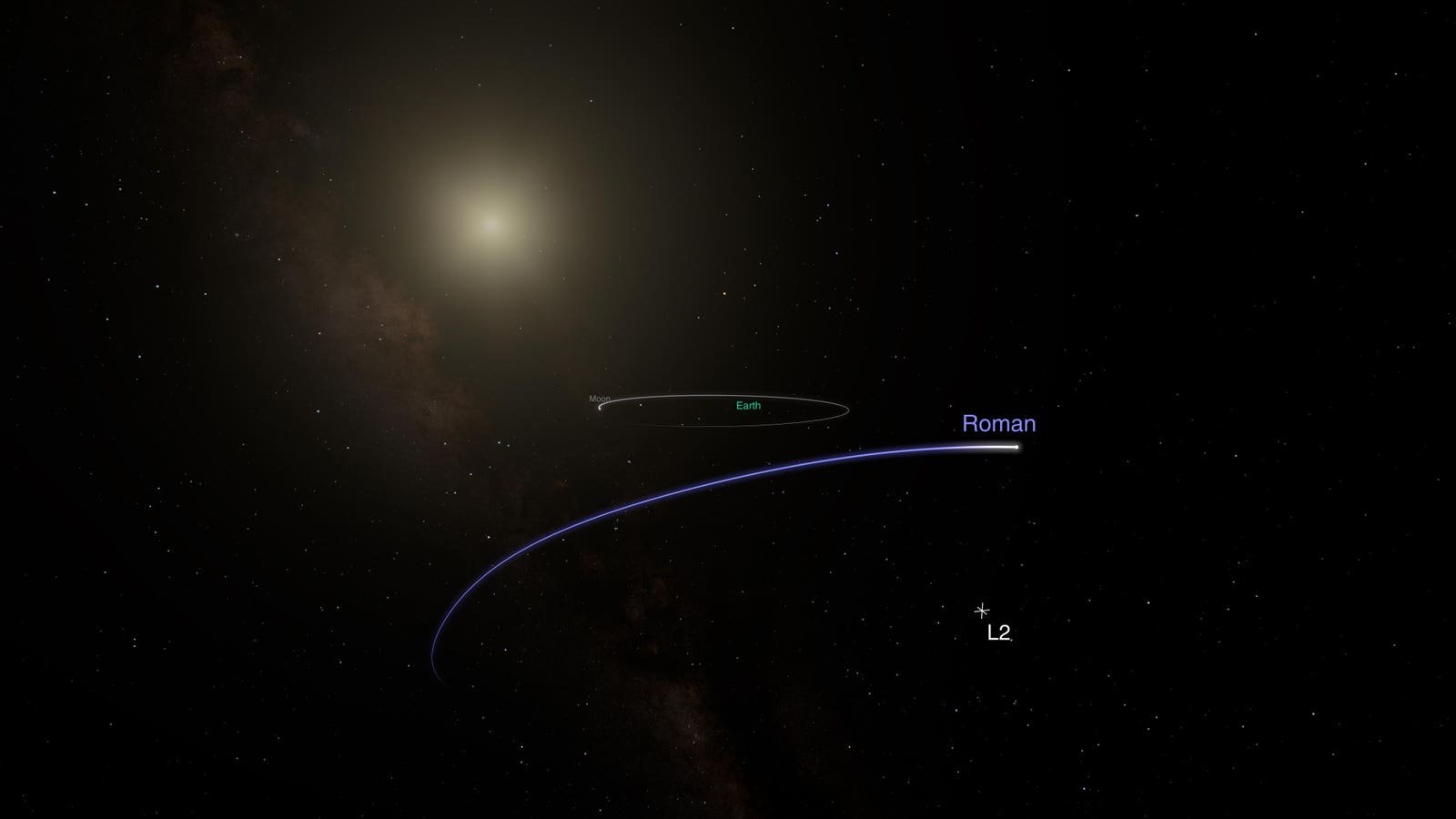
An artist’s view of NASA’s Nancy Grace Roman Space Telescope orbiting L2, a million miles from Earth — where it will join the James Webb Space Telescope.
Kel Elkins (Science and Technology Corporation) (via NASA)
NASA’s newest flagship observatory launches this weekend, but don’t think of the Nancy Grace Roman Space Telescope as a replacement for either Hubble or the James Webb Space Telescope. Although the three observatories will work together from space, each was designed for a different scientific mission. Hubble excels at producing razor-sharp images of individual objects, Webb peers farther back into cosmic history than any telescope before it, and Roman will survey enormous swaths of the sky to reveal how those objects fit into the wider universe.
That’s exactly how NASA wants astronomers to think about the three observatories. Shawn Domagal-Goldman, director of NASA’s Astrophysics Division, compares them to photographers exploring a forest. Hubble and Webb can zoom in on individual trees, leaves and birds, he said during a NASA press conference on July 29, while Roman “has that wide-angle view of the forest and the sharpness to see the birds and leaves on those trees.” In reality, the “forest” is the universe itself, with galaxies, stars and planets replacing trees and wildlife. Rather than competing with Hubble and Webb, Roman will provide the broader context that allows both telescopes to make even more important discoveries.
Roman’s Superpower: Seeing The Bigger Picture
Roman carries the same 2.4-meter (7.9-foot) primary mirror as Hubble, but its Wide Field Instrument can capture an area of sky more than 100 times larger in a single observation while maintaining comparable image quality. Over its five-year prime mission, Roman is expected to map more than two billion galaxies and collect about 20 petabytes of science data, creating the largest panoramic surveys ever made from space. Hubble has observed about 0.1% of the night sky during its 30-year mission, whereas Roman has the potential to cover the entire sky at the same resolution.
The scale is almost impossible to visualize. “Roman is poised to conduct revolutionary surveys that will impact every area of astronomy,” said Julie McEnery, Roman’s senior project scientist at NASA Goddard. She added that displaying just one image from the mission’s largest survey would require more than half a million 4K televisions, enough to stretch across 45 Manhattan city blocks or completely cover El Capitan in Yosemite National Park.
Five Ways Roman Could Rewrite Astronomy
Roman’s panoramic vision isn’t simply about producing bigger pictures. Astronomers expect it to tackle some of the biggest unanswered questions in modern science.
First, it will investigate dark energy, the mysterious force accelerating the expansion of the universe, by mapping billions of galaxies and observing thousands of distant supernovae. At the same time, those observations will produce the most detailed maps yet of dark matter, revealing how the invisible substance that outweighs normal matter has shaped the universe over billions of years.
Roman will also conduct what McEnery calls “the largest census we’ve ever done of planets outside our own solar system.” Using gravitational microlensing, it is expected to discover around 100,000 exoplanets, including thousands orbiting far from their stars — regions that previous missions have struggled to explore — as well as populations of rogue planets wandering through the Milky Way without orbiting any star at all.
Finally, Roman carries an advanced coronagraph that will block the overwhelming glare of nearby stars to directly image giant exoplanets and see planets 100 million times fainter than their stars. Although primarily a technology demonstration, it will test techniques that future observatories could use to photograph Earth-like planets around nearby sun-like stars. “It will be a crucial pathfinder for a future Habitable Worlds Observatory,” said Schuyler Wolff, an associate research professor of astronomy at the University of Arizona leading the observation planning working group for the Coronagraph Instrument, referring to a recommended futuristic telescope that would be specifically designed to search for signs of life in other star systems.
Working Together From Deep Space
After launch, Roman will travel to the sun-Earth L2 Lagrange point, about one million miles from Earth, joining Webb in deep space while Hubble continues orbiting much closer to our planet. From there, the observatories will complement one another. Roman will identify the most intriguing galaxies, black holes and planetary systems across enormous regions of sky, allowing Webb to zoom in for detailed follow-up observations, while Hubble continues providing high-resolution imaging across visible and ultraviolet wavelengths.
“Roman’s vast reach will allow us to find the weird, the rare, and the unusual,” said McEnery. “We’ll redefine what it means to find a needle in a haystack.”
Wishing you clear skies and wide eyes.
source: https://www.forbes.com/sites/jamiecartereurope/2026/08/29/nasas-new-roman-vs-hubble-vs-webb-whats-the-difference/



