
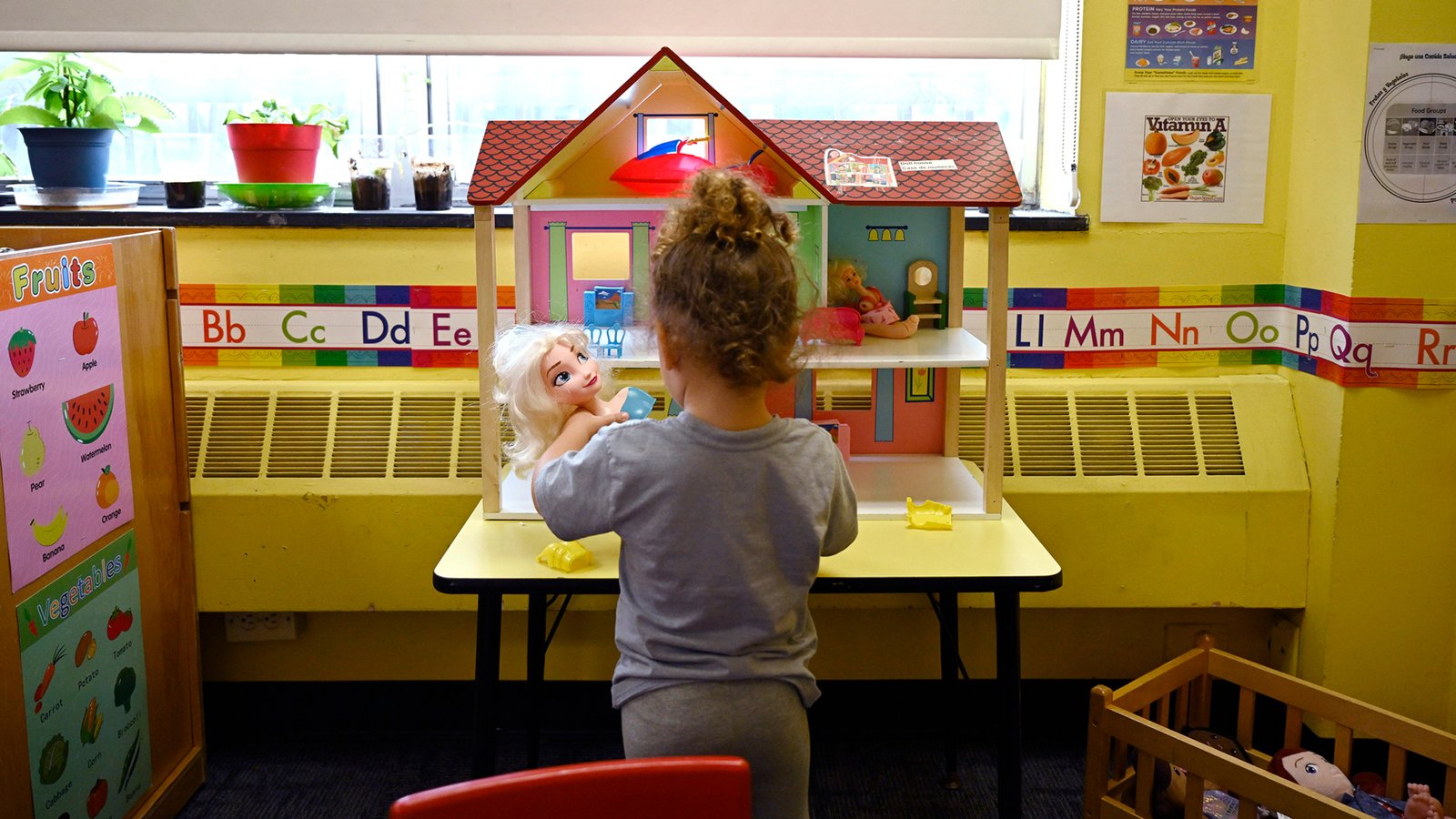
New Jersey now has the nation’s second highest-funded preschool program and the third-highest 3-year-old enrollment, moving up a rank in each of those categories, according to a Rutgers University report.
The gains point largely to the broadening of free universal preschool, which ramped up in 2018 and was codified last year under the Universal Preschool and Kindergarten Expansion Act.
Though higher enrollment is a positive indicator for a new, evolving program, the state also faces a wide participation gap.
In all, 61% of eligible 3- and 4-year-olds are not yet signed up for preschool, according to “The State of Preschool 2025,” released Wednesday by the National Institute for Early Education Research at Rutgers University.

Preschool enrollment shortfalls also persist in the universal pre-K program established more than 25 years ago in 31 high-poverty districts, called Abbott districts, according to a 2025 report by the Education Law Center, a Newark-based advocacy group.
“We have a very strong program that has cracks in the foundation,” said Steve Barnett, the Rutgers early education institute founder and senior director. “And we have a new law and a new governor that seem intent on not only repairing those cracks but moving forward.”
Gov. Mikie Sherrill proposed preschool education aid next year of $1.38 billion, for a 9.3% increase in the 293 school districts with free preschool. That pot of money includes $4.5 million to expand free access to full-day preschool, down from $10 million in the current fiscal year, according to the nonpartisan Office of Legislative Services.
The preschool aid also includes $4.6 million for education workforce preparation and training, according to the budget.
‘Best program on planet’
“Arguably, New Jersey has had the best preschool program on the planet — very high standards for quality, solid funding and a good structure for supporting strong implementation,” Barnett said. A preschool aid boost “in a state that has a structural budget deficit, signals that’s a clear priority.”
New Jersey spends an average $18,848 per child in preschool, placing between Washington, D.C., the nation’s top such spender, and Oregon, according to the institute’s national annual report of the preschool landscape.
The state placed third — up from fourth last year — for enrollment of 3-year-olds. That age group totals 27,673, for 27% of enrollment, the report showed. First on the list was Washington, D.C., with 76% enrollment, followed by Vermont, with 56% enrollment.
Since few states prioritize education for 3-year-olds, “to be one of the states that begins with saying, ‘It’s not just a 4-year-old program, it’s a two-year preschool program’ – that’s a big deal,” Barnett said.
Education before age 5 can lead to better outcomes into adulthood, on test scores, reading and math proficiency, mental health and more, according to the federal government-run National Institute of Child Health and Human Development.
The state has a 35% enrollment rate of 4-year-olds, making it 21st among states by that measure. Washington, D.C., has 94% and Vermont has 72%, for the nation’s top such rankings.
Short one benchmark
“Not only does preschool access vary by which state a child happens to live in, but so does the quality of that preschool experience,” said Allison Friedman-Krauss, lead author of the report. “Only high-quality early care and education programs support children’s development enough to result in lasting academic and other gains that ultimately deliver savings for taxpayers.”
New Jersey hit nine of 10 benchmarks the Rutgers institute identified as features of a high-quality preschool program. As in past years, the state lacked a higher education standard for teacher assistants.
State policy requires a high school diploma for those employees. Experts say that position entails more hands-on teaching in preschool than in K-12, and should require some additional credentials, such as a child development associate’s degree.
High-poverty districts
Under a 1998 state Supreme Court ruling in the landmark Abbott v. Burke case, the 31 poorest districts have compulsory free universal pre-K. Those enrollments, though are falling short.
Only five meet or exceed the 90% enrollment requirement, including Hoboken and Irvington. Keansburg, a borough in Monmouth County, has the lowest enrollment at 58%, and Newark, the state’s largest district, has 75%.
“Just because the districts are falling off the beam doesn’t let the state off the hook,” Barnett said. “That’s really where the state has a critical responsibility.”
New Jersey’s “rapid expansion” of preschool, “while laudable, has outpaced the state’s capacity to provide the oversight, technical assistance, and sustained quality improvement needed to ensure strong results,” according a December policy brief by Rutgers’ National Institute for Early Education Research.
The brief outlined ways the Sherrill administration could improve the program, primarily by updating the preschool aid formula and adding preschool staff to the state Department of Education.
“I suspect one of the reasons [Abbott] districts are not able to improve enrollment is because their preschool programs are underfunded,” Barnett said. “The state should be assisting the districts in employing strategies, collecting data and seeing what works to get kids into the programs.”
The state Department of Education’s proposed budget for 2027 asks for two new positions in the department, but not for the preschool office. The new positions would be for the school finance office to help monitor school district budgets, some of which are in dire need of more funding.



