
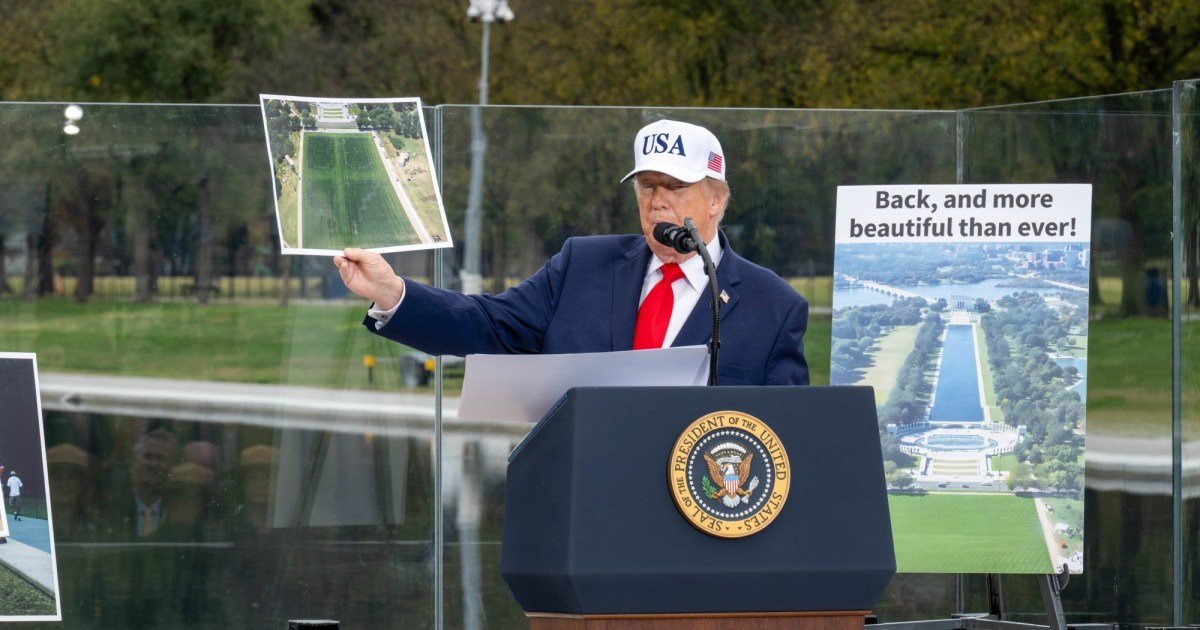
President Donald Trump spent his last speech before the midterms talking about the Reflecting Pool again.
Will undecided voters in states such as Alaska and Michigan base their ballot decisions Tuesday on President Donald Trump’s fountain repairs in Washington, DC?
If so, Trump’s 47-minute appearance on Monday afternoon at the Lincoln Memorial Reflecting Pool would make sense. But polls sh0w voters are worried about high prices, corruption, and Trump’s war with Iran, not DC algae blooms. And the president’s use of his final scheduled appearance before the midterms to talk about pipe replacements looks like the bizarre self-indulgence of a guy utterly uninterested in the problems of regular Americans.
Wearing a white USA hat and looking tired, Trump brandished photographs intended to make the case that his widely derided effort to repair the Reflecting Pool was a great success. He said, not for the first time, that the algae that have plagued the pool through several presidential administrations are at last vanquished. And he again attempted to fault vandals for damage to the pool that both the Justice Department and the firm that he hired through a no-bid $15 million contract to do the job have said was caused by contractor error.
Trump and Interior Secretary Doug Burgum used a press conference with a smattering of attendees to celebrate what they tout as their transformation of Washington. Trump talked up various fountains that are working again, having financed their rehabilitation with money diverted from national parks elsewhere in the country.
The president also gave a shout-out to his “National Garden of American Heroes,” a collection of, until Monday, 250 statues of famous Americans he intends to install near the Thomas Jefferson Memorial. But on Monday, Trump announced that the number of statues has grown to 500 and informed his audience that the work has “already started.”
That may be news to the Justice Department. In federal court, where opponents of the statue garden are seeking a court order blocking the work—which Congress has not approved—Principal Deputy Assistant Attorney General Adam Gustafson said in an October 29 motion that the administration has not completed decision-making on the garden, let alone begun work. “The National Park Service has not received direction to include the National Garden of American Heroes in West Potomac Park,” Gustafson wrote last Thursday.
Trump also talked up his controversial plans to overhaul a golf course in East Potomac Park, and the 250-foot arch he plans to build in front of Arlington National Cemetery. The “triumphant arch military complex,” as the president now calls it, “will have tremendous drone capability,” he said. “I would say sniper or shooter capability.” Trump recently began invoking a national security justification for the decorative arch in an evident ploy to try to get courts to grant deference to the plan. “It will be the most beautiful arch in the world,” Trump added on Monday. “It will be more beautiful than the Arc de Triomphe.”
Eventually, Trump shifted his attention to the election. In a familiar refrain, he called Democrats communists and repeated a seemingly racist, though also incoherent, attack on Abdul El-Sayed, the Democratic Senate nominee in Michigan. Trump said the Senate needed “a little bit of apple pie,” not “a jihadist.”
While gas and diesel prices remain high, Trump touted a recent dip in oil prices, attributing it in part to what he said was the seizure of Venezuela’s oil wealth following the US military takeover in January 2026. While other US officials have tried to downplay US influence in that country and pushed back on accusations of colonialism, Trump on Monday pretty much went there. “When you add in our conquest of Venezuela,” he said, “we are taking in hundreds of billions of dollars of oil every single day.”
Trump defended his work in office, asserting that he has “kept far more promises than I made.” But Trump, as he delivered his remarks, appeared, in a phrase he once popularized, “low energy.” He seemed ready for an electoral setback, acknowledging that the party of the president in power tends to lose seats in midterms. He noted, with uncharacteristic realism, that things were not looking good for the GOP: “We gave this a very strong shot.”



