
For decades, the most important question one could ask of a New Jersey candidate was: do you have the county line? Now, a new question has dethroned it: do you have a super PAC?
While super PACs have been a fact of life in New Jersey and around the country for a while, this was the first cycle that the groups – which can raise and spend unlimited amounts of money on congressional races, provided they eventually disclose their donors and don’t coordinate directly with campaigns – truly took the state by storm and reshaped its most competitive primaries.
Earlier this year, super PAC spending proved to be the decisive factor in the special Democratic primary for the 11th district, though not in the way that those groups had anticipated or hoped. And on the June 2 primary ballot, Democratic in the 7th, 8th, and 12th districts will vote in contests that have been inundated by outside money. (No Republican primaries have seen any outside expenditures this year.)
All in all, super PACs and other outside groups have spent more than $12.1 million in New Jersey this cycle boosting some Democratic candidates and opposing others, a number that may inch higher if any PACs make last-minute investments. Here’s the full breakdown.
7th district: $2,200,710
$1,282,294 for Rebecca Bennett
$648,096 against Rebecca Bennett
$150,024 for Tina Shah
$120,296 for Michael Roth
The last few weeks of the campaign for the 7th district, where four Democrats want to challenge Rep. Tom Kean Jr. (R-Westfield), have been dominated by three super PACs: two intent on making sure Rebecca Bennett wins, and one intent on stopping her.
The two pro-Bennett groups are VoteVets, a liberal veterans’ group that often spends millions of dollars advancing Democratic candidates with military backgrounds, and Article One PAC, a more mysterious group which seems to be acting as a pass-through for other veterans-focused PACs like With Honor Fund. They’ve spent a combined $1,282,294 ($1,028,638 from VoteVets, $253,656 from Article One) on ads that essentially repeat Bennett’s own campaign messaging about her military service and commitment to fighting Donald Trump.
The anti-Bennett spending, meanwhile, is a more complicated story. Two weeks ago, a murky super PAC called Real Change PAC popped up to bash Bennett and promote two of her foes, Tina Shah and Brian Varela; the PAC, which has reported spending $648,096 on the contest, is most likely a GOP front group seeking to prevent Bennett from reaching the general election, but its donors won’t be known for several more weeks.
Real Change PAC’s recent mailers have drawn particular scrutiny for their use of AI, depicting uncanny-valley versions of Bennett standing with ICE officers and wearing a MAGA hat. That may run afoul of New Jersey laws regarding AI-generated “deepfakes,” though there’s not much to be done before the primary tomorrow.
Shah and the fourth Democratic contender, Michael Roth, have gotten much smaller boosts from outside groups. The American Medical Association PAC spent $150,024 on pro-Shah ads, while Coalition for Progress – a group founded with the singular aim of supporting Roth, with some money provided by his relatives – spent $120,296 to support him.
12th district: $2,809,233
$1,903,714 for Adam Hamawy
$393,740 for Sue Altman
$272,071 against Sue Altman
$171,958 for Shanel Robinson
$41,000 for Brad Cohen
$20,000 for Verlina Reynolds-Jackson
$6,750 against Brad Cohen
At first, the wide-open contest for retiring Rep. Bonnie Watson Coleman (D-Ewing)’s 12th district looked like it might become a super PAC free-for-all, but only a handful of outside groups have seen fit to invest very much in the 12-way race.
By far the biggest and most important intervention came from American Priorities, a new super PAC formed earlier this year to boost pro-Palestine candidates and serve as a counterweight to the American Israel Public Affairs Committee. American Priorities decided early on that 12th district candidate Adam Hamawy would be a top priority and has since spent $1,553,845 supporting him, far outstripping any other candidate or PAC’s expenditures.
A constellation of other progressive groups has spent another $349,869 supporting Hamawy, including $191,329 from Justice Democrats PAC and $150,000 from Medicare for All PAC. And contrary to expectations, neither AIPAC nor anyone else ever spent any money opposing Hamawy, allowing him to build an advantage over the rest of the field.
In the waning days of the race, another well-funded super PAC called Project 218 landed in the 12th district to support a rival candidate, Sue Altman. The PAC, which has somewhat opaque motives but seems to be tied to national Democratic groups like the opposition research firm American Bridge, has reported spending $393,740 boosting Altman.
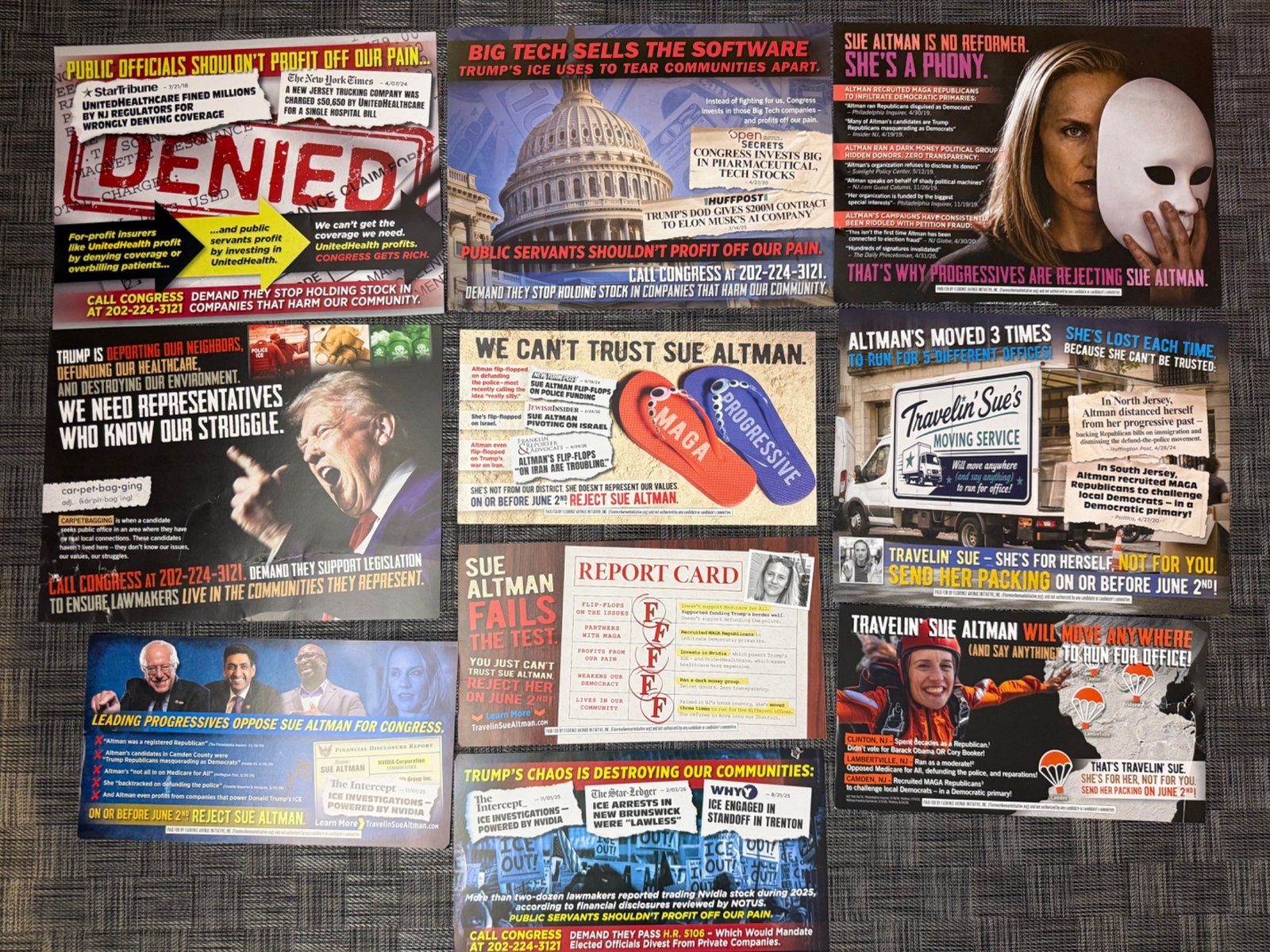
Altman, though, has also had to deal with the Florence Avenue Initiative, a heavily shrouded group with a penchant for meddling in New Jersey races. Florence Avenue Initiative has flooded the district with $265,321 worth of anti-Altman mailers and ads, many of which utilize AI to depict Altman in an unflattering light; the group has not reported its donors, but Altman has said she suspects her longtime nemeses in the South Jersey Democratic machine are behind it.
Three other groups have also spent smaller amounts to support three candidates backed by local party organizations: $171,958 from the Servant-Leader Fund for Shanel Robinson, $41,000 from Voice of the Electorate for Brad Cohen (featuring another interesting use of AI in politics), and $20,000 from the Affordability Initiative for Verlina Reynolds-Jackson. The Servant-Leader Fund, a veterans’ focused group, seems to be part of the same PAC network as Article One PAC and With Honor Fund; not much is known about the pro-Cohen or pro-Reynolds-Jackson PACs.
Finally, Citizens Against AIPAC Corruption – better known as the social media account Track AIPAC – has spent $13,500 attacking both Cohen and Altman.
8th district: $924,124
$924,124 for Rob Menendez
While the battle between Rep. Rob Menendez (D-Jersey City) and former Jersey City school board president Mussab Ali hasn’t become the kind of super PAC slugfest that the 8th district witnessed two years ago, several outside groups have unexpectedly stepped up to give Menendez a boost in the race’s final weeks.
By far the biggest investment came from Think Big, an AI industry super PAC seeded with tens of millions of dollars by OpenAI and Andreessen Horowitz. The PAC – which has been known to both get involved in hotly contested races and more obscure contests where one candidate is heavily favored – has spent $649,899 on pro-Menendez ads and mailers. (The group evidently wasn’t bothered by Menendez’s own ads disparaging AI data centers.)
Also coming in to support Menendez was Protect Progress, a cryptocurrency super PAC that’s spent $262,965 boosting the two-term congressman; Menendez has now benefited from cryptocurrency spending in all three of his primary elections. Lastly, there’s the National Association of Realtors PAC, which dropped $11,260 on pro-Menendez “digital ad buys, meta, and GIFs.”
2nd district: $81,319
$81,319 for Bayly Winder
Super PACs have largely steered clear of the Democratic primary for the 2nd district, where four Democrats want to wage an uphill battle against Rep. Jeff Van Drew (R-Dennis). The one exception: South Jersey Leadership, a PAC founded exclusively to give one Democratic candidate, Bayly Winder, a leg up.
The PAC, which was mostly funded by Winder’s father, has spent $81,319 on digital ads and mailers supporting Winder. That’s far less than what super PACs have spent in other races, of course, but it could go a long way in an otherwise low-cost contest.
(Another super PAC with close ties to rival Democratic candidate Tim Alexander – Alexander’s own email address was listed as the contact for the PAC, Common Ground Coalition – never reported raising or spending a dime.)
11th district (including February special primary): $6,119,423
$2,465,144 against Tom Malinowski
$2,115,938 for Tahesha Way
$734,274 for Tom Malinowski
$465,656 for Analilia Mejia
$306,472 for Zach Beecher
$31,939 for Brendan Gill
It’s old news at this point, but the definitive super PAC story of 2026 may still be the 11th district, where AIPAC spent millions to sink former Rep. Tom Malinowski – and ended up with a much more progressive congresswoman, now-Rep. Analilia Mejia (D-Glen Ridge), instead.
AIPAC’s designated super PAC, the United Democracy Project, spent $2,326,917 disparaging Malinowski in the weeks leading up to the February 5 special primary. At the same time, AIPAC’s donors funneled money into a different group, the Democratic Lieutenant Governors Association, which spent $1,720,986 boosting Tahesha Way.
Two other PACs also got involved in the Malinowski-Way war. The 218 Project – not to be confused with Project 218, the pro-Altman group in NJ-12 – was formed with the explicit purpose of propping up Malinowski, and spent $734,274 to support him. Way, meanwhile, got $350,000 in additional support from Article One PAC; the money came by way of the Guzman Foundation, a dark-money organization about which basically nothing is known.
Brendan Gill’s allied PAC, Affordability and Progress PAC, spent $31,939 supporting him and another $138,227 bashing Malinowski, and VoteVets came in with a $306,472 investment to support Beecher.
The winner, though, was Mejia, who got $442,972 in outside aid from a coalition of progressive groups, chief among them the Working Families Party PAC. Mejia now faces a trio of primary opponents for a full term, and she’s gotten another small investment of $22,684 from her progressive allies.



