
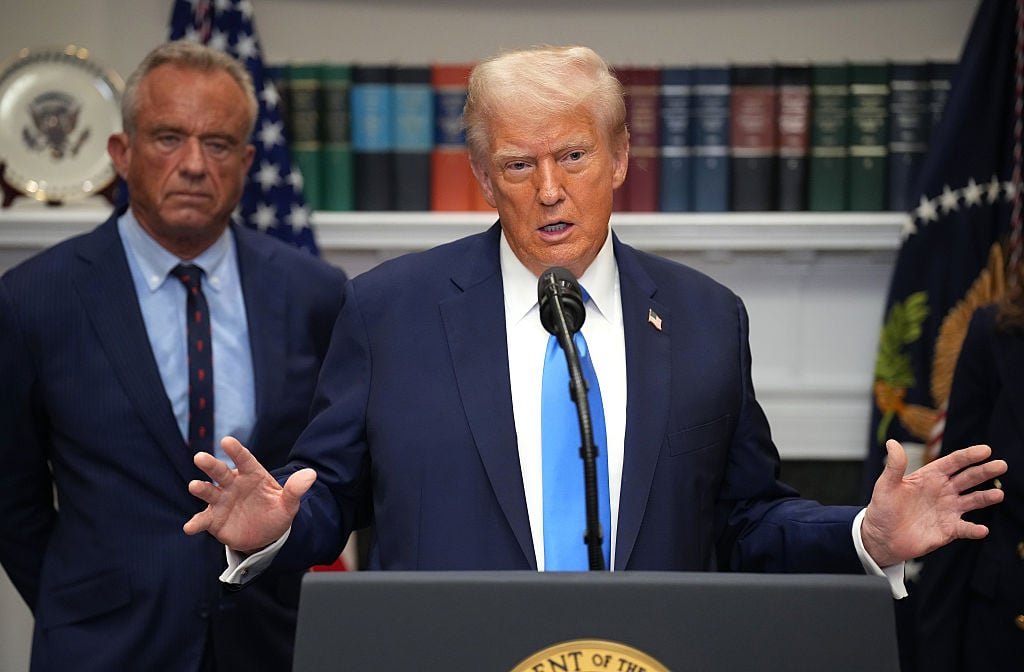
President Donald Trump has endorsed a decision by the Department of Health and Human Services to cut down the number of required vaccinations for children, directing federal agencies to align their policies with HHS’ assessment.
In an executive order issued Friday, Trump directed the Centers for Disease Control and Prevention (CDC) and its Advisory Committee on Immunization Practices (ACIP) to review and potentially update the childhood immunization schedule, backing a move earlier this year to reduce vaccine recommendations.
In December, Trump issued a memorandum instructing the Centers for Disease Control and Prevention (CDC) to review the childhood vaccine schedule. A month later, in January HHS Secretary Robert F. Kennedy Jr. announced a major overhaul to the immunization schedule for children in the U.S., eliminating six of the 17 vaccines that were previously recommended to protect them from disease.
The new schedule removes recommendations for flu and COVID vaccines for children. Also chopped were shots for rotavirus, meningitis, hepatitis A and hepatitis B. These shots can still be administered but only after consultation with a healthcare specialist.
The changes were determined through a “comprehensive scientific assessment” of the U.S. immunization schedule compared to other developed nations, according to a release from HHS.
“The scientific assessment found that the United States currently recommends more childhood vaccines than any peer nation, including more than twice as many vaccine doses as some European nations, and identified a set of consensus vaccines that are consistently recommended in all peer countries. The scientific assessment also found that, instead of implementing vaccination mandates, most peer nations maintain high childhood vaccination rates through public trust and education,” Trump wrote in an executive order.
The scientific assessment, with its proposed updates to the categories of the vaccine schedule, is acknowledged as a guiding resource for the federal government, Trump wrote.
“The CDC and ACIP shall review the scientific assessment and the latest clinical data and, to the extent permitted by law, take any appropriate steps to update the United States childhood and adolescent vaccine schedule. ACIP’s review should consider ways to provide maximum flexibility to parents and doctors through recommendations for timing and sequencing of the administration of routine immunizations,” Trump wrote in the EO.
Trump wrote in the EO that it is the policy of the United States that the core childhood vaccine schedule “should be aligned with scientific evidence and best practices from peer, developed countries while preserving access to vaccines currently available to Americans and that the federal government will continue to protect religious freedom and enforce all legal protections for parents.”
Major medical groups have pushed back on the administration’s high-profile changes to vaccine regulations and recommendations. The American Academy of Pediatrics (AAP) and other prominent medical organizations filed a lawsuit against HHS to reverse changes to the CDC’s childhood vaccine recommendations.
In March, a federal judge in Massachusetts blocked significant parts of the HHS’ vaccination agenda, finding that officials acted unlawfully in ushering in certain changes.
Contrary to HHS’ assessment, American Medical Association president Bobby Mukkamala, M.D., asserted “there is no credible scientific evidence to support changing the current childhood vaccine schedule.”
“That schedule is built on decades of rigorous research and real-world data, and it is designed to protect children in the U.S. when they are most vulnerable based on our nation’s disease burden,” Mukkamala said in a statement issued on Saturday. “Altering it without clear, evidence-based justification risks continued confusion for parents and patients, undermining trust in vaccines, and ultimately lowering vaccination rates. That would put more children and communities at risk of preventable illness.”
“Vaccines are one of the most effective tools in modern medicine. Decisions about their use must be guided by science, patient safety, and the expertise of unbiased physicians and public health experts—not by policy shifts that erode confidence in proven protections,” Mukkamala said.



