
According to the Bible, the world’s first con man was a snake. It deceived Adam and Eve, leading them to commit the first sin, which is how we wound up living in this messed-up world we have now.
I mention this because we are approaching the start of Florida’s snake-snagging season. The official name is the Florida Python Challenge, but I like to call it “the Florida version of The Simpsons’ ‘Whacking Day.’ ”
Starting July 10 and running through July 19, professional and amateur snake-catchers will invade the South Florida swamps to beat the bushes for Burmese pythons — literally. They’ll be vying to see how many “Burms” they can capture, motivated by the big-money prizes and extensive public attention. There’s even a documentary film about the hunt.
Last year’s contest drew a whacking great crowd: 934 contestants from 30 states and even Canada, who collected 294 pythons. A social media celebrity from Naples named Taylor Stanberry became the first female champ, winning the $10,000 first prize by catching 60 pythons.
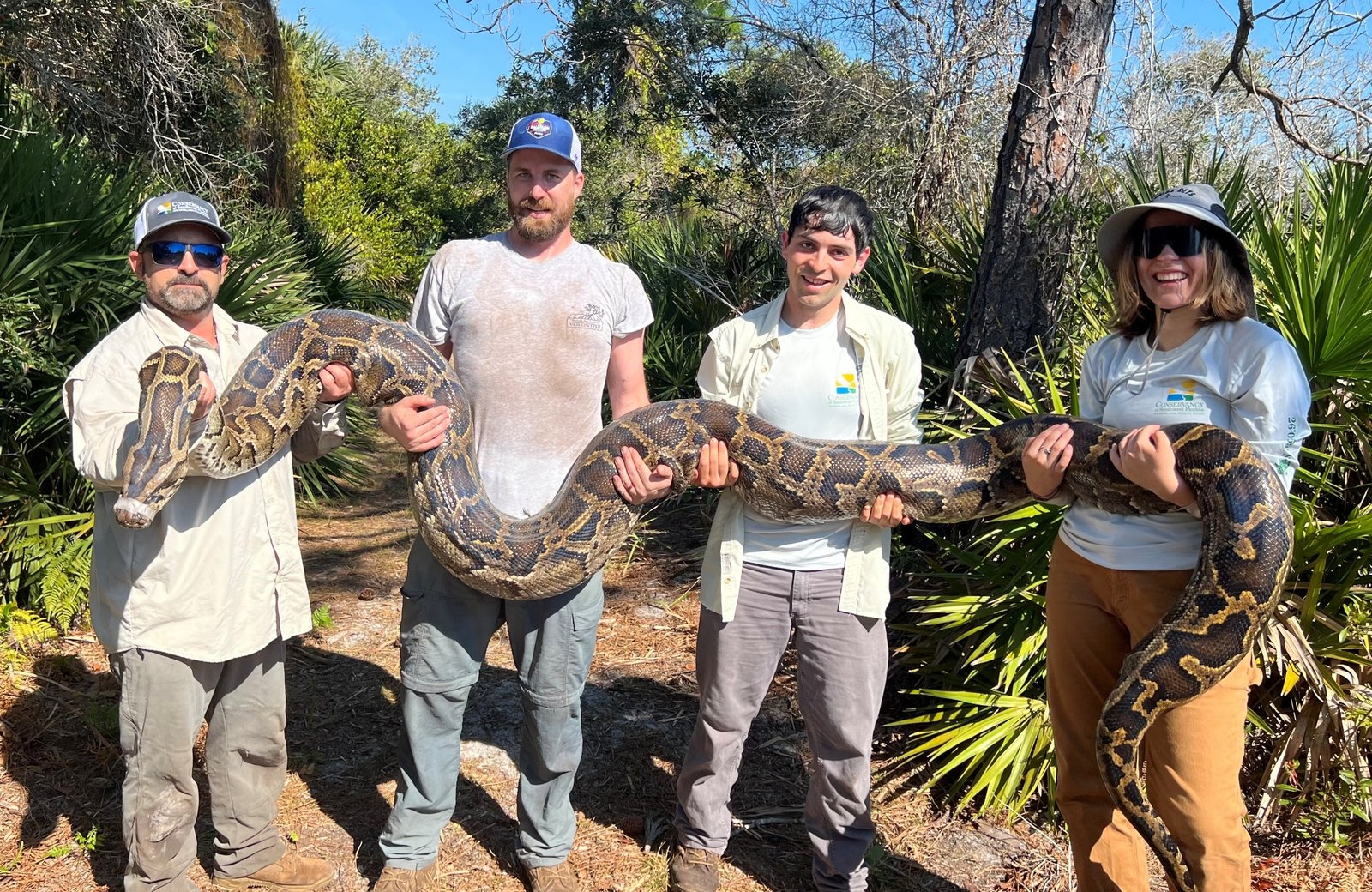
Contrast this with a lower-profile pursuit that made news last week: Four biologists who work for the Conservancy of Southwest Florida brought in 177 pythons weighing an eye-popping 8,080 pounds.
WINK-TV reported that that weight beat last year’s total by 2,000 pounds.
“This was our first four-ton removal season,” said Ian Bartoszek, the wildlife biologist who is the conservancy’s science manager.
The celebrated state roundup tends to bring in snakes the size of sticks. The Conservancy wrangles snakes as big around as entire trees.

The Conservancy crew is the one that’s caught both the largest female python in the state (nearly 18 feet long, 215 pounds) and the largest male python (16 feet, 140 pounds).
So far, though, nobody has handed them any $10,000 prize checks or filmed a documentary about them.
Intrigued, I set up an interview with Bartoszek, and I’m glad I did. He’s as analytical as he is adventurous — and he delivered a sobering warning.
“This is a South Florida problem,” he told me, “that is rapidly turning into a Central Florida problem.”
The real swamp
The first Burmese python turned up in the Everglades in 1979, but no state or federal official took the invasive snake problem seriously until the 2000s. Since then, their main response has been to dispatch armed hunters to kill as many as possible. Yee-haw!
That Wild West approach has seen only limited success, although our politicians keep doing their best to put on a happy face and declare “victory.”
In October, for instance, Gov. Ron DeSantis contended that by partnering with a company that turns python skin into belts and shoes, the state had tripled the number of pythons caught.

He said the state’s partnership with the Miami company, Inversa, had “supercharged” the removal. Actually, all it did was give the state’s poorly paid trappers a greater financial reward for catching snakes.
What DeSantis didn’t mention is that Inversa has a connection to his own political fortunes.
Inversa’s parent company, Quintessence Marine, put $82,000 over the past year or so into a political committee controlled by a lobbying company named Capitol City Consulting, according to investigative journalist Jason Garcia.
The lobbyists use that political committee to make donations to the governor and legislators on behalf of their clients. That committee gave $60,000 to DeSantis’ “Florida Freedom Fund” in January, Garcia told me.
Quintessence Marine also lobbied the Legislature to boost state funding for python removal, he said.
The owner of Capitol City Consulting, incidentally, is Rodney Barreto. A developer, Barreto also serves as chairman of the Florida Fish and Wildlife Conservation Commission, which runs the annual Python Challenge.
The top sponsor of the wildlife commission’s python hunt this year just happens to be Inversa.
Gee, maybe the real snake-infested swamp is the one in Tallahassee.
Anyway, you can see why I was eager to talk to an expert South Florida snake handler who’s NOT affiliated with this bunch.
No more monkey rodeo
The first time Bartoszek captured a python, he said, he’s glad no one took pictures or video. During the struggle, he split his pants at the crotch.
This happened during Christmas week in 2012, he said. He and a state panther biologist were in Immokalee talking to farmworkers. Afterward, the two biologists asked the farm’s owner if they could roam around and look for pythons. Suit yourself, they were told.
They mounted all-terrain vehicles and took off down the levee. The panther biologist got about 100 yards in the lead, then stopped dead. Bartoczek saw him waving his arms but didn’t understand why until he’d pulled even.
Then he saw the 10-foot snake lying across the levee, clearly trying to avoid attracting notice. If it made it to a nearby canal, the snake would get away forever.
Bartoczek leaped off the vehicle and wrapped his hands around the snake’s tail. He quickly learned that that’s the wrong end to grab.
“What followed was 15 to 20 minutes of the most insane snake-wrestling monkey rodeo you’ve ever seen,” he told me. “I wound up on the ground, covered in mud and (snake) musk and with my pants ripped up. But I eventually got my boot on top and pinned the head.”
Now, when he and his team of biologists venture into the wilds of Southwest Florida, they are so well coordinated that sometimes they don’t even need to speak, he said. Even though they’re often wrestling a snake so large it’s like a horror movie monster, they each know what role to play.
“It’s a well-oiled machine,” he told me. Often, after a smooth operation, he tells his teammates they remind him of the mercenaries on the old TV show “The A-Team.”
Of course, his most important teammates are the scout snakes.
A creepy cool nightmare
The first person I ever heard mention the use of scout snakes was a biologist named Frank Mazzotti, nicknamed “the Croc Doc.”

Mazzotti, one of the smartest scientists I’ve ever met, had for years specialized in studying Florida’s crocodile population. Florida is the only place in the world where alligators and crocodiles live together in peace — with each other, that is, not with us humans.
But as invasive species have grown into a bigger and bigger threat, Mazzotti turned his attention to the reptiles moving in on Florida’s native species — pythons, iguanas, tegus, and so forth. He told me he decided to try turning some pythons into scout snakes after learning of the success a Venezuelan biologist had with giant anacondas.
When Florida officials scheduled the first Python Challenge in 2013, which attracted some 1,500 publicity-hungry amateurs, Mazzotti took three of the live pythons that were turned in. He put tracking devices on them and turned them loose again.
Hunters went straight past the tagged snakes, utterly oblivious. That’s how good pythons are at hiding.
That year, the Conservancy began using this “scout snakes” technique as its primary tool for hunting their targets. They have now equipped a total of 40 snakes with tracking devices, then turned them loose during python mating season.
The tagged snakes — bearing fluorescent orange tags and highly visible scale marks so no human hunter will take them out — follow the pheromones of fertile females.
Their radio signals show the biologists where they’re headed. The scientists can then interrupt their reptilian get-down groove.
If you’re a sensitive soul, I do NOT encourage you to Google the term “mating ball,” but that’s what sometimes turns up. Two years ago, Bartoszek’s team located not one but two mating balls in one day. They captured 11 pythons, one of them more than 16 feet long.
“It’s probably most people’s worst nightmare,” he told the Miami Herald, “but for us, it’s a good day. … Most would say it’s creepy, but it was creepy cool to see.”
Serial killer in action
What’s even creepier is what turns up when the Conservancy crew conducts a necropsy, the animal version of an autopsy.
They cut open every snake to document what the pythons have been eating. The answer is: Everything.
“We’ve documented 57 species of birds and 28 species of mammals,” Bartoszek told me.
This verifies the findings of a 2012 study that Mazzotti worked on. That study found that in the areas of the Everglades where pythons proliferated, they had all but emptied the landscape like an overenthusiastic vacuum cleaner.
The study found a 99% decrease in raccoons, a 98% drop in opossums, a 94% drop in white-tailed deer, and an 87% drop in bobcats. Rabbits and foxes had entirely disappeared.
White-tailed deer, the favorite prey of our state animal, the Florida panther, is a particularly big loss.
One surprising fact that Bartoczek’s crew documented recently: For many female pythons that are about to lay eggs, their last meal is a white-tailed deer. Think of it as the python version of a power bar, boosting their energy and stamina ahead of the ordeal of producing offspring.
At one point, the biologists even interrupted a female python halfway through swallowing a 77-pound deer. Bartoczek remembers thinking, “There’s our serial killer in action.”
What’s really disturbing, though, is how many big snakes they keep finding in the 200 square mile area they cover every year.
You would think, after all these years, the number of ginormous pythons would begin to taper off. Instead, the opposite is happening, Bartoczek said.
He’s not happy about what that means.
“I’ve been doing this a long time,” he told me. “I’d like to see those numbers drop.”
Scientists have been monitoring the trail of DNA left behind by an organism in sources such as feces, mucus, and shed skin. This “environmental DNA” trail has shown the pythons steadily moving northward, Bartoszek said.
“We’re seeing DNA hits well north of Lake Okeechobee,” he told me.
Maybe Disney World better rename Animal Kingdom as “Snakeworld.” And put Mickey and Minnie in protective custody.
Don’t be like Adam and Eve
Over the years I have interviewed a lot of Florida python hunters. It started with Bobby Hill — no relation to the “King of the Hill” character.

Hill was a laconic great grandpa with a shotgun and a prodigious sense of smell. For years, he was the only state employee authorized to seek out and kill pythons.
A veteran Florida outdoorsman and a longtime employee of the South Florida Water Management District, Hill could read the terrain, spot where a snake might be, then verify the hiding place by inhaling the telltale musky scent.
“Once you smell it, you don’t forget it,” he told me. It was the longest sentence I ever heard him say.
One of the better-known hunters these days is Donna Kalil, who’s become a mentor to a lot of the other professional python catchers.
She used to sell real estate. Now she wears a python-skin hat and calls herself a “python elimination specialist.” She also does cooking demonstrations with python meat and eggs.
In 2017, the 5-foot-10 Kalil became the first female python hunter hired by the South Florida Water Management District. She was going to try it for three months. Nine years later, she’s still at it.

Some professional python hunters disdain the annual Python Challenge, but not Kalil. Last year, she won in the professional category for catching more snakes than any other pro — 56. The prize: $2,500. She plans to compete this year, too.
Competing in the contest “is how I got started in python catching,” she told me. “It’s a way of giving back to the community.”
But except for the addition of scout snakes, python hunting has not progressed beyond the Bobby Hill technique.
Over the years, there’s been talk of miraculous technological solutions such as drone flights, phony pheromones, and even robot rabbits. So far, Bartoczek said, not one has proven practical.
That means we still depend on humans laying hands on these snakes as if it were some backwoods religious ritual. We should root for all the dedicated python hunters, even the amateurs chasing a big cardboard check.
But don’t be like Adam and Eve. Don’t be fooled by all the hoopla when the Python Challenge rolls around. Remember which hunters are catching a lot of skinny tree branches, and which ones are bringing in the whole tree.



