
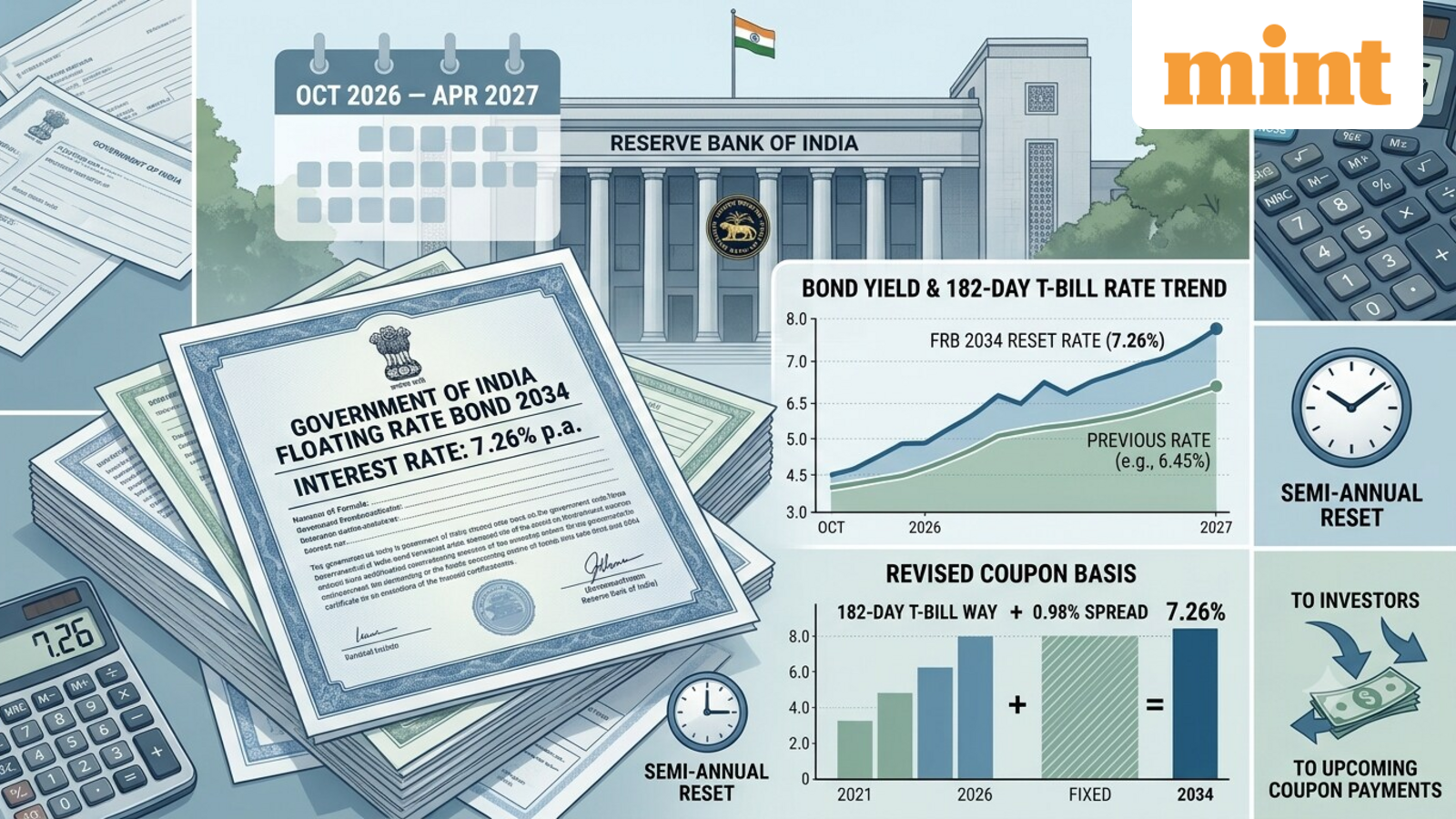
The Reserve Bank of India (RBI) has announced a revised interest rate of 7.26% per annum on the Government of India Floating Rate Bond 2034 (FRB 2034) for the six-month period from 30 October 2026 to 29 April 2027.
This new interest rate of 7.26% per annum, applicable from 30 October 2026 to 29 April 2027, is higher than the earlier rate of 6.45% per annum, which applied from 30 April to 29 October 2026. This marks an increase of 81 basis points (bps) from the previous interest rate.
Floating-rate bonds offer investors the opportunity to earn interest that is periodically adjusted rather than remaining fixed throughout the investment period. Here’s what you need to know.
How is interest rate on FRB 2034 determined?
According to the RBI’s press release on Thursday, “The rate of interest on Government of India Floating Rate Bond 2034 (FRB 2034) applicable for the half-year October 30, 2026 to April 29, 2027 shall be 7.26 per cent per annum.”
The interest rate is linked to the yields on 182-day Treasury Bills (T-Bills), short-term government-issued borrowing instruments.
“It may be recalled that FRB 2034 carries a coupon, which has a base rate equivalent to the average of the Weighted Average Yield (WAY) of last three auctions (from the rate fixing day i.e., October 30, 2026) of 182 Day T-Bills, plus a fixed spread (0.98 per cent),” the release mentioned.
The RBI calculates the base rate by averaging the Weighted Average Yield (WAY) from the last three 182-day T-Bill auctions held before the rate-fixing date. WAY represents the average yield earned by investors, weighted by the amount of securities allotted at different yields.
A fixed spread of 0.98 percentage points is then added to this base rate to arrive at the final interest rate. This spread remains unchanged during the bond’s tenure, while the base rate can change at every reset.
What does the revised rate mean for investors?
For example, an investor holding FRB 2034 with a face value of ₹1 lakh would earn approximately ₹3,630 in interest over six months at an annual rate of 7.26%, before taxes, assuming the investment is held for the entire period.
Since the interest rate is revised every six months, the income can increase or decrease depending on the movement in T-Bill yields. Unlike fixed-rate bonds, do not assume that the current rate will continue throughout the bond’s tenure.
How can retail investors buy government floating-rate bonds?
Retail investors can access eligible government securities through the RBI Retail Direct platform. They must first open a Retail Direct Gilt account.
Investors can participate in eligible primary issuances or purchase existing government securities in the secondary market through the Negotiated Dealing System-Order Matching (NDS-OM) platform.
Government securities carry sovereign backing, meaning the government is responsible for interest payments and principal repayment. However, investors should consider interest-rate resets, taxation, and secondary-market price fluctuations before investing.
Disclaimer: This is for informational purposes only. Please consult a SEBI-registered investment adviser before making any investment decisions.



