

The passing of Yoshihiro Nishimura feels particularly cruel because his cinema always seemed to resist the very idea of death. Bodies in his work were sliced, transformed, exploded, weaponized, reassembled, and turned into grotesque sculptures of flesh and metal, but they rarely simply ended. Instead, they mutated. In that sense, Nishimura’s oeuvre remains one of the most instantly recognizable in contemporary Japanese genre cinema, a bloody, excessive, hilarious, offensive, and often strangely inspired body of work that turned splatter into a form of pop art.
Yoshihiro Nishimura was a rather unique artist, particularly since his work in SFX, makeup, designing, and directing deemed the genre of splatter a highly artistic form, in an accomplishment very few can boast of, and probably none to the degree he managed to do so. He had been interested in cinema from childhood, while a major influence on his career was a painting by Salvador Dalí with distorted human bodies that he saw when he was in elementary school. Although he majored in law, he started making movies while in junior high school by teaching himself filming, lighting, special effects, and modeling.
This self-taught background explains much of his later career. Nishimura was never simply a director who ordered effects to be made for him. He was an effects artist, makeup creator, editor, writer, producer, designer, and sometimes actor, a figure who understood cinema from the ground up and could make a whole grotesque world out of limited means. He once said that directing was his calling, and that, after working for a company that created commercials, he learned to handle many tasks at once, including budgeting and producing.
His cinema was frequently marginalized in Japan, where, as he himself said, pure love stories with teenagers and yakuza movies were more popular, while there was not much budget or audience for splatter. That is the “cancelling” part of his career, not in the sense of an officially confirmed blacklist, but in the sense of a creator whose work was often too extreme, too messy, too bodily, and too strange for the mainstream domestic industry. Abroad, however, Nishimura found a different kind of response. After “Tokyo Gore Police”, he became a cult name internationally, where audiences laughed, screamed, and reacted immediately, unlike the quieter Japanese audience he described.
At the same time, Nishimura’s later years were also marked by controversy and a sense of professional isolation. Although the exact circumstances remain difficult to discuss with certainty from the outside, his name had increasingly become connected with rumors of being sidelined within parts of the Japanese industry. Whether this amounted to a formal blacklist or a more informal kind of distancing, the result was clear enough: a director once celebrated internationally for expanding the possibilities of Japanese splatter found it increasingly difficult to work with the kind of visibility and support his cult status suggested he deserved. In a way, this makes his self-produced later works even more revealing. They show an artist continuing to create despite reduced resources, damaged industry access, and an environment that no longer seemed willing to fully accommodate his excesses.
His own description of his work remains the best one: “What I create is entertainment.” Nishimura wanted to create a “wave” for the audience, to show something gross and at the same time make them chuckle. He wanted to show something nobody had seen before, making sure the audience did not get bored. That idea, the “wave”, is the key to his cinema: horror, laughter, disgust, shock, cheapness, sincerity, slapstick, sensuality, and blood all arriving together, sometimes clumsily, sometimes brilliantly, but almost always unmistakably as his own.
In that regard, it is quite interesting to see where it all started, and “Anatomia Extinction”, an independently produced movie that Nishimura wrote, directed, and did the special effects for, provides a great starting point. The movie was shown at the Yubari International Fantastic Film Festival in February 1995, where it won a Special Jury Award, and eventually became the basis for probably his most famous work, “Tokyo Gore Police”.
The story takes place in an undisclosed time in the near future, when Tokyo is suffering from overpopulation and overcrowding, with the psychological effect on people being rather intense, turning a number of them into serial killers. An ordinary businessman seems to suffer from this ailment also, despite the fact that he is quite lonely in his life. Eventually, while riding the subway, he is first “stalked” by a trans man, then becomes witness to his murder, and finally is pursued by the killer himself, whose appearance is as scary as it is strange.
The killer eventually captures the businessman, but does not seem willing to kill him. Instead, he recruits him to be an “Engineer”, a member of a group with superpowers, whose aim is to reduce the population of the country by killing in the most horrible ways. Soon, and after some strange occurrences that revolve around the way his heart works, the businessman finds himself transforming in the most horrid ways, while his murderous intent eventually brings him against the police.
Yoshihiro Nishimura directs a movie that unfolds in a number of axes, both contextual and technical. The news about overpopulation and the gruesome murders that continuously take place, which are given both as narration and through sequences presented on TV, form the basis of the narrative, since the rest of the story seems to derive from this concept. While Nishimura on occasion uses this “tool” for humorous purposes, his rather serious comments about overpopulation and the alienation Tokyo inhabitants experience also derive from this idea.
The transformation that changes the nature of the movie begins in the protagonist’s body, starting with his heart, which experiences a rather different attack that gradually changes his whole body into something truly monstrous and absurd at the same time. As the transformation proceeds, the Businessman is dominated by his rage to kill, which, after a fashion, knows no boundaries, as exhibited in the fight with the policemen, the visually most impressive sequence of the movie.
The viewer who can see beyond the grotesqueness of “Anatomia Extinction” will discover a rather rich context, essentially one of the most intriguing works of Nishimura and a great entry to the unique oeuvre of the Master of Splatter. Looking at it now, after his passing, it feels even more important, because it already contains almost everything he would keep refining: flesh as machinery, violence as satire, media as absurd commentary, and bodies as the battlefield where society reveals its sickness.

If “Anatomia Extinction” was the origin, “Tokyo Gore Police” was the explosion. Released in 2008, the movie became Nishimura’s cult calling card abroad and remains the title most closely associated with his name. In 2008, after years of working in special effects and special makeup effects for several productions, including Sion Sono’s “Suicide Club” and Noboru Iguchi’s “A Larva to Love”, Nishimura directed his first feature, “Tokyo Gore Police”.
Set in futuristic Japan, the story follows a city terrorized by a serial killer called the Key Man, who has created a virus. Once infected, a human turns into a monster hybrid that basically only thinks about killing. The only way to get rid of them is to cut off the body part where the virus is hiding, or they will come back. To help fight them off, the Tokyo police have privatized a group dedicated to hunting the Engineers, the infected humans.
Ruka, played by Eihi Shiina, is assigned to help the specialized team because she is so good at killing Engineers. She cuts herself and does not like people, but she can cut a man’s face up with the best of them. The movie is dedicated to Ruka’s search for the Key Man and also her father’s murderer. During her search, she not only loses a few loved ones, but also her sense of justice when she begins to uncover the depth of corruption and cruelty the specialized force is actually capable of.
Really, the storyline seems like just an excuse to kill something, but that is alright since the actual killing is done with such flare. Whether Ruka is cutting herself or someone else, the amount of blood spilled in this movie could sink an ocean liner. The small wounds send gallons of blood gushing like broken fire hydrants, until blood becomes not simply an effect but the whole meaning of the image.
What makes “Tokyo Gore Police” great, however, is that Nishimura does not use gore only for shock. His aim is more a celebration of blood and guts, and in that sense he does a remarkable job. He once explained that for Sion Sono’s movies, he could make blood realistic, but for his own cinema, he consciously went his own way, showing much more blood and making it more showy. As a professional, he said, he should be able to manage both approaches.
Eihi Shiina’s presence also became crucial to the movie’s legacy. She is recognized internationally for her role as Asami Yamazaki in Takashi Miike’s “Audition” and as the vengeful police officer Ruka in “Tokyo Gore Police”. In her interview with Asian Movie Pulse, she said that, when talking about her career as an actress, Nishimura was crucial for her success, adding that they had been “fighting through the world” together and that Japan, supposedly their home ground, was the most difficult environment they worked in.
Shiina also described Nishimura as straightforward, pure, quite self-centered, but very clever. He could go too far and make small mistakes, but it never affected his work. No matter how hard the circumstances, thanks to his intuition, he was always able to deliver precise solutions in a short period. In a way, that description captures “Tokyo Gore Police” perfectly: a movie of obsessions and fixations, but also one of precise instinct.

“Helldriver” is another preposterous splatter work by the master of the genre, this time engaging with zombies. The story begins with Taku and his sister Rikka, a couple of roaming sadistic murderers who eventually decide to kill her abandoned husband. During the act, his daughter Kika arrives and attacks them. Subsequently, a meteorite falls on Rikka, releasing a toxic gas that transforms every resident of northern Japan into a zombie, and her into their queen.
Some years later, the country is split in half by a wall that separates the healthy population of the south from the zombies in the north. The government hires Kika, now a skilled zombie killer, to lead a team of outlaws to the north and kill the zombie queen. Not to forget, the only way for someone to kill a zombie is to cut a kind of Y-shaped appendage situated on their head. Furthermore, this appendage, when made into powder, becomes a very addictive drug.
Nishimura, as usual, incorporates as much absurdity as possible, starting with the movie’s title, which appears after almost half an hour has passed. Furthermore, the zombie boxer, the guards with peculiar helmets, and a fighting scene involving a kind of pole dancing are only a few of the irrational scenes and notions appearing here. Apart from these, his usual tendencies are also present: constant bloodbaths, surreal humor, impressive battles, and a rudimentary effort for social remark, specifically concerning drugs and racism.
Yumiko Hara plays Kika and Eihi Shiina, who had become a Nishimura regular, plays Rikka. Expectantly, talking about acting in a splatter movie is futile to say the least, since the actors largely exist to provide a background to the violence and the special effects. Shiina’s presence, though, is as cult as always, and “Helldriver” shows how Nishimura could turn performers into living extensions of his effects work.
“Helldriver” is addressed to very few, but fans of Nishimura and slapstick splatter are bound to enjoy it. It may not be the best place to start for newcomers, but it remains a pure expression of his willingness to push past taste, patience, and logic. In retrospect, it also stands as one of the clearest examples of his refusal to separate horror from comedy, or gore from absurd political allegory.
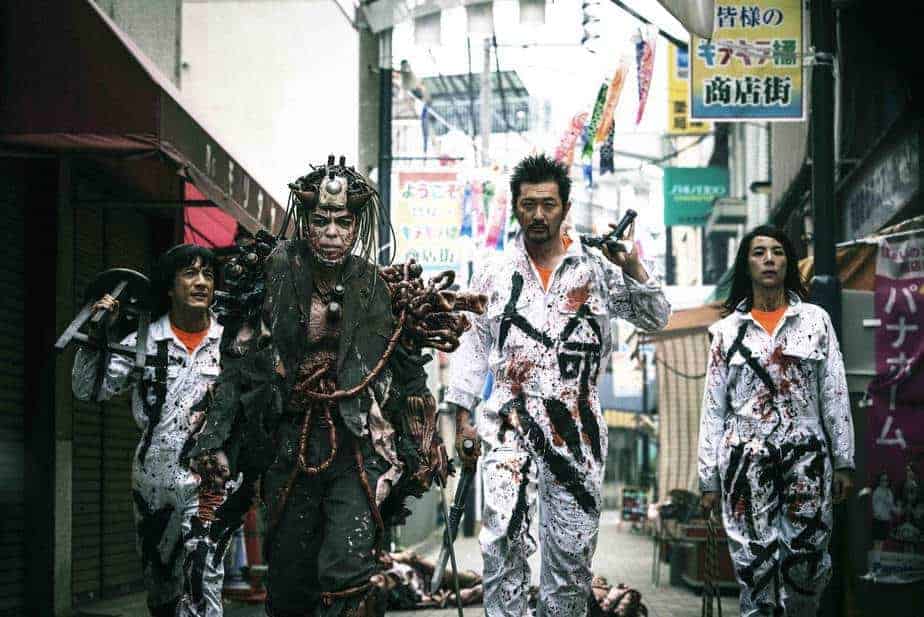
“I consider Yoshihiro Nishimura the undisputed master of Japanese splatter, a man who had moved the genre forward into new and exciting paths through all his roles in similar films, which include Special Effects, Makeup, animation and directing, among others.” That sentence, originally written in the context of “Kodoku Meatball Machine”, now sounds like a concise summary of his entire career.
“Kodoku Meatball Machine” screened as part of the Asian selection at Fantasia International Film Festival, and the fact that Nishimura was going to revive 2005’s “Meatball Machine”, where he had been in charge of special effects, was one of the greatest pieces of news for fans of the genre. The outcome justified that excitement totally.
Yuji is a 50-year-old bill collector and he truly sucks at it, as he cannot get money from anyone he has to, and occasionally he is even stripped from his own. Furthermore, he lives alone, and everyone in his life seems to try to take advantage of him. His boss, his mother, Kaoru, a girl from his bookstore he seems to like who introduces him to a cult, and the members of a sex club who initially draw him in order to comfort him but eventually beat him and leave him with an exuberant bill, all contribute to his misery. If that was not enough, he is diagnosed with cancer, with the doctor suggesting he only has a few months to live.
Around that time, aliens invade the Earth, engulfing an area inside something that looks like a giant glass, and they start invading human bodies, taking control of them and transforming them into NecroBorgs, a kind of biomechanical monster, and attacking anyone in their path. Yuji manages to survive the transformation process, as his host is killed by his cancer, and sets on a path to fight the aliens in order to save Kaoru.
Nishimura takes a totally unexpected approach here, as there is almost no gore for the first 20 to 25 minutes, with the aesthetics being very close to the ones implemented in Sion Sono’s movies. The scenes in the cult’s “church” and the one in the “massage parlor” are distinct samples of this tendency, although the references to “Tokyo Gore Police” are not missing. In that fashion, he manages to analyze Yuji and Kaoru quite a lot for a splatter movie.
At the same time, he parodies many concepts and tendencies of contemporary Japanese society: the police and martial artists, who are presented as fanatic jingoists of sorts, the cults that just want to take money from the people they draw in, the massage parlors that do the same in more obvious ways, the relationships between bosses and employees, the way the public misjudges what it witnesses, since people always assume the worst, and most of all, the sci-fi concept of aliens invading human bodies.
“Kodoku Meatball Machine” is among the best splatter works ever made, a movie that highlights Nishimura’s style and extreme imagination in the most impressive fashion, and a must-see for every fan of the genre. It also reveals something that can be overlooked in his reputation: beneath the blood, he could still structure a story around loneliness, humiliation, illness, exploitation, and the desperate fantasy of becoming powerful after a life of being trampled.
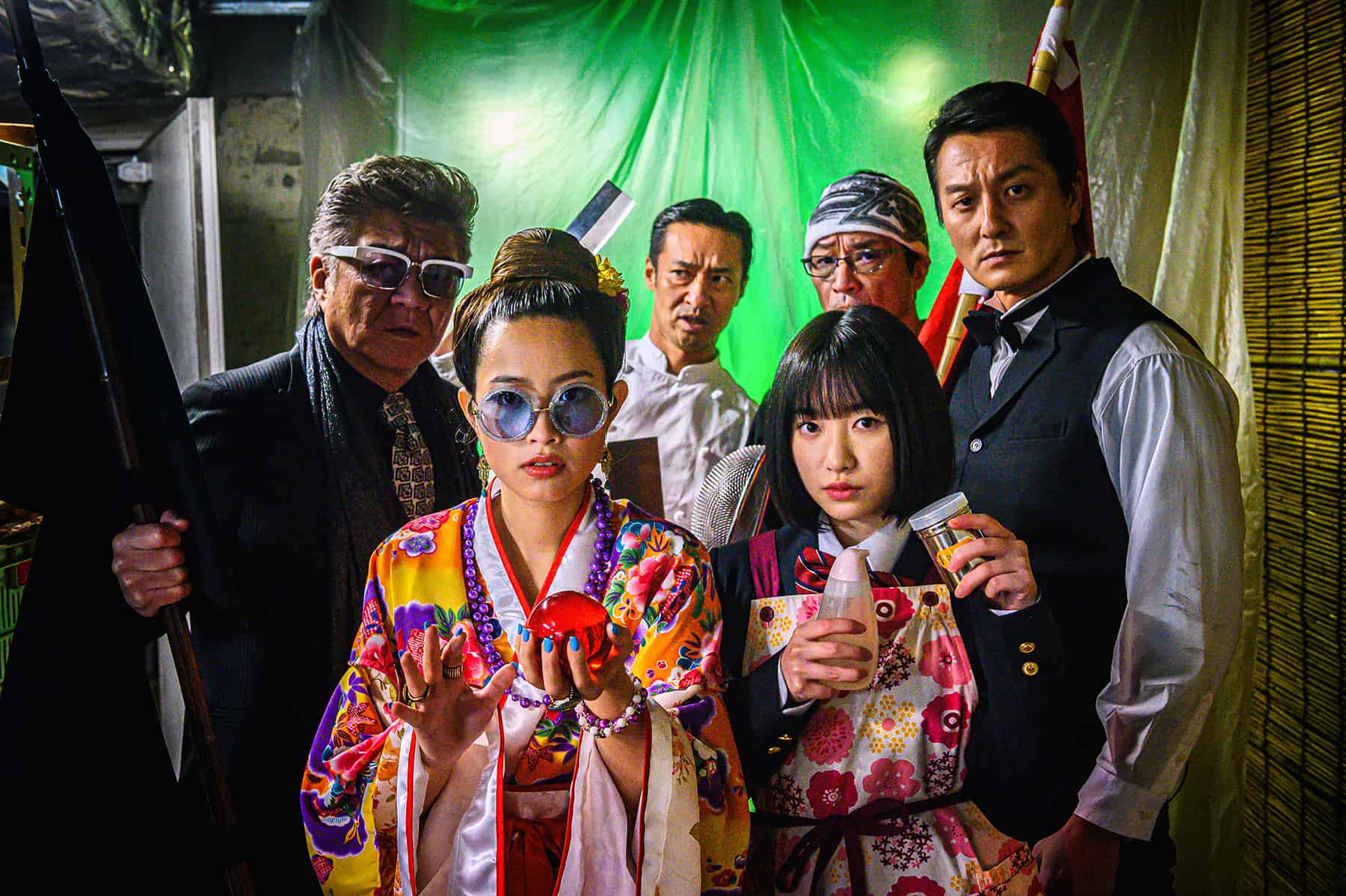
Yoshihiro Nishimura continued to bring his absurdly grotesque imagination to the big screen with “Tokyo Dragon Chef”, although this time in a fashion much tamer than “Helldriver” or “Kodoku Meatball Machine”, but equally fun and nonsensical. Here, instead of pure bodily horror, he mixes yakuza, food, musical, and exploitation in the most insane manner, through a rather low-budget approach that did not allow him to present his trademark special effects at full force.
Ex-yakuza members Ryu and Tatsu reconnect after the latter is released from prison, following the dismemberment of their gang and a number of other gangs by a group wearing masks of eye bulbs, led by a mysterious young man named Gizumo. Ryu convinces Tatsu to open a ramen restaurant, and the two embark on their paths as host and cook respectively. Their shop quickly becomes a success after a young girl helps them with marketing, in the most illogical way.
However, Jin and Kazu, two brothers who also happen to be their rivals from their yakuza days, open a ramen canteen nearby and, after hiring a rather unusual girl influencer to promote their shop, manage to steal all the customers from Ryu and Tatsu. A violent clash eventually ensues and the failing duo are forced to hire their own influencer, a medium with questionable powers. Just as things are about to get really bloody, Gizumo and his gang reappear, forcing the ex-yakuza to join forces.
The characters are as absurdly hilarious as they can come, with the whole concept of hardcore yakuza trying to be kind to their customers and hiring influencers to help them being both extremely funny and a kind of social comment regarding social media and the fate of failed or retired yakuza. Particularly the first influencer, a motley girl who seems able to eat humongous amounts of food, is unique in both conception and implementation, including the way she gets mad every time someone mentions she is not human.
Of course, action and violence could not be missing from a Nishimura movie, and the last part is almost filled with these two elements, although again in a fashion that is more sarcastically playful than grotesque. Lastly, the “Ramen Rock” finale concludes the movie in the most unexpected, insane, and entertaining fashion. “Tokyo Dragon Chef” may be a smaller entry, but it shows Nishimura’s ability to transform even culinary rivalry into an arena of absurd masculinity, nostalgia, violence, and pop nonsense.

Released as a world premiere at FANTASPOA, “Holy Mother” stars transgender actress Anna Nagasaki in a picture that is, as usual, wild, bloody, and fun. However, the limits of the director’s creations are also becoming more apparent here, since despite its pleasant sides, the movie feels quite recycled.
As with all of Yoshihiro Nishimura’s works, it is hard to accurately describe the unfolding story. Sometimes the characters’ names are not given, incongruous events occur apace, and the moral, if there is one, is blurred. The storyline centers on a Chinese yakuza organization, discriminated against by the Japanese, which has just lost its leader and several of its members. Cornered, the survivors are aided by a young pink-haired woman who comes out of nowhere and fights with vigor.
As she is mute and performs miraculous healings, the poor Chinese inhabitants name her Maria and start to worship her. But the battle is far from over against Hime, a business leader and torture enthusiast, and her accomplices, Cloud Girl and Umbrella Man. In addition, a new threat from another dimension approaches.
As always with these kinds of productions, the characters are over the top and mostly ridiculous. Between the grief-stricken and cowardly yakuza, the sadistic villain who laughs while slicing people with a laser, or Cloud Girl and her little song, all the elements tell us not to take the movie seriously. Nevertheless, the characters are not endearing due to a lack of knowledge about them. And yet, the director tries to include darker themes in relation to them.
First, the movie attempts a commentary on anti-Chinese racism in Japan, which, from a Western viewer’s point of view, renders the whole thing awkward, especially since the subject is treated clumsily. Hime’s motives, besides the racism symbolized by repeated insults, are not well defined. Then, the story tackles, more broadly, various discriminations, between the poverty of the Chinese community in this futuristic world and the reactions to Maria’s transness.
A self-production, “Holy Mother” is the definition of a free, creative, and generous cinema. Gory as the director has known how to be since his first work, and organic, especially with these bloody bodies that form sculptures or become useful amusing objects, the dismemberments are numerous and the practical effects of Yoshihiro Nishimura are very impressive. But, as with his other works, the budget is not up to his ambitions.
Eihi Shiina has a blast in the role of Hime, the sadistic racist with a laser, and even recreates the iconic sequence from “Audition”. As for artist Anna Nagasaki, she is a true talent, even if she does not have the opportunity to demonstrate the full extent of her abilities. What is welcome, however, is to have her cast, a trans woman, as a powerful and beloved Madonna. Natsumi Tadano, who plays Cloud Girl, is also entertaining.

Anotjer work from prolific Japanese director Yoshihiro Nishimura, this self-produced project is meant to be a spin-off of his action flick “The Ninja War of Torakage”. First shown at “2300 Plan 9” in Switzerland, then in Brazil, the movie had yet to be released in Japan, a fact that now feels even more striking after Nishimura’s passing. It suggests again the paradox of his career: a Japanese cult director whose most devoted routes of circulation often seemed to run outside Japan.
The ninja samurai Onimanji, locked in a cursed urn for 631 years and 59 days, is resurrected back into the present day by the Kika Company. This hitman organization consists of Kika, a seemingly impassive leader, Shigeru, a goofy assassin, and their mysterious informant. Disoriented, Onimanji must adapt to modern Japan and support his new teammates. But his ultimate test is to face the rival company Nutmeg and its boss, Natsumegu, with whom his employers have a rocky history.
As one quickly understands, the interest is less in the scenario and the themes than in the visual experimentation. Thus, it is not required to have seen “The Ninja War of Torakage” to understand and appreciate “Onimanji”, since it provides all the necessary explanations, even though the story is chaotic. The circumstances that led Onimanji to his imprisonment are summarized, and all the characters are given a backstory in flashback.
Nevertheless, they are not fully fleshed out and rely on superficial characteristics. The relationship between Onimanji and Shigeru is particularly annoying, since the humor drags on between the samurai, who threatens to kill the clumsy man, and the latter, who makes jokes. The running time of almost two hours is also at fault, and many scenes would have benefited from being shortened. But sometimes the wit hits the spot, like the running gag around the crab burgers, or even the appearance of the title during a fun decapitation.
Fans of splatter and other gory antics may be disappointed that blood spurts are rare and often digital. But the director’s other gimmicks, such as the sexy shots of the heroines, sudden displays of extreme violence, and uneven humor, are all present. Freedom of self-production allows Yoshihiro Nishimura and his team to include several split screens, aspect ratio changes, and blinding neon flashes. In some of the fight sequences, everything is undertaken to distort the image and do a lot to amaze with little means.
Thus, indoor fights are better worked and mastered than outdoor ones. One can note the lack of budget in the frequent changes of luminosity, the questionable choice of music, and the lack of extravagance of the costumes and sets, a trademark of the director. At the same time, the first face-off between the two companies, in the form of an ultra-choreographed musical, is very impressive and catchy. If it is not the climax, it remains the culmination of the movie, where the actors deploy at best their competence in action scenes and where they are the most credible.
Despite its many obvious technical shortcomings, “Onimanji” is a valuable experience. It marks a nice throwback to the cheap Japanese productions dear to fans’ hearts. In the context of Nishimura’s death, however, it now carries additional weight. Its roughness, its self-produced freedom, its uneven humor, its visual tricks, and its refusal to behave like a “proper” action movie all feel like final extensions of a sensibility that was never interested in polish for its own sake.
The Patterns of a Blood-Soaked Career
Looking at Nishimura’s works chronologically, one realizes that his career was not merely a succession of outrageous images. The same patterns recur in different forms. Tokyo is overcrowded and alienated in “Anatomia Extinction”. The police are corrupt and privatized in “Tokyo Gore Police”. The country is divided between healthy citizens and zombies in “Helldriver”. A lonely, exploited bill collector becomes a grotesque hero in “Kodoku Meatball Machine”. Failed yakuza try to survive through ramen and social media in “Tokyo Dragon Chef”. Marginalized communities are transformed into religious and splatter spectacle in “Holy Mother”. A samurai from another temporality struggles inside modern Japan in “Onimanji”.
In almost every case, society is already absurd before the blood begins to flow. Nishimura’s gore does not create disorder; it reveals disorder. His bodies mutate because his worlds are already broken. Capitalism, police brutality, loneliness, poverty, racism, social media, cult exploitation, failed masculinity, and family trauma all appear inside his movies, even when handled crudely or drowned in blood.
The other major pattern is the use of women as powerful centers of violence. Nishimura said he always had an image that women are strong and that he preferred female leading roles because women could express strength better. This is evident in Ruka, Kika, Rikka, Maria, Hime, and many of his grotesque heroines and villains. His female characters can be fetishized, ridiculous, monstrous, or underwritten, but they are rarely passive in the visual structure of his cinema.
There is also the constant tension between cheapness and ambition. Nishimura could create impressive SFX with small budgets, and his best sequences often come when limitation becomes style. Yet the later works also reveal the strain of working in conditions that could not always support his ideas. The lack of budget in “Onimanji” and the recycled elements in “Holy Mother” are clear, but even then, there is something valuable in the fact that he kept making movies on his own terms.
Eihi Shiina’s comments perhaps explain the man behind the madness best. She called him crucial for her career, a treasure, peculiar, obsessive, but also professional and trusting. That combination of obsession and professionalism is what allowed his world to exist. The blood was ridiculous, but it was not careless. The monsters were absurd, but they were designed. The humor was uneven, but it was intentional. Nishimura’s best work is not “good taste” cinema. It is cinema against taste.
Epilogue
Yoshihiro Nishimura’s passing leaves a very particular absence. There are many horror directors, many splatter artists, many cult figures, and many low-budget eccentrics. There are very few, however, who managed to build such a recognizable cinematic body from blood pumps, mutated flesh, cheap sets, warped humor, and wild sincerity. His cinema could be exhausting, childish, offensive, brilliant, repetitive, and exhilarating, often within the same sequence. But it was never anonymous.
The Japanese industry did not always have space for him. Splatter did not have a large domestic audience, budgets were limited, working conditions were difficult, and his later productions often seemed to survive through sheer will, festival curiosity, and foreign cult devotion. Still, that is part of the legacy. Nishimura was not a director who waited for permission. He taught himself, built effects, wrote scripts, edited frantically, collaborated with friends, trusted familiar actors, and made blood fly higher than most budgets should allow.
From “Anatomia Extinction” to “Tokyo Gore Police”, from “Helldriver” to “Kodoku Meatball Machine”, and from “Tokyo Dragon Chef” to “Holy Mother” and “Onimanji”, his work remains a catalogue of grotesque invention. The viewer who can see beyond the grotesqueness will discover a rather rich context, one full of social anger, loneliness, absurdity, and a strange belief in cinema as handmade spectacle.
In one of his clearest statements, Nishimura said he wanted to show something gross but also make the audience chuckle. He wanted to create a wave. That wave is still there, messy and red, moving through Japanese cult cinema, through the actors who trusted him, through the audiences who screamed and laughed abroad, and through every filmmaker who understands that sometimes the body must explode for the image to feel alive.



