Reverie by Caroline Hú presented its Spring Summer 2027 collection during Paris Fashion Week, exploring romanticism through childhood memories, damaged surfaces, and the possibility of creating something beautiful from difficult experiences. Designer Caroline Hú developed a fairy-tale narrative that reflects her response to a world she increasingly struggles to romanticize. Through intricate construction, embroidered messages, and reconstructed garments, she examined the relationship between fantasy and reality.
The presentation took place inside an old hôtel particulier, where faded interiors provided the setting for a sequence of living scenes. Models occupied different rooms, standing and moving like characters within an unfinished story. Bears, insects, broken walls, and love letters contributed to an atmosphere that suggested a fairy tale carrying traces of time and uncertainty.

Hú structured the collection around the story of a lonely girl who leaves her familiar surroundings and enters an unknown place. Her passage through a hidden entrance and a magical mirror leads into an imagined environment shaped by memory and desire. The narrative allowed the designer to address contemporary anxieties through personal symbolism and the visual language of childhood fantasy.
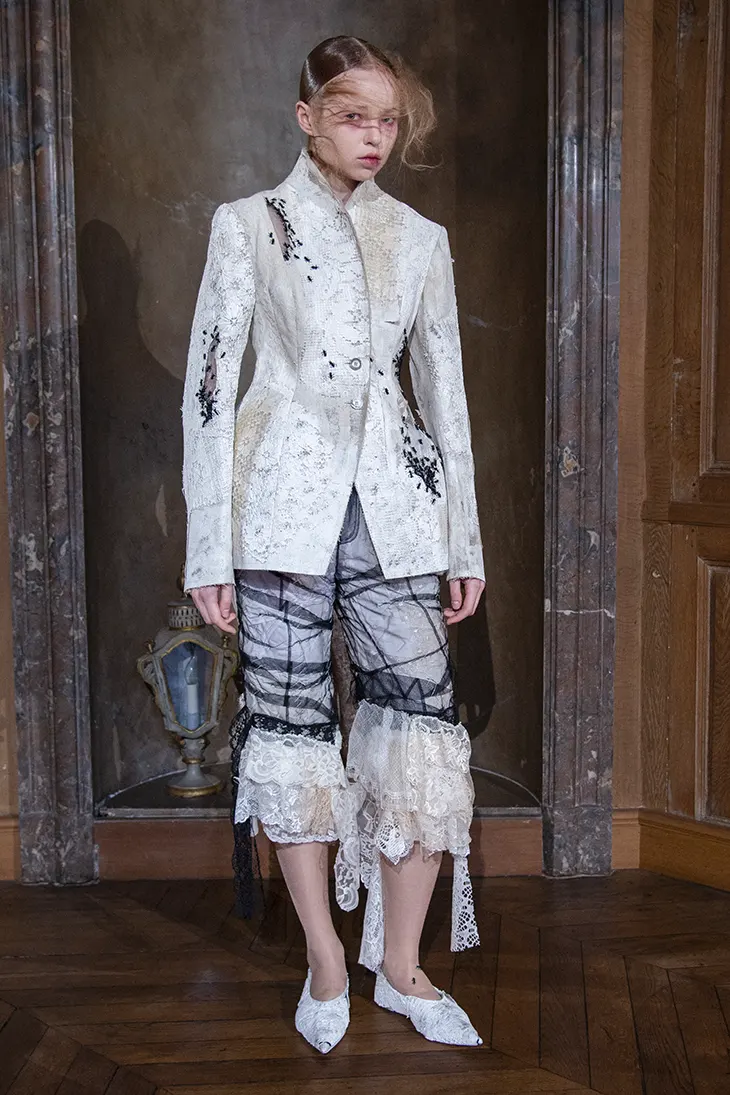
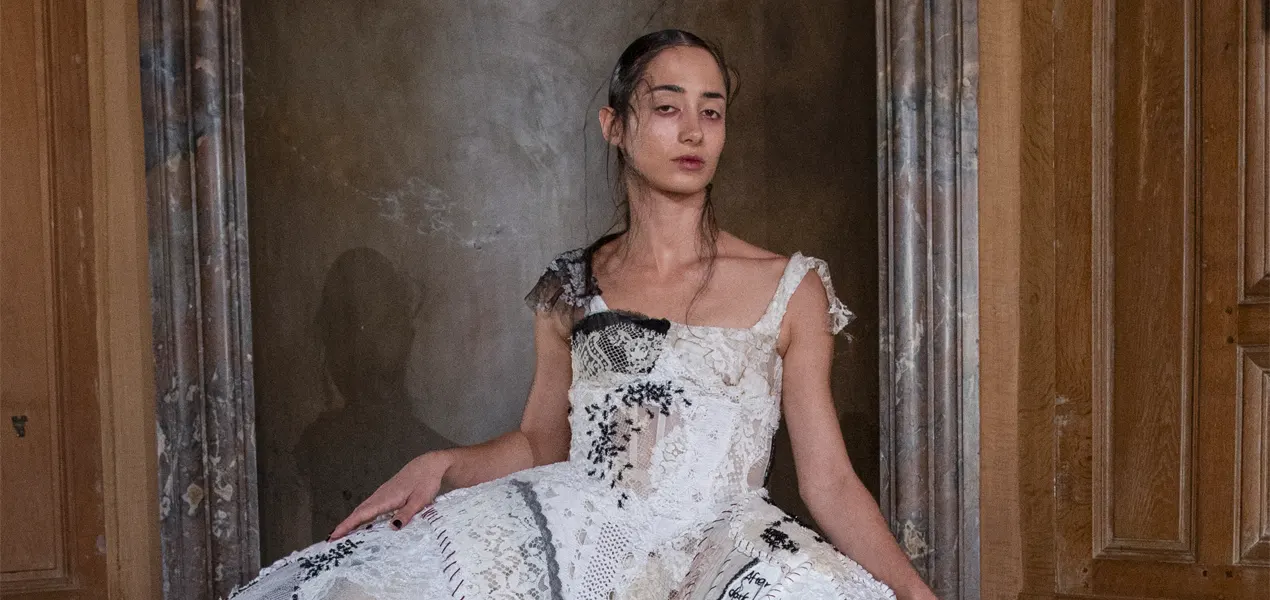
Romantic details appeared throughout the collection, with lace, roses, and delicate fabrics establishing a sense of innocence. Hú interrupted these familiar references through distressed surfaces, irregular construction, and unfinished elements. The garments suggested objects that had accumulated emotional significance through repeated use and the passage of time.
Embroidery became an important means of expressing the collection’s personal themes. Hú incorporated love letters into the clothing, using black and red stitching to reproduce written messages. Some of the letters contained words of encouragement addressed to herself, giving the garments an autobiographical quality. Their presence transformed private thoughts into visible components of the designs.
The collection also explored reconstruction through patchwork. Hú assembled contrasting fabrics into garments that suggested fragments from different periods and experiences. A black coat combined several materials, creating a surface that emphasized the process of bringing separate elements together. An evening dress incorporated deconstructed lace and floral fabrics, extending the same approach to formal clothing.
Another jacket introduced a rigid silhouette with tiny beaded ants across its surface. The unexpected embellishment brought an unusual detail into the collection’s romantic vocabulary. Such elements reflected Hú’s interest in allowing unsettling images to coexist with decorative beauty.
The designer used construction techniques to communicate the collection’s central ideas. Layers of fabric, irregular surfaces, and carefully arranged embellishments gave the clothing a sense of accumulated history. The resulting silhouettes suggested garments that had experienced changes, repairs, and transformations.
Hú approached romanticism as a way to confront difficult realities. Her imaginary narrative acknowledged emotional damage while exploring the possibility of rebuilding after disruption. The collection’s unfinished and fragmented details became visual expressions of that idea, allowing vulnerability to inform the character of the clothing.
The presentation’s theatrical format reinforced this direction. Through stationary poses, movement, and carefully arranged scenes, the models became participants in Hú’s imagined narrative. Their presence connected the collection’s elaborate garments with the emotions and memories that inspired their creation.