
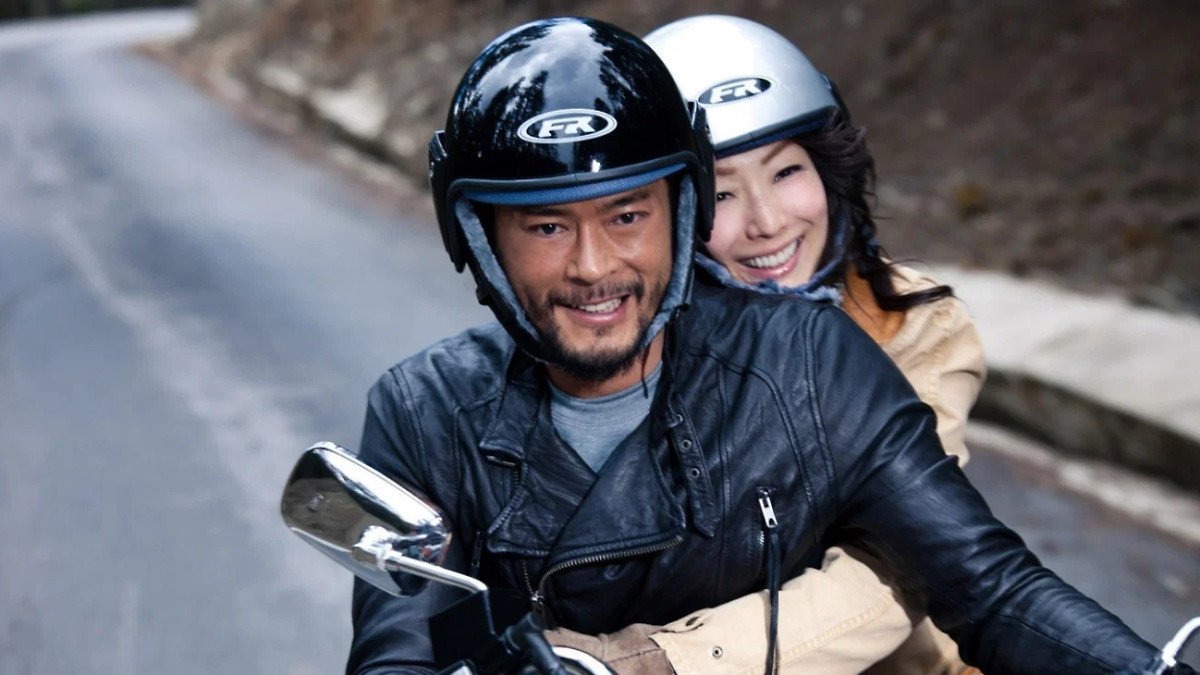
Though best known for directing action and crime films, Johnnie To is versatile across various genres. “Romancing in Thin Air” is a great example of his ability to move beyond his usual territory of fatalism, brotherhood, and loyalty. In doing so, he brings his creative touch to a romantic drama of grief and closure.
Buy This Title
by clicking on the image below
Michael Lau is a successful actor but finds himself in a deep depression following his breakup with his former fiancée, Ding Yuanyuan, who leaves him when her first love, Zhang Xing, unexpectedly appears at their televised wedding reception. Heartbroken, Michael turns to alcohol and, in a drunken state, winds up in the snowy mountains. At a local guesthouse in Shangri-La, Yunnan, he’s found unresponsive by its owner, Sau, who is dealing with her own heartbreak after her husband, Yang Xiaotian, disappeared seven years earlier. As she helps nurse the movie star back to health, the two grow close and open up about their respective pasts as they seek catharsis from the pain that continues to haunt them.
As a romantic melodrama, this is the kind of film that could easily be seen as outlandish or even morally questionable given the heightened turns the plot takes. However, there’s a prominent self-awareness, especially in its satire of celebrity culture and its use of the metatextual qualities of a film-within-a-film. Blurring the line between reality and cinema aligns with the movie’s overall approach to depicting Michael and Sau’s efforts to heal and to help one another find closure for their personal losses.
“Romancing in Thin Air” works so well because there is a genuine sincerity to how it portrays people dealing with traumatic grief and working towards shared catharsis. Their emotional journey together naturally reveals their personalities while allowing their relationship to blossom without feeling blatantly contrived. The mountainous area, characterized by freezing temperatures, foreboding forests, and thinner air, serves as both a physical and metaphorical setting. Michael and Sau cope with their heartbreak as they adjust to life at high altitude. As they grow from their pain, they learn to breathe again.
Louis Koo and Sammi Cheng are both terrific. They fully commit to their roles as Michael and Sau, and their chemistry is wonderful. Li Guangjie also leaves a strong impression as Xiaotian, making his disappearance even more tragic. Rather than Ding Yuanyuan and Zhang Xing being one-note plot devices, Gao Yuanyuan and Wang Baoqiang bring a surprising humanity to them.
Visually, the film is beautiful, with Cheng Siu-keung’s cinematography making Shangri-La just as important a character as the two leads. The score by Guy Zerafa feels melancholic yet equally hopeful. The most memorable part of the soundtrack is the film’s theme song, “Do Re Mi,” beautifully sung by Sammi Cheng.
“Romancing in Thin Air” is a moving film on healing from a painful past and embracing newfound love in the present. Johnnie To celebrates the power of cinema itself and highlights that, though closure can be hard to process, it allows one to move forward.



