
Builders are preparing the way to fill 2,400 tons of local sand into a silo under construction off a rural route between two large lakes in southern Finland in what will be, when finished, the second heat-storage battery for renewable energy operating in the region.
Currently designed to power local district heating networks, the ‘sand battery’ is the brainchild of startup company Polar Night Energy. It now has two utility partners in the region deploying the technology. One sand battery has operated since 2025 in the town of Pornainen; the second is under construction about an hour’s drive away in the larger town of Vääksy.
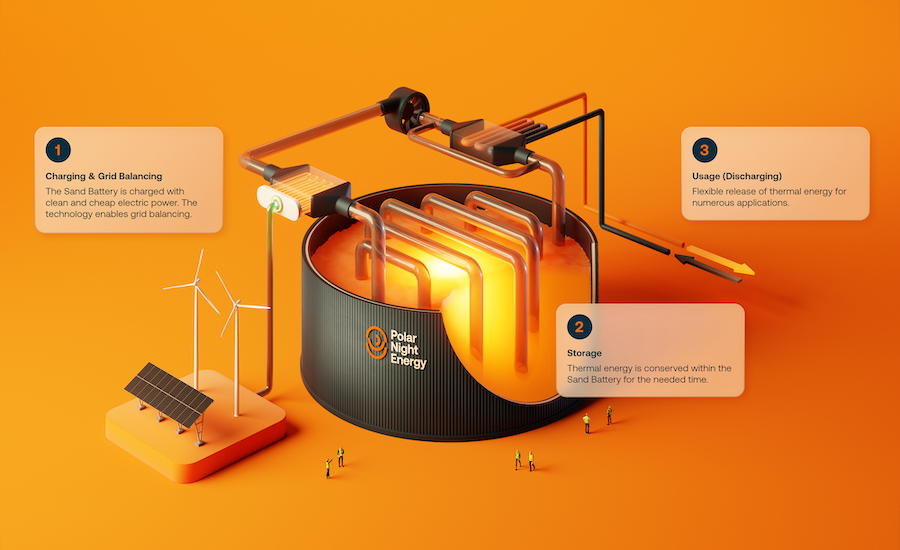
A sand battery is a large silo filled with an inert, non-combustible material that absorbs and retains heat from superheated air. The air circulates through a network of pipes and ducts coiled through the silo.
This heat energy can come courtesy of excess electric power from renewable sources such as wind or solar. That power often arrives at the wrong time, creating a use-it-or-lose-it problem. This issue has stalked renewables for decades, spurring a hunt to develop creative energy-storage solutions.
Photo courtesy Polar Night Energy
A sand battery uses electricity to power resistance elements (like a toaster, only bigger) that heat air flowing into the battery. The sand inside—or in the case of the Pornainen battery, the crushed soapstone recycled from a local fireplace manufacturer—can hold that heat. Internal temperatures can reach 500° to 600°C, or 930° to 1,100°F.
The stored heat is then dispatched, on demand, via a heat exchanger. The output can be heated air, water, or steam, explains Annette Höglund-Dönnes, chief commercial officer at Polar Night Energy, based in nearby Tampere. The sand battery components include steel, piping, an electric fan and resistors, insulation, and a steel carriage.
The idea came to Tommi Eronen and Markku Ylönen, now Polar Night Energy’s chief executive and chief technology officers, respectively, when they were students in the early 2010s. They developed it in a backyard. By 2022 they had a pilot battery running, successfully boosting runoff from a data center for heating purposes.
Looking for quick answers on construction and engineering topics?
Try Ask ENR, our new smart AI search tool.
Ask ENR →
That same year the utility Loviisan Lämpö, which is owned by a private equity firm, bought the heating business from a utility serving Pornainen’s 5,000 people. That’s when the town’s mayor, Antti Kuusema, got a call. If the town was willing, Lämpö intended to install a 2,000-ton, 1 MW/100 MWh sand battery unit. It was in place by 2025, replacing the oil-and-wood-chip boiler the town used, along with biomass, to operate its district heating network.
“Our experience has been very good. The idea for us as a small municipality has been to try to reduce carbon emissions in all operations,” Kuusela says. So far it’s meant a 60% to 70% reduction in carbon emissions in its district heating, and no more oil burning.
 Graphic courtesy Polar Night Energy
District heating networks are specific environments: they are common in Scandinavia, less so elsewhere, but there are about 2,500 in the United States (including the steam tunnel system in Manhattan). They distribute heat from a central source, be it fossil, geothermal, or nuclear, through a spaghetti network of insulated pipes into surrounding residential or industrial areas.
As of July 2026, the foundation was in place at the Vääksy sand battery site, which will be a 2MW/250 MWh facility, and construction was moving ahead for spring 2027 operation. Polar Night Energy recently inked a distribution deal to expand its reach into the Baltic states, partnering with US investors Solsiden Wangard Family Office and SIA Soldag, a construction firm based in Latvia. Plans call for the next sand battery to be even larger—perhaps 10 MW.
The sand batteries are now being used for heat in cold weather, but the technology is not strictly tied to that, Höglund-Dönnes says. They could find industrial uses at a shipyard, university campus or in dairies for pasteurization.
“You just need to have the need for heat,” she says.
Source: www.enr.com



