
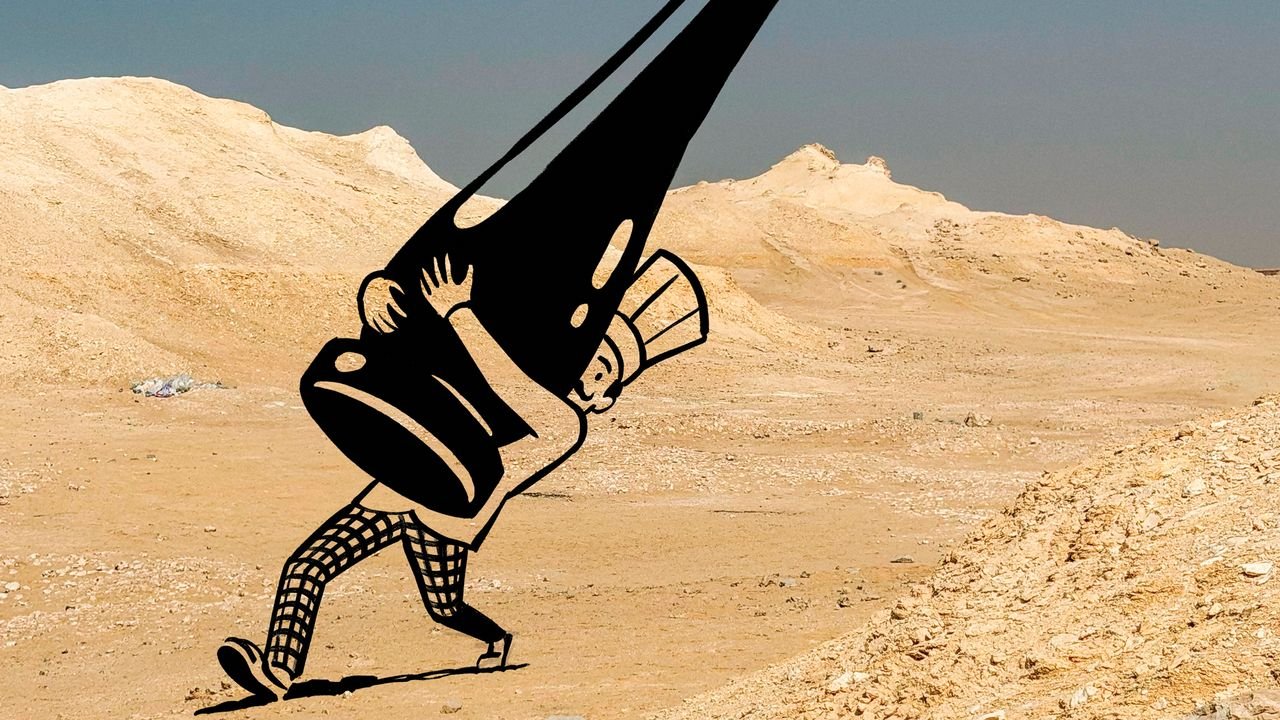
For much of its history, Saudi Arabia—which, like a lot of the Islamic world, has a rich tradition of hosting at home—was not especially suited to restaurant culture. This partly came down to lawmakers’ interpretations of religious principles. Restaurants were required to separate single men from women and families. A few years ago, one cleric questioned the morality of all-you-can-eat buffets, because they require—in the heady optimism needed to hand over money, up front, for unquantified rewards—something of a gambler’s mentality. The sale of alcohol was banned until 2024, and, even now, only high-earning foreigners living in the diplomatic quarter can reportedly shop at Riyadh’s sole liquor store, which has no name and no sign. The hospitality industry “reflected the society at the time,” Stefan Breg, a British food-and-beverage consultant who has worked in Saudi Arabia for more than a decade, told me. There were about a dozen high-end hotel restaurants, in major cities, and that was about it.
Then, in 2016, the kingdom announced a program called Vision 2030— a brain dump of economic initiatives, infrastructure plans, social reforms, and cultural gambits, apparently dreamed up by M.B.S., designed to make the country less economically dependent on oil. The aim was not just to make Saudi Arabia a juggernaut in burgeoning industries such as A.I. and fintech but also, seemingly, to paint over the country’s reputation—cemented by the murder of the journalist Jamal Khashoggi, in 2018—as a repressive autocracy. The most notorious parts of Vision 2030 have been its beleaguered giga-projects, such as the Line, a futuristic megacity that was meant to be housed inside two parallel mirrored buildings, each roughly the height of One World Trade Center and more than a hundred miles long. (The Financial Times reported in January that construction had slowed, and that the development would be much smaller than anticipated.) Other initiatives have been comparatively down to earth, such as the kingdom’s investments in Formula 1 racing and in soccer, and legal changes that permitted women to drive and travel freely without the permission of a male guardian or a family chaperon.
M.B.S.’s evident hope was for Saudi Arabia to look and feel more like other wealthy, modernized countries, where people drink matcha and go to music festivals, and where foreigners visit not solely for business or pilgrimage but for a good time. The kingdom revoked the enforcement powers of the religious police (also known as the Committee for the Promotion of Virtue and the Prevention of Vice) and committed to attracting a hundred million tourists yearly by 2030. This endeavor forced the obvious question of where all of those people would eat. In 2018, a government task force laid out a few goals: there would be 3.33 restaurants and cafés per thousand people by 2030, and the number of “globally rated fine dining restaurants” would be at least twenty-one. The official program document reported that “3star Michelin chefs are recognized as the utmost level of food quality.” How many restaurants run by such chefs would suffice? The task force established an opening target of three.
The kingdom was setting out to build an illustrious dining scene, more or less from scratch. At the outskirts of Riyadh, dozens of big, glitzy restaurants manifested seemingly overnight, among them a branch of Wolfgang Puck’s Spago, a Japanese steak house called Wagyumafia, and Madeo, a Tuscan-inspired restaurant whose only other outpost was eight thousand miles away, on Sunset Boulevard. A new government body, the Culinary Arts Commission, was created to codify Saudi recipes and increase the number of chefs at the country’s disposal, brokering the opening of a Cordon Bleu campus in Riyadh and dispatching young Saudis, on full scholarships, to culinary colleges around the world. Big-name restaurateurs had their rent and startup costs subsidized. Much of this has been funded by the Saudi government and the Public Investment Fund (P.I.F.), the country’s nearly trillion-dollar sovereign wealth fund, which has been the engine of M.B.S.’s breakneck reforms. Madawi Al-Rasheed, a British anthropologist of Saudi origin, told me that the P.I.F.’s investments in Western brands and pre-Islamic heritage sites such as AlUla reflect the prince’s intention to forge a “Saudi identity where Islam is just one component of it.” “The contradictions in the national narrative become apparent,” she said. “It’s all about Saudi Arabia, but it’s also all about globalization—foreign tourists, shopping centers, and patterns of consumption that we see across the globe.”



