
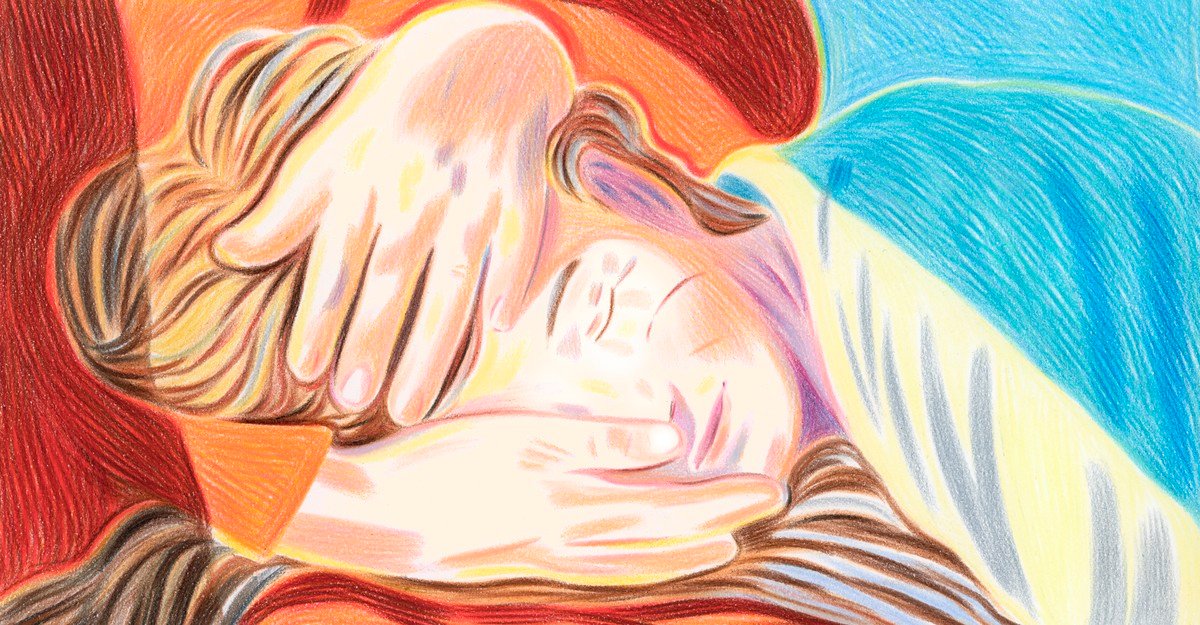
It was Nell’s turn to visit Coral, who was spending the holidays in the hospital, recovering from a breakdown. (“Better here than with my family,” Coral said. “At least here, people admit they’re not normal.”) It was her second hospitalization in three years. She had had one other breakdown—her worst, in fact—the summer following her high-school graduation. By then her mother was on her third marriage; her father, twice her mother’s age, was on his fifth. Both parents were dead now, and among Coral’s several siblings and half siblings were none with whom she was close and some with whom she had never gotten along. She had been married once, pitifully young, to a man whose whereabouts she’d lost track of decades ago. Even younger, unmarried, she had had a baby that she gave up for adoption. She had no other children, which she came to count as a major reason for the depression that often incapacitated her, though she had suffered from depression even as a child.
The few friends who knew that, contrary to what she’d told other people, Coral hadn’t left town for the holidays but had instead taken herself one dawn to the ER and from there agreed to be admitted to the psych ward, had made a schedule. During her first week, she wasn’t allowed any visitors at all, and now, week two, the rule was only one visitor at a time.
Nell had come on Christmas Day (“Whatever you do, don’t bring a gift,” Coral had warned. “I don’t think I could bear it”). On New Year’s Day she was there again. As usual, they hung out in the dayroom, rather than in Coral’s room, which she shared with a young woman who’d completely stopped speaking some time ago, but who, in striking contrast with the rest of the ward, had a mild, imperturbable way about her. Nell recognized her serene gaze and soft, sad smile from a multitude of Madonnas. According to Coral, there were two other patients on the ward who didn’t speak, and Nell, whose only idea of psychiatry was talk therapy, wondered how the doctors dealt with them.
Psychiatric inpatients usually wore street clothes—were, in fact, asked to do so—but not long after Nell and Coral had sat down, a woman in grippy socks and a loosely belted bathrobe walked in.
“They’re going to kill him,” the woman said.
“Kill who, Magda?” asked Coral.
“The president, who else?”
“Who’s going to kill the president?”
“The Democrats, who else? Just like they killed JFK.”
“You think the Democrats killed JFK?”
The surprise was all Magda’s. “You don’t?” She bared her teeth in a manner so savage that for a moment Nell was afraid she was going to bite Coral. Instead, she flounced from the room, pausing in the doorway to turn back and shout: “You disgust me.”
Coral sighed. “There’s been a lot of that on the ward.” As if there weren’t a lot of that everywhere. “And I’m supposed to get well here?”
Actually, she had been getting well, or at least better—enough to be going home the following week. Though she did not feel quite up to returning to work, she said. For most of her life, Coral had worked in the theater, a career that had brought her much success, but the demands that came with it had become less and less tolerable. She had made the decision to take a break—and immediately regretted it. She wasn’t used to such freedom. She wasn’t used to having time on her hands. So much time to think, so much time to fret. So much, in the troubled world, to fret about.
She decided to adopt a cat. She’d never had a cat before, but she liked cats, and she knew how entertaining and companionable they could be. She went to a rescue center and was astonished to be told that she couldn’t take home one of the kittens. A requirement for kitten adoption was that the person be in a position to care for it for life. Coral’s age disqualified her. Any cat she adopted had to be at least five years old.
“I thought of telling them the kitten was actually for my great-great-great-grandchild,” she said later. Instead, she swallowed her tears and walked out.
Nell had known Coral from the day they met in drama school. Back then, like Nell, Coral was studying acting. It was her mother, a film actress herself and an alumna of the school, who’d pushed Coral to follow in her footsteps. She had had to push, because Coral had always been doubtful about acting. Her adviser called it one of the worst cases of impostor syndrome—that plague of the gifted and accomplished—that he’d ever seen. She was nagged by the thought that it was only because of her mother that she’d been admitted to the highly competitive school in the first place. And although this was untrue, as her teachers were quick to attest, she could not be convinced that she was exceptionally talented.
Not like her mother, she said. Not like Nell.
Another fear was that her mother’s ambitions for her were an attempt to continue, vicariously, a career that had been cut off, like those of most female actors, when she found herself nearing 40 and no longer acceptable for starring roles. Yet another fear was that living up to her mother’s ambitions might mean that Coral would never be free of this woman, with whom she’d had a contentious relationship for as long as she could recall.
But Coral had grown to love the drama school. For all her anxiety and self-doubt, it was more of a home to her than any other she’d known, and she felt more kinship with the friends she made there than she had ever felt with her family. Instead of dropping out, she reapplied, this time to the department of dramaturgy.
When, about a month ago, Coral had been invited by a journal to contribute to a special issue devoted to the current political situation, she had jumped at the chance. A small project to focus on was just what she needed. She wanted to write about what she saw as a connection between the degradation of politics—the evil of disinformation, in particular—and advertising: its ubiquity, and society’s long habituation to marketers’ manipulative distortions and lies.
Articles should include ideas for how to think about the future, instructed the editor. But the more Carol thought about the future, the more she felt at sea. Just how were you supposed to live when the world appeared to be spinning on borrowed time?
Failure to deliver her piece filled Coral with humiliation, to which she had always been perilously sensitive. Add in migraines and escalating panic attacks, and she quickly unraveled. “Every day I woke up and wished that I hadn’t.”
She had gone so far as to compose a farewell, whose banality (as she saw it) now ironically served as a deterrent. “I’m not going ’til I can come up with something more original.”
Hearing this reminded Nell that, in high school, Coral had been voted both “Most Likely to Succeed” and “Class Comedian.”
There was a television in the dayroom, tuned at the moment to a news channel but with the sound and the closed-captioning off: a panel of two women and two men, hosted by a female anchor. As usual, each of the women was lavishly made up. Nell had long found this dissonant. Every hour the news aired stories of global disasters and atrocities, and apparently, in order to report them, a woman needed the works: 18 different products, according to an anchor’s how-to video that once, out of perverse curiosity, Nell had watched.
Coral laughed. “You counted?”
Nell had. “Four different shades of eye shadow. It’s like, they want you to hear about war crimes and at the same time admire the way their eyes pop.”
Even when a woman was reporting from some hellhole—“You can hear the explosions”; “People are fleeing”; “Many are trapped in the rubble”—her lipstick was impeccable. Was it a war, or a play about a war?
Agitation on the screen: a mime of shouting and angry gesticulating.
“I know it sounds pathetically nostalgic,” Coral said, “but what the world needs now is another hippie movement.”
Nell laughed.
“I’m serious.”
Which was why Nell had laughed.
“Anti-violence, antiauthoritarian, anti-materialist, pro–civil rights, pro–Mother Earth,” Coral recited. “They say you can judge an era by its soundtrack. So—all those songs about brotherhood, about workers’ rights and the common man, and everybody getting together to make a better world. Music plus activism plus love. You laugh, but I’d be a lot more optimistic about the future if Gen-whatever were to go back to that.”
Nell shrugged. Her brother had been a tie-dyed-in-the-wool hippie and a heroin addict who, not many years later, became more conservative than their parents ever were.
“Speaking of politics,” said Coral, “what’s it like out there? I’ve only been off the ward a couple of times, but always with a nurse, and only as far as the nearest Starbucks. I remember how strange it seemed to me, the day after the election. Somehow I’d expected it to be more like the day after 9/11. The looks on people’s faces, I mean. But I didn’t see anything like that.”
Everyone going about their business as if nothing extraordinary had happened, rather than something that would radically affect every aspect of their lives, for the rest of their lives: It had struck Nell too. It was still like that, she said.
“How’d you get that scar?” Magda was back. A different Magda. She was dressed now, in jeans and a cotton pullover, and her air was calm.
“Sorry,” Coral said to Nell. “That’s the thing about the mentally ill.” She spoke as if Magda were not standing right there. “No filter.”
“It was an accident,” Nell said.
Magda made a grave face. “My scars are all internal,” she said. “And that’s a big problem. My scars can’t be seen. So people don’t know.”
Whenever Nell looked back, she was amazed at her own naivete. She had never forgotten what turned out to be the last time she saw her manager, the excruciated look on that woman’s face: a mix of pain, pity, exasperation, and guilt. “I am so sorry, darling.”
Nell had refused to understand. She had never been a beauty. What she was was an actor: skilled, hardworking, and reliable. Supremely capable of playing any number of nonbeautiful characters.
“I look like a real person,” she said. “And real people have scars.”
“But don’t you see?” said her manager. “You can’t have a character appear with a scar and no explanation. It’s too distracting.”
“But if I were a man—”
“If you were a man, it would be different, yes. But even then. Unless the character is a villain, like an outlaw or a gangster, the writers will add some kind of backstory to account for a scar. And that would definitely be the case for any major role.”
The manager had first contacted her while Nell was still in school, after admiring her performance as Anna Christie in a student production. Since then, Nell had landed her first television role, as the mother of a missing child, in an episode of Hill Street Blues, and she was about to start rehearsals for a part in a made-for-TV movie about the Holocaust.
She had barely begun. How could she possibly be finished.
As part of her physical training, and to improve her movement technique, she had been taking dance classes, both modern and jazz. It could so easily have happened that she’d gone to modern that day instead of jazz. Or what if she’d been sick and unable to take class at all? What if the class had been canceled, as it had been only the week before, when the teacher got stuck on a stalled train? What if the class had not been overcrowded that day? If Nell had not been standing at the front of the room when they were doing fouetté turns? If the teacher had not made them do fouetté turns? If the woman next to her had not lost her balance and whipped into Nell, who, herself always a woozy turner, had not had time to even put out a hand?
The impact had concussed her. When she came round, her face was so wet that she thought someone must have thrown water on her.
It could have been her eye. Everyone—every health-care worker, every aesthetician, her friends and relations, and far too many people she barely knew—all said the same thing: She could have lost an eye. And it was true. The evil shard of mirror that had slit open her cheek had narrowly missed her right eye. Only Coral refrained from offering this as solace. Steeped in the art of drama, she knew all about missed chances and lost dreams (if only … what if …), how contingency determines the course of our lives and lies at the core of every tragedy, true or invented.
It was not Nell’s eye that had been cut out of her. It was her heart.
An accident: There were people Nell would know for years who’d never get more out of her than that.
She often found herself judging a person from the way they reacted to the scar—and not, as she really didn’t need her big brother to tell her, always fairly. It wasn’t Sean who had to hear the same stupid things over and over: The scar was cool. The scar was sexy. It gave her edge. It set her apart. “You don’t look like everyone else” (as if everyone else looked like everyone else). Almost as bad were those who said nothing but whose expressions betrayed mild revulsion or intense curiosity. Worse yet, those who couldn’t control their curiosity: You can tell me, I promise not to repeat it. Worst of all: those who began to avoid her, among them two people whom she’d long regarded as good friends and who ended up ghosting her.
“It’s a gut fear,” said Sean. “Bad luck is contagious.”
About a year after the accident, Nell received a letter from the woman who’d crashed into her and whom Nell hadn’t seen, or thought much about, since. Meanwhile, according to her letter, the woman had thought endlessly about Nell. She knew that Nell had quit acting, for which the woman said she felt responsible. She herself had wanted to be a professional dancer, but she had felt so guilty about what had happened that she could never bring herself to return to class.
Nell knew exactly what the woman was asking of her, and hated herself for not being able to give it.
Nell’s family had a rule: No matter what bad thing happened to you, you did not sit around feeling sorry for yourself. (Why me? was a wicked question, implying that misfortune was perfectly acceptable so long as it befell the next person.)
Nell’s mother had her own business, a child-care agency that she had started as a way to counter empty-nest syndrome. Once her wound had healed, Nell agreed to help out in the office. Simple tasks: answering the phone, scheduling appointments for job interviews, matching clients with sitters and nannies.
Every now and then, when someone called in sick, Nell was dispatched as a substitute. She discovered that, unless they were particularly fussy or unruly, babies and young children were a comfort to be around. And, as long as no other grown-up was present, she didn’t mind if a child asked her about the scar, or wanted to touch it, as a surprising number of them did. And one bold little girl gave it a kiss: to make it better.
After several months subbing, Nell decided to become one of her mother’s regular sitters. Later, at the invitation of one of the agency’s clients, she took a job with a company that produced entertainment for children’s parties. At first she worked as one of the performers, for which her acting and dancing skills served her brilliantly, and masks or heavy theatrical makeup took care of the potentially distracting scar. When she got older and was no longer so agile or energetic (“I feel like I’m just one backflip away from disaster”), she stopped performing but stayed with the company, taking on more and more responsibility, until, at the director’s retirement, she was ready to replace him.
Nell’s plastic surgeon had told her that in time, the scar would fade, but only very slowly. And no matter how much time passed, he said, it would never be gone completely. “And be happy when you start getting wrinkles,” he said. “The more wrinkled you are, the less noticeable the scar will be.”
And the less will I give a fuck, she responded silently.
As for her heart: It grew back, also very slowly. And she didn’t need to be told that no matter how much time passed, it would never grow back completely.
For a few years in their late 20s, Nell and Coral had shared a large Manhattan apartment, a classic six (perfectly affordable then) on Morningside Drive. Decades later, one evening over a bottle of rosé, they made a list of the men who’d passed through that apartment.
Looking down the names, Coral gave a low whistle. “That’s a lot. But it can’t be all of them. I don’t think I remember all of them, do you?” Nell did not. She did remember what her mother used to say, that a woman who couldn’t remember every man she’d been to bed with was, by definition, a whore.
“Just think,” Coral said. “A lot of these guys, if we ran into them today, we wouldn’t even recognize them.” And she added, wistfully, “Nor they us.” Forgetting, for the moment, her friend’s distinguishing mark.
But could that really have been them? So brazen, so free, so unafraid? Among the men had been no lack of strangers, encountered at some bar, or in the park, or on the nearby university campus, and brought home for a night, or just a couple of hours. Even some of them had expressed disapproval. (“I mean, I’d never hurt you, but another guy?”) Crime was on the rise in the city, with their neighborhood bearing much of the worst.
The woman who lived across the hall left a copy of Looking for Mr. Goodbar outside Nell and Coral’s door. They already knew the true story: the murder committed sometime during the night of New Year’s Day, the city’s first sensational crime of 1973—TEACHER FOUND NUDE AND SLAIN—which had happened only about two miles away. A single woman about their age, who taught at a school for deaf children and was a regular at the bar across the street, where she and her killer had hooked up. Found bludgeoned and stabbed 14 times.
The woman across the hall, Shoshana, who was separated from her husband and whose only child was grown, taught women’s studies at Hunter College. She sometimes forgot that she was now cooking for one and made too much, then invited Nell and Coral to join her for dinner.
About the novel, Shoshana said she was torn. On the one hand, it was gratifying to see a frank portrayal of female desire: A woman, no less than a man, could want to have sex solely for the thrill of it, for the sensual pleasure—nothing to do with romance, let alone marriage or procreation. Also, a woman could love children and want to devote herself to teaching them, yet not want to have any of her own.
On the other hand, Shoshana said, the story was clearly a cautionary tale. A promiscuous woman—a woman who gets off on picking up men, the rougher the better, in dive bars and inviting them into her bed—is playing with fire and thus complicit in what harm may come to her. (As the police captain heading the investigation opined of the actual victim: A death like hers should be expected.) How else to read the book except as a tragedy ending in punishment for a woman’s rebellious, deviant behavior.
“Don’t get me wrong,” Shoshana said. “I get how you cherish the freedom my generation never had, and I envy you. I even admire your guts. But I also worry.”
Under a thin veneer, she said, drawing her eyebrows into one thick, dark line, men were animals.
“They can seem perfectly safe, decent, even chivalrous. But never underestimate the power of misogyny and how easy it is to trigger male violence.”
Her own Ezra, a pussycat if there ever was one: “All it took was a couple of drinks in him and one negative word out of me …”
When Coral pointed out that the situation was different because, unlike the schoolteacher, she and Nell did not live alone, Shoshana’s jaw dropped. “Ever hear of Richard Speck?” He who, one summer night in 1966, broke into a Chicago town house and stabbed or strangled to death eight women, all student nurses. A ninth woman had survived by hiding under the bed in the room into which he’d herded the women. He must have lost count as he returned again and again to fetch his next victims, one of whom he also raped.
Coral said, “I have never understood how nine healthy young women were not able to fight off this one man. Just the thought of them together in that room, for hours, waiting their turn—”
“He had a gun as well as a knife,” said Shoshana, “and he used the knife to cut a bed sheet into strips to bind them.”
“And presumably he had only two hands. So while he was busy making strips, and busy tying up this or that woman—”
“Perhaps,” Shoshana gently roared, “rather than blame the victims, we should see this as a perfect example of a man’s power to paralyze women through fear. Not to mention how the patriarchy conditions women to be submissive to men.”
In his frenzy, thought Nell, he must have appeared not like a man at all but rather like some non-human being.
Each wondered: What had the women talked about during all those hours? Or did they remain silent.
“Women together never remain silent,” asserted Coral.
“My guess is that they prayed,” said Shoshana. “I see them praying.”
Nell saw them sobbing.
Reading Looking for Mr. Goodbar, Nell discovered that the character based on the victim has a scar, from spine surgery for scoliosis that she’d undergone when she was a girl, and about which she is morbidly self-conscious. Studying her naked back in a mirror makes her shudder.
Nell was at the hospital the morning Coral was discharged, ready to accompany her and help her resettle back home. A group of patients and staff had gathered to see her off. “Lose a screw,” they told her—their way of saying “Break a leg.”
Something she would miss about the psych ward, Coral said, panicky as she was about rejoining the outside world: “It’s the only place where the inmates aren’t running the asylum.”
They stopped at a coffee bar across the street from Coral’s building, where the cappuccinos they ordered were served by a barista who painstakingly drew a heart while pouring the milk foam into their cups.
“I know it’s supposed to be a heart,” Coral said. “But I always see a scrotum.”
“Everything is a Rorschach test,” Nell deadpanned.
Coral had left her apartment in considerable disorder before going to the ER. In the kitchen: the empty fridge and full sink of the majorly depressed. She and Nell spent the day lazily cleaning and ordering groceries, taking so many breaks along the way that, by the time they said goodbye, it was almost dark.
Coral’s apartment was not far from where she and Nell used to live, although it was in a newer and much nicer building. Like most of the city’s other neighborhoods, this one had been redeveloped over the decades. But their old building remained, and several of the tenants, who’d bought their units in the ’80s when the building went co-op, still lived there, among them Shoshana. And so it wasn’t really such a coincidence that on this day the two women ran into each other.
Crossing Broadway from opposite directions, they arrived on the traffic island at the same time. Even a good, hard look would not have revealed to Nell who this gnomelike person was, thickly wrapped against the cold and wheeling a rattly shopping cart. But Shoshana knew Nell at a glance.
“You’ve still got that scar. Though it doesn’t look as bad as it did back then.” (No filter.)
There was a bench on the traffic island. Easing herself down, Shoshana beckoned to Nell. “Sit, please.” A command.
She was in her 90s now, Nell calculated. And clearly frail but, as it turned out, still living on her own.
“I have a daughter,” Shoshana said. “Ava. But I don’t see much of her.” They had had a rift over something that had happened when Ava was a girl. “I don’t mind telling you,” she said. “I don’t care who knows anymore.” Ava had woken up one night to find her father sitting on her bed, his hands under her nightgown.
“She’d only just reached puberty,” Shoshana said. “I didn’t know what to say to her. Right around then, she’d had surgery to correct wandering eye, and she was on some post-op medication. I told her that sometimes the medication could cause a person to have weird dreams, or even hallucinations.” And Ava had seemed to accept that explanation, Shoshana said. “I spoke to Ezra, of course, and, believe me, I gave him hell. I swore that if he ever did anything like that again, I’d report him, and he’d lose us both forever.”
When Ava didn’t bring up the incident again, Shoshana thought that she must be okay, and, after a while, that she might even have forgotten it.
“But about 10 years ago”—and about three years after Ezra died—“she confronted me.” Which, it now came out, she had been wanting to do forever. Telling her that it was all in her head—denying the reality of the harm that had been done to her—she would never forgive her mother for that, Ava said.
“I tried to explain that I’d done what I thought was best, that all I’d wanted was to protect her, and to save our family. What—for that one sick act of Ezra’s, the whole family should be destroyed? I just wanted us to move on—and we had! And though she kept talking about the harm, the harm, I honestly couldn’t see that. She did great in school. She’s a physician, for God’s sake. She has a wonderful husband. No kids, because she never wanted any. So, of course, she has no way of comprehending what it meant to be a mother in the dilemma I was in.”
Among Shoshana’s friends were several whom she’d first met through the women’s-liberation movement, and some of whom had been in the same consciousness-raising group—a group that later evolved into a book club that read only women writers. At their next meeting, Shoshana told the other women everything. “I thought they would understand.” Instead, the women were outraged. “Not one of them took my side. Their empathy was all for Ava. And for me, disgust.
“When I tried to defend myself, things got really ugly,” Shoshana said. After a few more meetings, it was suggested that she drop out of the group. “Apparently, my presence made everyone too uncomfortable. So they canceled me!” She laughed hideously. “Bah, who cares. Big feminists, these ladies. Big cunts. They could get down on their knees and beg me to come back, and I’d just spit on them. Oh, the things you want to believe in. Friendship! Family! Sisterhood! But make no mistake. You’re all alone in this world.”
Nell could think of nothing to say—she barely knew what to think—and Shoshana, who may or may not have been waiting for her to comment, lapsed into silence as well. After a few minutes, it was as if, mesmerized by the traffic droning alongside them, north one way, south the other, they had forgotten each other. The holidays were over, but, as every year, some stores had not yet gotten around to taking down their Christmas lights, which shone brightly but no longer festively in the gloaming. It was rush hour, and the sidewalks were dense with people, who walked quickly because of the cold. Nell remembered that the forecast for tomorrow was a chance of snow—but why get excited? The magical, gladdening snowfalls of childhood—the city almost never saw those anymore.
First Shoshana and then Nell began to shiver, and still they sat mutely on. What could break the spell? Surely the words existed: precise, truthful, though not unkind. But, for the life of her, Nell could not find them.



