
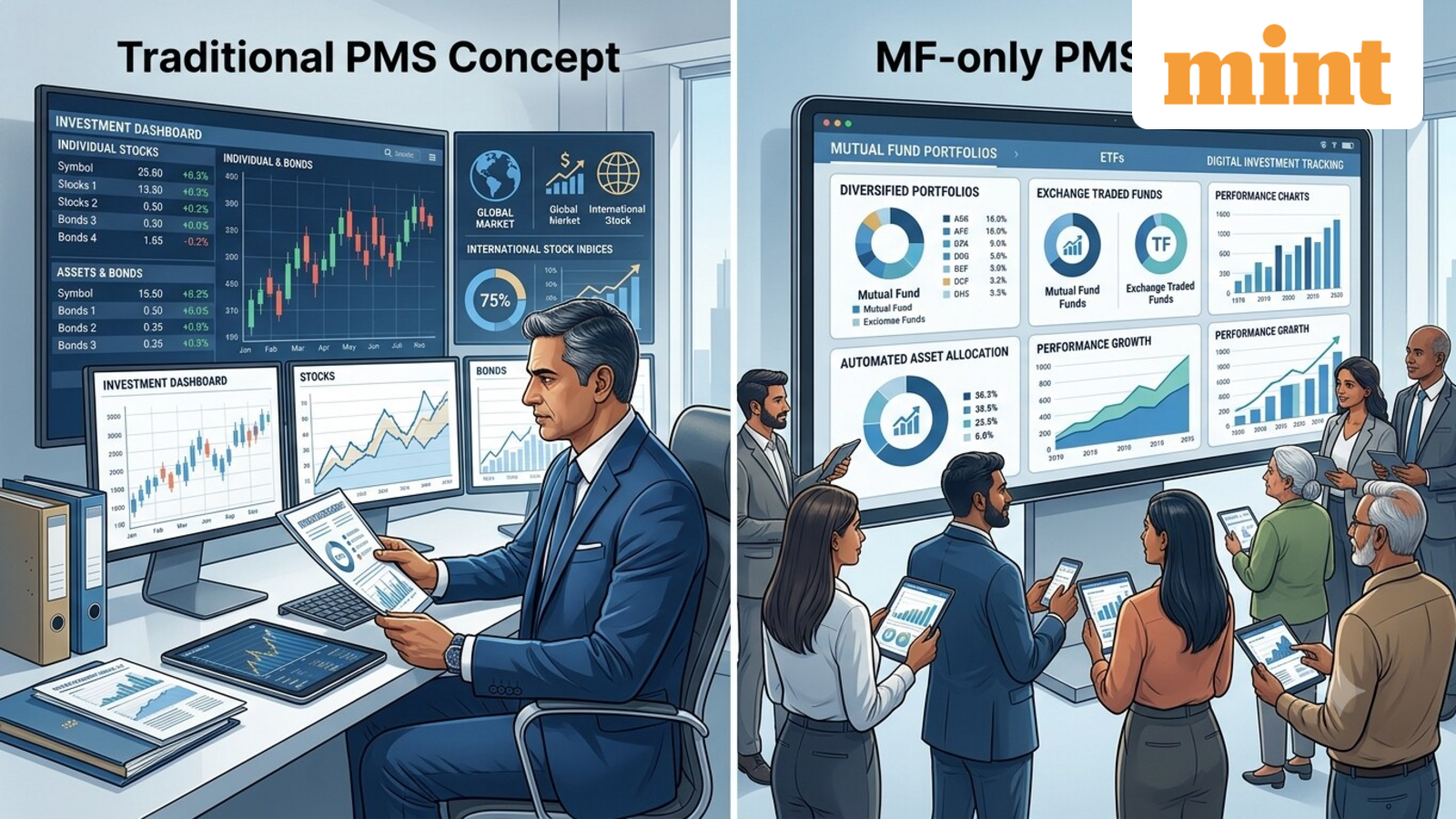
For years, investors with ₹25 lakh of investable surplus occupied a gap in India’s wealth management ecosystem. They often had enough capital to seek professional investment assistance but did not qualify for Portfolio Management Services (PMS), where the minimum investment requirement is ₹50 lakh.
SEBI’s proposed Mutual Fund-only Portfolio Management Service (MF-PMS) framework, outlined in its consultation paper released on 23 July, could expand access to professionally managed portfolios by lowering the minimum investment requirement to ₹25 lakh.
This framework is meant for portfolio managers who exclusively manage client investments only in direct plans of mutual fund schemes, including exchange-traded funds (ETFs) and Specialized Investment Funds (SIFs).
According to Sandeep Jethwani, Co-founder, Dezerv, this could benefit investors who have built significant investable surpluses but do not meet the eligibility criteria for traditional PMS.
He estimates that this segment could include around 1.5 crore to 2 crore Indian citizens with investable surpluses ranging from ₹25 lakh to ₹50 lakh.
Why has SEBI proposed an MF-only PMS framework?
Mutual funds were introduced to simplify investing by reducing the complexity of selecting individual stocks. However, the rapid expansion of the mutual fund industry has created new challenges for investors.
“Mutual funds were originally conceived to simplify the complexity of individual stock selection, yet today’s landscape features roughly 2,000 schemes against a backdrop of just 500 investable stocks,” Jethwani mentioned.
The increasing number of schemes has made fund selection, portfolio construction, asset allocation and regular monitoring more challenging for investors.
The proposed MF-only PMS framework seeks to provide a regulated structure where investors can delegate these responsibilities to professional managers instead of managing multiple mutual fund investments themselves.
MF-only PMS vs traditional PMS: Difference in investment universe
Traditional PMS allows managers to invest across a wider universe, including listed equities, listed debt securities, mutual fund units, and ETFs. SEBI’s consultation paper has also proposed expanding the investment universe for traditional PMS to include unlisted securities and foreign securities.
“The MF-only PMS restricts the universe to direct plans of mutual funds, ETFs, and Specialized Investment Funds. Nothing else,” Jethwani said.
Discretionary management versus advisory services
Another important difference is the level of responsibility for investment decisions.
In an advisory model, professionals provide recommendations, but investors remain responsible for executing those suggestions, monitoring portfolios and making decisions during market volatility.
According to Jethwani, investment strategies often fail because investors delay execution, miss rebalancing opportunities or take emotional decisions during market fluctuations.
“Conversely, an MF-only PMS operates under a discretionary mandate. Here, the manager holds the legal authority to act and is directly accountable for the portfolio’s performance,” he explained.
By delegating scheme selection, asset allocation, portfolio review, rebalancing and execution, investors are effectively outsourcing the entire investment management process.
Jethwani said the framework provides two layers of oversight — product-level protection through SEBI’s mutual fund regulations and portfolio-level fiduciary responsibility under SEBI’s PMS regulations.
Cost structure and transparency
SEBI’s proposed framework also aims to improve transparency around investor costs.
Jethwani explained that since MF-only PMS portfolios can invest only in direct mutual fund plans, embedded distributor commissions associated with regular mutual fund plans will be eliminated.
Under the proposal, portfolio managers operating under MF-only PMS can charge a fixed management fee capped at 2.5% of assets under management (AUM). They may also charge performance-based fees or a combination of fixed and performance fees, subject to investor consent.
“Exit loads at the portfolio level are explicitly waived, so investors are never charged twice on the way out. The investor sees exactly what they are paying, and exactly what they are paying for,” Jethwani said.
| Feature | MF-only PMS | Traditional PMS |
| Minimum investment | Proposed ₹25 lakh | ₹50 lakh |
| Investment options | Direct mutual funds, ETFs and SIFs only | Equities, debt, mutual funds, ETFs and other permitted securities |
| Portfolio flexibility | Limited | Wider investment choices |
| Management style | Discretionary | Discretionary and advisory |
| Cost structure | Fixed management fee capped at 2.5% of AUM | Fee structure decided between investor and manager |
| Exit load | No portfolio-level exit load | As per underlying investments and PMS terms |
Disclaimer: This story is for educational purposes only. The views and recommendations made above are those of individual analysts or broking companies, and not of Mint. We advise investors to check with certified experts before making any investment decisions.
About the Author
Sheetal Goel is a Content Producer at Livemint, where she covers corporate developments, personal finance, business trends, markets, and SEBI-related updates. She focuses on simplifying complex financial concepts and presenting them in a clear, reader-friendly manner, thereby helping audiences better understand investment trends, personal finance, and market developments. Her writing focuses on making finance more accessible to everyday readers while maintaining clarity, accuracy, and relevance.
She holds a degree in Economics (Hons.) along with an MBA in Finance, which has helped her develop a strong foundation in financial analysis, market understanding, and business reporting. Before joining journalism, she worked with finance and broking firms, where she closely followed market developments, investment strategies, and evolving industry trends. This practical exposure strengthened her understanding of financial markets. She has also written content across multiple formats and platforms, including YouTube, LinkedIn, and Instagram.
Over time, she has developed expertise in covering market-linked stories, investor-focused topics, and regulatory updates in a simplified yet informative style. She also enjoys reading and listening to Hindi poetry, reflecting her appreciation for literature and creative expression beyond the world of markets and numbers.



