
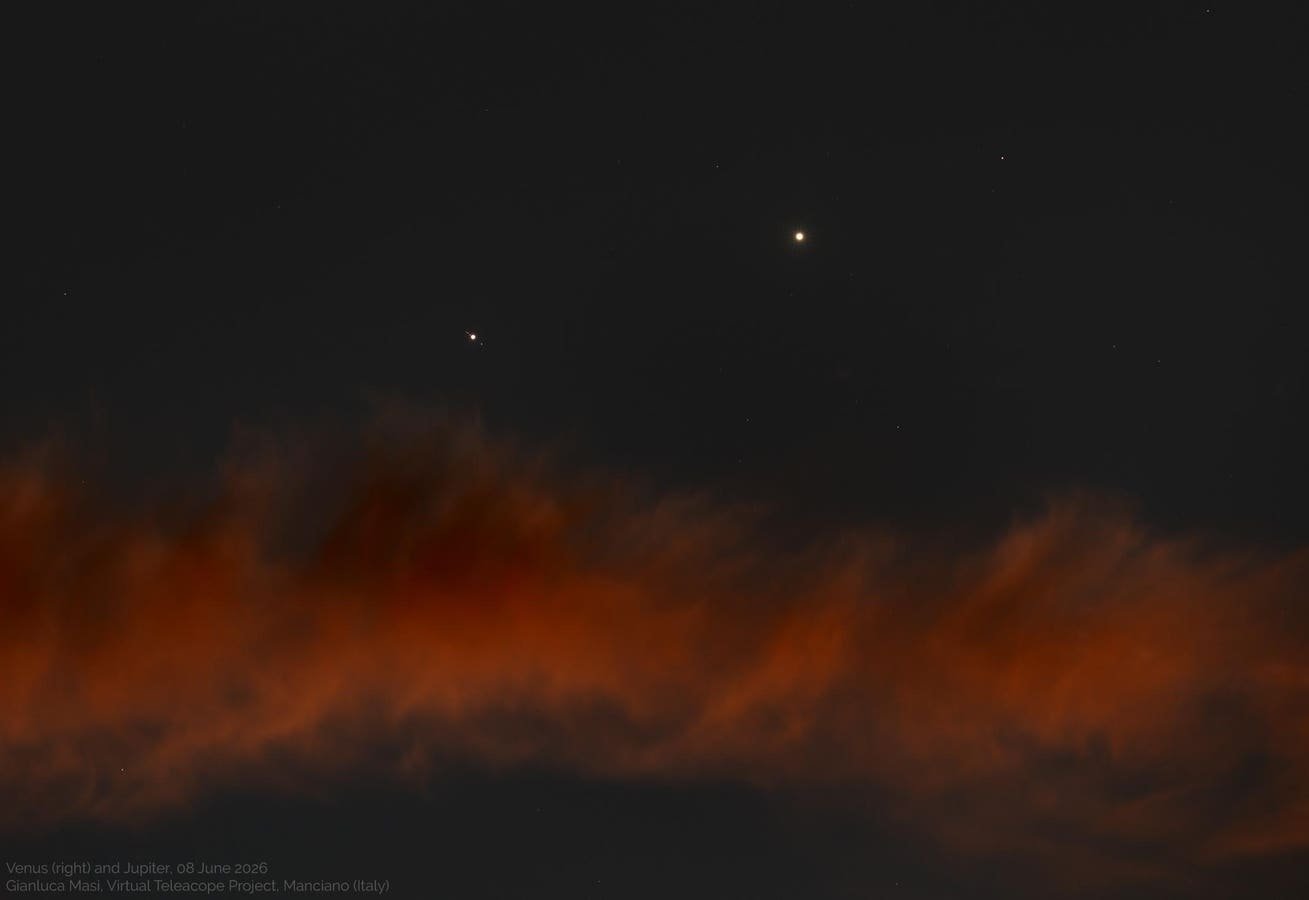
Venus and Jupiter appeared just 1.6 degrees apart in the post-sunset night sky on June 9, 2026.
Gianluca Masi/The Virtual Telescope Project
Venus and Jupiter appeared almost side-by-side after sunset on Tuesday, June 9, creating one of the most striking naked-eye planetary events of the year. The two brightest planets in the night sky reached conjunction low in the western twilight, appearing almost to “kiss” in a dazzling display visible to skywatchers around the world.
The good news is that although the closest point of the conjunction — when Venus and Jupiter appeared to come within just 1.6 degrees of each other — is now over, you can enjoy seeing the planets within a few degrees of each other all this week. The best time to look is about 45 minutes after sunset, when the planets become visible in the deepening twilight before setting roughly an hour later.
Venus and Jupiter in conjunction as seen from Cardiff, Wales, on June 9, 2026.
Jamie Carter
A Brilliant Planetary Pairing
The conjunction occurred as Venus, traveling along its faster inner orbit around the sun, appeared to catch up with Jupiter from Earth’s perspective. Though the planets seemed close together, the effect was entirely one of line-of-sight alignment.
Venus easily dominated the scene. Shining about seven times brighter than Jupiter, it earned its nickname as the brilliant “Evening Star” above the western horizon, with Jupiter glowing nearby against the fading twilight. The pair were close enough to fit comfortably within the same binocular field of view. The display resembled a bright double star hanging above the sunset glow.
Jupiter (left) and Venus (right) “dressing” a elegant, colorful corona, as captured by Gianluca Masi at The Virtual Telescope Project from Rome on June 7, 2026.
Gianluca Masi, The Virtual Telescope Project
Why The Planets Appeared To Meet
The conjunction was an optical effect caused by the motions of the planets around the sun. Venus and Jupiter remained separated by hundreds of millions of miles in space, but from Earth’s viewpoint, they appeared almost aligned against the background stars.
Pairings between Venus and Jupiter are not uncommon. Jupiter’s 11.9-year orbit carries it steadily eastward through the zodiac, while Venus remains relatively close to the sun in Earth’s sky. However, since the plane of the solar system is flat, all planets appear along the same line in the sky — called the ecliptic, the sun’s path. As a result, the two planets appear near each other every year or two.
The planet Venus and planet Jupiter are seen in the evening sky during a rare Venus-Jupiter celestial meetup often nicknamed as “cosmic kiss”, in Srinagar, the summer capital of Jammu and Kashmir. (Photo by Saqib Majeed/SOPA Images/LightRocket via Getty Images)
SOPA Images/LightRocket via Getty Images
The Conjunction Wasn’t A One-Night Event
While June 9 marked the moment of closest approach, the planetary pairing will remain visible throughout the rest of the week. In fact, Venus and Jupiter will stay within about five degrees of each other through June 14, according to Sky & Telescope, allowing skywatchers several more evenings to enjoy the sight. Mercury is also lingering lower in the western sky, creating a three-planet display for observers with clear horizons.
There’s set to be another planetary highlight on June 16-17, when a slender waxing crescent moon joins Venus and Jupiter low above the horizon.
The planet Venus and planet Jupiter are seen in the evening sky during a rare Venus-Jupiter celestial meetup often nicknamed as “cosmic kiss”, in Srinagar, the summer capital of Jammu and Kashmir. (Photo by Saqib Majeed/SOPA Images/LightRocket via Getty Images)
SOPA Images/LightRocket via Getty Images
Rare Planetary Transit
The next Venus-Jupiter conjunction will take place on Aug. 26, 2027. Although Venus and Jupiter conjunctions occur every one to two years, this week’s event was notable because the planets appeared unusually close together while remaining well placed in the evening sky.
An extraordinarily rare spectacle is a planetary transit, in which one planet passes directly in front of another from our perspective on Earth. According to Universe Today, that will happen on Nov. 22, 2065, when Venus will occult Jupiter in the only such event of the 21st century. During the event, the two planets will briefly appear as a single, intensely bright star low on the horizon.
Venus and Jupiter appear close together above clouds, mountains and residential buildings in Shenzhen, Guangdong Province, China, on June 9, 2026. The Venus-Jupiter conjunction reached its peak visibility on June 8 and 9, with the two brightest planets in the night sky appearing only about 1.5 degrees apart, making it one of the most notable naked-eye astronomical events of 2026. (Photo by Cheng Xin/Getty Images)
Getty Images
Wishing you clear skies and wide eyes.
source: https://www.forbes.com/sites/jamiecartereurope/2026/06/10/in-photos-see-venus-and-jupiters-brilliant-kiss-in-the-night-sky/



