
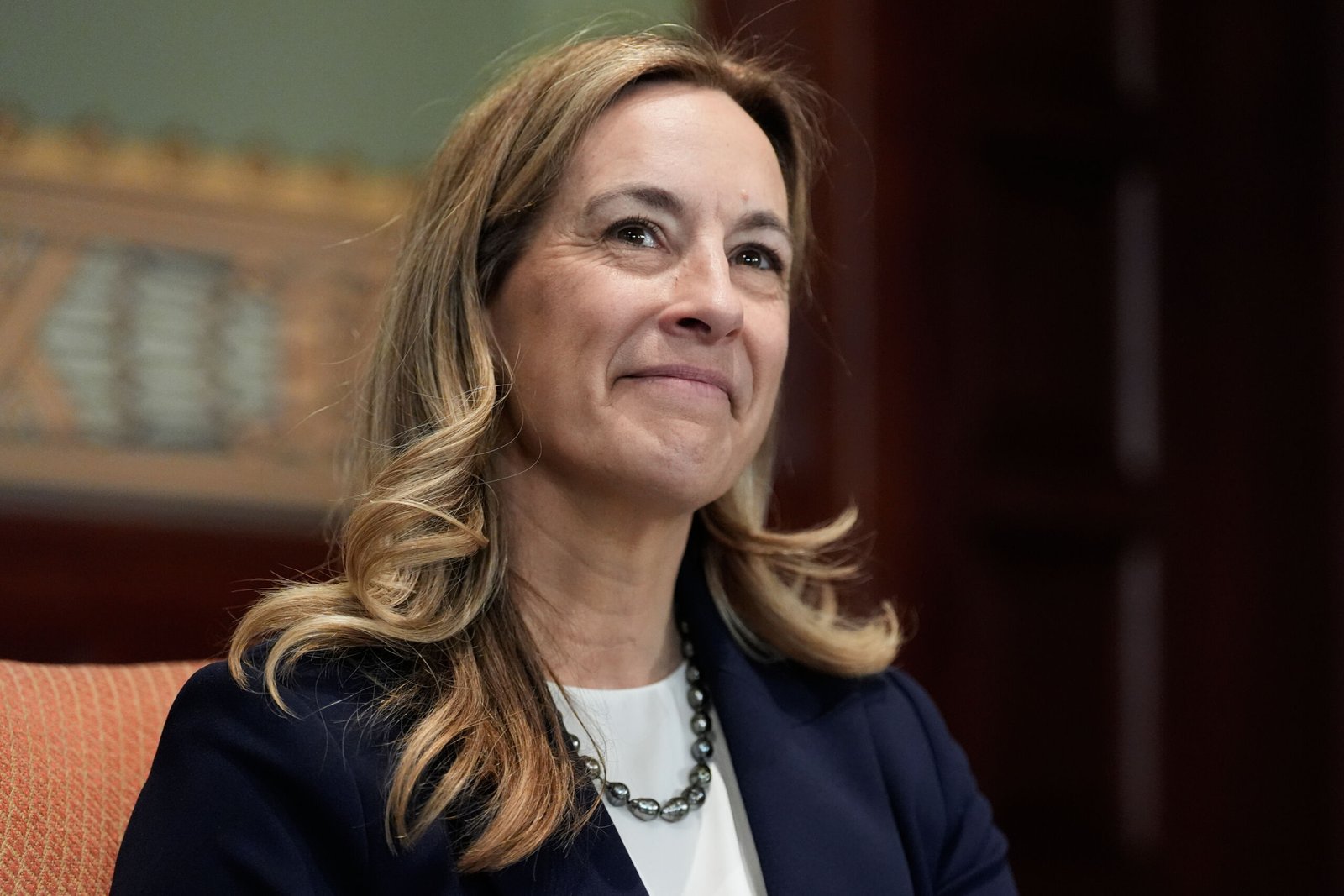
Mikie Sherrill is the first Democratic woman to win a New Jersey governor’s race, and she will be sworn in as the state’s 57th chief executive in Newark on Tuesday.
Sherrill’s history-making inauguration will be followed by a ball at the American Dream retail and entertainment complex in East Rutherford.
As Sherrill and running mate Dale Caldwell commemorate a 14 percentage point election victory, though, their government is facing significant policy challenges. The concerns range from the state budget and taxes, to housing affordability and mass transit, to erratic federal policy of many kinds.

An immediate issue is the escalating federal immigration enforcement by Republican President Donald Trump’s administration.
U.S. Immigration and Customs Enforcement, or ICE, flooded Minnesota this month, setting off widespread protests particularly after the agents’ shooting death of a 37-year-old woman, a U.S. citizen, in Minneapolis.
While on a much smaller scale, ICE enforcement also has roiled several New Jersey communities, including Morristown, where a high school student was reportedly detained during a laundromat raid.
Roxbury officials are also on high alert as ICE is reportedly considering their community for a detention center site.
State lawmakers during the final hours of the lame duck session last week approved a package of bills intended to enhance protections for undocumented New Jersey residents. To go into effect, the bills required a signature from outgoing Gov. Phil Murphy. The two-term Democrat had yet to announce if he’d taken action on these measures as of Monday evening.
Meanwhile, Trump by next month is also threatening to cut federal funding to cities and states that offer protections to undocumented immigrants. That means Sherrill, a former congresswoman, could be facing a major confrontation with the Trump administration within her first few weeks.
Other federal policy changes
Right behind the pressure to navigate the Trump administration’s immigration enforcement efforts, Sherrill will also have to navigate a host of significant fiscal policy changes enacted in Washington, D. C. over the past year. These include U.S. government cuts to Medicaid, the state and federally funded health care program.
Murphy and lawmakers appropriated more than $24 billion for Medicaid in the latest annual budget, with nearly $15 billion from federal sources. However, federal legislation enacted by Trump and the Republican Congress is projected to take billions of dollars from the state’s federal Medicaid funding share, imperiling coverage for thousands of New Jerseyans.
Federal cuts also are expected to New Jersey’s child welfare system, food security programs, community violence intervention and more. And other Republican-led changes in Washington have prompted significant increases in health care premiums for those receiving health insurance through Get Covered NJ, the state’s Affordable Care Act marketplace.
Some K-12 public school districts also are alarmed by the Trump administration’s attempt to revoke preapproved federal schools funding.
Budget imbalance
State tax collections have outpaced a Department of the Treasury growth forecast through the first half of the fiscal year, which ends June 30. Sherrill also is inheriting a structural budget imbalance in excess of $1 billion.
To cover the gap between projected annual revenues and expenditures in the short term, Murphy and fellow Democrats who control the Legislature authorized a series of one-shot, nonrecurring measures. These included spending down budget surplus and taking money from a reserve that was supposed to manage bonded debt.
Republicans on the state Senate Budget and Appropriations Committee in recent weeks have warned about a looming fiscal cliff due to the one-shots and other budget challenges.
Meanwhile, a report published last week by the left-leaning New Jersey Policy Perspective think tank also laid out five separate “budget time bombs” the Sherrill administration will have to defuse.
Among them is the need for more than $1 billion to sustain promised property tax relief for thousands of senior homeowners through the Stay NJ initiative.
The cost of public employee health benefits is also rising faster than the inflation rate, the New Jersey Policy Perspective warned.
Other rising costs
Sherrill is coming into office amid outrage at New Jersey’s high living cost, particularly ever-rising property taxes and utility bills.
Murphy, despite ramping up direct tax relief programs, received only poor grades on affordability and taxes, according to a survey of New Jerseyans released by the Rutgers-Eagleton Poll last week.
Sherrill made several high-profile promises during the campaign, including a pledge to freeze utility bills immediately by declaring a state of emergency. As cold weather drives soaring heating bills, residents will be expecting Sherrill to come through on her big affordability promises.
Affordable housing
Buying or renting housing in New Jersey is a chief affordability worry.
Some advocates have said the crisis has been shaping for decades, with an estimated shortfall of more than 200,000 units needed to meet current demand, according to data from the National Low Income Housing Coalition.
In recent years, lawmakers passed and Murphy signed into law a new process for determining local housing obligations. At best, it would lead to the construction of 60,000 low-cost homes over 10 years, but housing plans filed by municipalities indicate that far fewer will be built.
All the while, housing costs continue to rise, with Zillow reporting the average New Jersey home value had risen to nearly $560,000 as of the end of December. Rent averaged $2,078 as of this month, according to Apartments.com.
Mass transit
Public transportation costs are another key concern for many residents, particularly after toll increases on the Garden State Parkway, New Jersey Turnpike and Atlantic City Expressway on Jan. 1. A state gasoline tax increase also took effect.
New Jersey Transit, the statewide bus and rail agency, hiked fares in 2024 and 2025, and another increase is due in July, according to agency budget documents.
Still, NJ Transit’s long-term financial outlook remains uncertain: December 2028 marks the sunset of a temporary tax on top-earning corporations that is generating hundreds of millions annually for NJ Transit operations.
Sherrill will also have to decide whether to carry on significant funding transfers from the New Jersey Turnpike Authority, which operates the Turnpike and Parkway. Prior administrations have used the infusions to subsidize NJ Transit’s operating budget, plus routine diversions from the state Clean Energy Fund that environmental activists have long opposed.
School funding
State education aid makes up a significant portion of the annual budget, and many communities — particularly those that lost cash support under the current school-funding law – say their classrooms are at risk.
Money for K-12 public education typically accounts for the largest share of local property taxes, which now average more than $10,000 per home.
Exactly how much money each district gets from the state is based on the School Funding Reform Act, which dates to 2008. Democrats and Republicans alike routinely criticize the law for not providing stable annual revenue.
Many education leaders and lawmakers say it’s time for some updates after the state fully funded the formula for just the second time ever this fiscal year. Murphy wrote some formula changes in the budget he enacted in June, but they’re in place for just a year.
New Jersey is also facing legal challenges on efforts to desegregate schools, which remain among the most racially bifurcated in the country. That’s due in large part to residential segregation and the requirement that children attend schools in their communities.
A lawsuit over the lack of progress in rectifying the issue, filed in state court by families and advocates early in Murphy’s first term, may result in a ruling during Sherrill’s tenure.
The fate of health and mental health initiatives
Murphy’s administration prioritized children’s mental well-being and expectant mothers’ health, as New Jersey lags behind the national average for maternal mortality and has significant racial disparities in maternal health outcomes. Black women are seven times more likely to die — and Hispanic women, 3.5 times more likely — than white mothers, according to the latest state analysis.
The state budget funded Family Connects NJ, a home visit to new moms from a nurse who assesses their health and the baby’s and can connect them with support services. This program, available in 11 counties, will go statewide starting in 2027, assuming Sherrill continues funding.
Also facing an uncertain future is Statewide Student Support Services, a mental health model started in 2023 for response to a sharp increase in depression, anxiety and stress among teens and young adults that was exacerbated by the COVID-19 pandemic.
Also potentially at risk is the Arrive Together, a pilot program started in late 2021 to pair mental health clinicians with police when responding to mental health crisis calls. The program, now statewide, appears to be reducing the use of police force, according to a 2023 study.
Another concern: funding for hospital and community-based violence intervention programs that provide peer support, counseling, mentorship and conflict mediation in violence-prone neighborhoods. As a candidate, Sherrill expressed support for such funding.
Voting rights and voting security
Sherrill could also play a role in shaping New Jersey elections in the face of presidential executive orders and federal legislation that seek to force changes ahead of closely watched congressional mid-terms. Democrats in recent years have pushed to expand voting rights with same-day voter registration and universal mail-in balloting, while Republicans have embraced efforts to tighten controls around the ballot box, including requiring voter identification. Currently a voter’s signature is proof of identity.



